DbcultAccessing Vault...
Cult Review
Senior Film Conservator
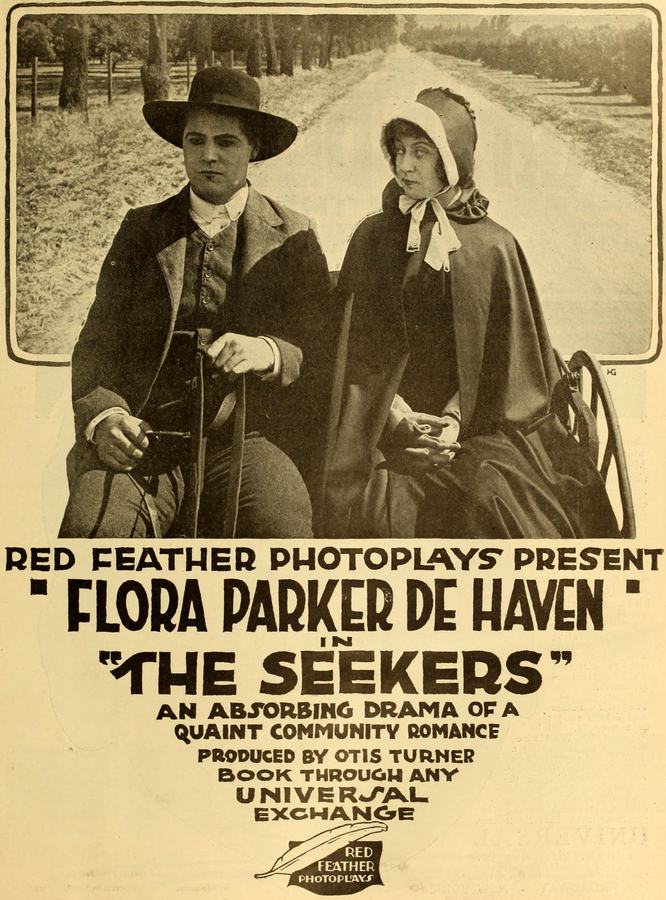
Picture, if you can, a nickelodeon in 1916: the air thick with malt and perfume, a pianist spidering across chipped ivories, and on the screen a parable of providence and peril unfurls like a blood-stained hymnal. The Seekers—directed by Otis Turner, scripted by Olga Printzlau—surfaces from the archives as a soot-smudged window into America’s uneasy marriage of faith and jurisprudence. Its intertitles crackle with the moral absolutism of a tent-revival sermon, yet the images smolder with pre-code ambiguity: duty versus desire, community versus conscience.
Ruth Heck, incarnated by Countess Du Cello with the porcelain resolve of a Madonna who has seen too many sunrises in the ward, embodies the film’s bruised compassion. She glides through sickrooms where kerosene shadows jitter across whitewashed walls, her lantern throwing halos on consumptive brows. Each gesture—spooning broth, tightening bandages—registers as sacrament rather than service. Flora Parker DeHaven’s Lem, by contrast, is all sinew and flint; his shoulders carry the weight of anvil and accusation, a boy forged in iron who will be hammered by the law into a shape he never chose.
Prison, Providence, and the Packing-Box Miracle
The film’s midpoint pirouette—Lem’s escape by means of a convict’s crate—plays like something Dickens might have hallucinated after too much laudanum. Turner wrings every ounce of suspense from the contraption: the clang of the padlock, the rasp of nails, the lurch of a baggage car racketing through midnight nowhere. When the lid splinters and Lem’s gaunt face emerges, moonlight slicks his cheekbones like quicksilver. It is a resurrection in miniature, a secular transfiguration that upends the narrative’s Calvinist scaffolding: salvation arrives not by predestination but by carpentry.
Meanwhile, Ruth’s new dominion, Canaan Mountain, is rendered in tableau that flirt with German Expressionism: jagged rooftops clawing mist, a church steeple skewering a pewter sky. Edwin B. Tilton’s Sheriff John Mount first appears as a silhouette against a rain-slick horizon, his badge a nickel star catching the last pewter gleam. Their meet-cute transpires not over coffee but over gunfire: a soused tyrant brutalizing his wife on the chapel threshold, the congregation frozen in pious paralysis. Ruth’s intervention—she thrusts herself between muzzle and flesh—reads as both Christ-like and brazenly feminist, a riposte to every Sunday-school lesson that equated womanhood with silence.
Courtship under a Cloud of Scandal
Once the embers settle, Turner pivots to a courtship conducted in glances rather than kisses—this is 1916, after all. Their betrothal sequence unfurls beside a cataract that cascades like liquid glass; Ruth’s fingers graze John’s sleeve, a gesture so tremulous it could shatter the celluloid. Yet domestic bliss curdles the instant Lem staggers out of the forest, a Lazarus bearing the stench of chain-gang despair. The siblings’ reunion—filmed in a single, unbroken medium shot—lets us witness the moment when private joy collides with public moralism. Ruth’s embrace is ferocious, maternal, erotic in its intensity; the camera dares us to misread it, to impute incestuous whispers where only solace exists.
Gossip, that invisible hydra, coils through Canaan Mountain. A spinster’s curtained eye, a deacon’s sidelong leer—these are the surveillance apparatus of early-American puritanism. Turner’s montage here is proto-Pudovkin: a flurry of clipped shots—fluttering curtains, a dropped thimble, a quill scratching moral condemnation—builds a crescendo of paranoia. When John’s suspicion metastasizes, the film’s chromatic palette shifts; sepia tones give way to slate-blue tints, as if the very emulsion were bruised.
Chain, Flame, and the Anatomy of Betrayal
The barn confrontation is the film’s voltaic core. Cinematographer Charles E. K. Lock films the interior through a lattice of hay-bale chiaroscuro; every shaft of lantern light seems carved by a machete. John, duty-bound, produces handcuffs. Lem, panic-eyed, pleads. And Ruth—poor, cornered Ruth—hoists an iron chain, swings, and fells the man she loves. The impact is not played for pulp thrill; instead, the camera lingers on Ruth’s face, a cartography of horror and relief, as if she has split her own soul along with John’s scalp.
Seconds later, a lantern topples. Fire snakes up dry timber with ophidian hunger. The barn becomes a tabernacle of perdition; Ruth drags John’s limp form through flame and smoke, her palms blistering, her silhouette haloed by perdition. Outside, villagers gather like ravens, their hymnals clutched against chests. John revives, tastes ash, and utters the lie that will redefine him: “I knocked the lamp.” In that moment he becomes both savior and sacrificial lamb, his perjury an act of grace.
The subsequent estrangement is rendered with a sparsity that rivals Ozu. Months elide in a series of dissolves: Ruth scrubbing flagstones, John mending harnesses, both framed through doorways that emphasize separation. Dialogue is replaced by the rhythmic clank of washtubs and the creak of leather, a diegetic symphony of penance.
Lottery of Fate, or the Divine Rigging of Heaven
Turner reserves his most subversive gambit for the third act: the ritual lottery. The elders proclaim that a young couple must seed a new settlement, their union determined by providence—or, rather, by a cedar box whose bottom Rev. Mount can dexterously manipulate. The sequence, scored by a dirge-like organ, intercuts Ruth’s tremulous prayers with close-ups of folded slips fanned like tarot. When her name unfurls, the crowd exhales a collective amen, unaware the fix is in. It is a moment of institutionalized cupidity masquerading as divine will, a sly jab at patriarchal paternalism.
Compare this to the fatalistic matrimony in The Valley of the Moon or the contractual nuptials of The Great Divide; here the film winks at its own contrivance, acknowledging that every Eden needs its serpent, every lottery its clandestine thumb on the scale.
Urban Coda: Ink, Exoneration, and the American Arc
Lem’s epilogue transpires in a metropolitan print shop that clangs like a steel foundry. Turner contrasts the mountainous hush of Canaan with the city’s staccato violence—newsboys barking, presses thundering, life reduced to boldface. The moment Lem sets type for his own vindication is nothing short of metaphysical: words become flesh, and flesh becomes freedom. The pardon that arrives—printed, public, irrevocable—feels like a rebuttal to the village’s cloistered absolutism. Modernity, for all its grime, can still be an angel of annunciation.
Back in the hinterland, Ruth and John embark on a journey that the film refuses to romanticize. Their buggy rattles across craggy switchbacks, the camera retreating to a God-shot that dwarfs them against geologic time. No swelling orchestra, no iris-in kiss—just two silhouettes receding into a horizon that devours them. It is a finale at once hopeful and terrifying: the promise of a new colony, and the specter of repeating every suffocating custom they fled.
Performances, Politics, and the Aura of 1916
Countess Du Cello carries the picture with eyes that seem perpetually on the cusp of tears yet never surrender. Her micro-gestures—a jaw muscle fluttering, a thumb smoothing a skirt wrinkle—externalize the internecine war between obedience and rebellion. Opposite her, Edwin B. Tilton underplays John Mount with the laconic stoicism of a man raised on covenant theology and cold mornings; his eventual moral fracture feels seismic precisely because it is so quietly rendered.
Printzlau’s scenario, adapted from a Saturday Evening Post potboiler, interrogates America’s foundational contradictions: communal aid versus carceral cruelty, feminine virtue versus patriarchal ownership, divine election versus human manipulation. The film refuses to demonize The Seekers wholesale; their charity is genuine, their blind spots systemic. Such nuance distinguishes it from contemporaneous melodramas like Little Mary Sunshine or Little Miss Happiness, where virtue is a birthright and vice wears a waxed mustache.
Visual Lexicon: Tint, Texture, and the Ghost of Color
Surviving prints exhibit a panoply of tinting—amber interiors, cerulean nights, roseate dawn—that function as emotional cue cards. The crimson conflagration of the barn is so saturated it seems to bleed through the sprocket holes. Such chromatic bravura anticipates the expressionist palettes of Der Hund von Baskerville, yet remains rooted in Americana, a Remington painting set ablaze.
Compositionally, Turner favors diagonal vectors: slanted rooflines, wagon tongues, the jut of Ruth’s elbow as she wields the chain. These obliques destabilize the frame, suggesting a world forever tilting toward ethical vertigo. Deep-focus shots of the village well—a stone maw at the crossroads—recur like a memento mori, reminding us that every thirst slaked demands a coin of something precious.
Pace, Rhythm, and the Modern Ear
Yes, the film ambles by 21st-century standards; its intertitles sprawl like Victorian valentines. Yet within its unhurried cadence lies a hypnotic pulse, the respiration of a community that believes eternity has already arrived. Viewers weaned on smash-cut adrenaline may fidget, but patience yields dividends: the slow burn permits moral stakes to calcify, so that when Ruth swings the chain, the shock detonates like a cannon in a cathedral.
For aficionados tracking silent-era rescues, The Seekers occupies a unique interstice between the mountain mysticism of Strathmore and the proto-feminist parables of A Factory Magdalen. It lacks the oriental exoticism of It Happened in Honolulu or the newspaper frenzy of The War Extra, yet its ethical interrogations feel startlingly contemporary.
Final Appraisal: A Forgotten Psalm Worth Unearthing
Restoration notwithstanding, fragments of The Seekers survive in 4K scans from a Dutch print, replete with Dutch intertitles whose English translations flutter like moth wings across the screen. Nitrate deterioration nibbles the edges, but the emotional core—molten, conflicted, radiant—persists unscathed. New scores range from Appalachian dulcimer to atonal string quartet; I recommend the latter, whose dissonance amplifies the moral vertigo.
In the end, the film offers neither tidy redemption nor nihilistic despair, only the uneasy truce we call adulthood. Ruth and John roll toward a horizon that promises both genesis and repetition; Lem walks city avenues where freedom smells of ink and sweat; and we, centennial voyeurs, confront the disquieting possibility that seeking—whether for salvation or for self—inevitably leads us back to the flawed communities we flee. Turner’s flickering parable may be a century old, but its questions throb fresh: What do we owe the accused? Whom do we choose to believe? And how far will love bend before it breaks?
Seek this film out, not as an antiquarian curiosity but as a mirror. In its silvered surface you may glimpse your own face—torn between duty and mercy, chain and embrace, flame and forgiveness—straining toward a light that flickers yet refuses to die.
IMDb 6.7
1933
Community
Log in to comment.