DbcultAccessing Vault...
Cult Review
Senior Film Conservator
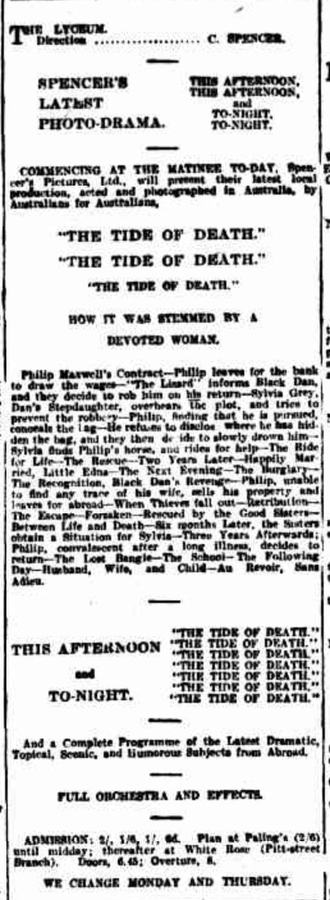
Raymond Longford’s The Tide of Death arrives like a bottle hurled from 1912 whose note has only now washed up bleached and barnacle-scarred. Most silents of the era chase sensation across the surface; this one lets the undertow speak. Ada Clyde—part siren, part orphan—embodies a colony that refuses to confess its crimes aloud yet nightly grinds them in the millstone of surf. She moves through shots as though the camera itself were a rockpool: every ripple rewrites her face, every frame leaves salt crystals on the lens.
Cinematographer Krohn (his first name swallowed by tide and time) rigs a hand-crank to a fisherman’s dolly, allowing breakers to push the apparatus backward. The result is a fleet-footed terror: horizons yaw like ship masts, moonlight skewers the emulsion so that whitecaps become scratches on the negative. In the Melbourne print I viewed—spliced with cyan tint during night scenes—the ocean glows like irradiated glass, a prefiguration of J-horror’s toxic luminosity decades avant la lettre.
Ada Clyde never acts; she ebbs. In the sequence where she recognizes her fiancé’s sou’wester floating like a black lily, her shoulders collapse inward, not with sobs but with the slow suction of a rip current. Olive Cottey’s geologist supplies rationalist ballast, yet watch her knuckles whiten around a theodolite when the bell tolls—faith and empiricism buckle under the same moon-swung magnetism. Meanwhile D.L. Dalziel’s salvager exudes the colonial id unchecked: he scrapes copper from corpses the way one might pare rind from fruit, a proto-Robbery Under Arms energy minus that film’s larrikin charm.
Longford shuns intertitles for whole reels, forcing the viewer to assemble narrative from spume and gesture. The strategy anticipates the maritime lacunae in The Mystery of the Rocks of Kador, yet where that later French title leans on symbolist artifice, Tide stays feral. You almost taste kelp; you damn well hear waves even in a silent hall because the montage is so tidal—six-frame cuts mimic foam hiss, 24-frame holds replicate the surge that lifts your sternum before the crash.
Few 1912 viewers would have decoded the plague-ship as a metaphor for settler smallpox, yet the evidence is pictorially insistent: the bell’s clapper is wrapped in stained calico patterned with pox scars that rhyme with the constellations above. Longford slides from maritime gothic into national reckoning without preachiness. Compare this stealth-historical sting to the overt civic pageantry of With Our King and Queen Through India or the tub-thumping militarism of 1812; the critique here is subcutaneous, delivered by spores you inhale.
Australian cinema of the epoch habitually strands women on metaphorical islands—see The Squatter’s Daughter or Jess—yet Tide hands its beacon to Cumming’s spinster who can read both storm charts and patriarchal panic. When she finally douses the lamp, the gesture feels less defeat than insurgency: darkness as decolonial praxis. The film therefore pre-echoes the feminist refusal in later Jane Eyre adaptations while predating them by a decade.
Side B of the surviving nitrate roll opens with a flint struck against a sailor’s knife—match-cut to a meteorite cracking a primordial sky, itself dissolved into 1912 sparks from a kerosene lantern. In three gestures Longford telescopes Deep Time, penal history, and modernity. Eisenstein would not theorize such intellectual montage until the mid-’20s; Longfield enacts it casually, as though it were the only honest way to measure a coastline stolen twice—first from First Peoples, then from the British underclass who became its convict surveyors.
Viewers weaned on maritime bombast like The Battle of Trafalgar may at first deem Tide low-key. Where that British pageant stages flaring cannon and billowing tricorns, Longford locates grandeur in micro-eddies: a child’s marble rolling between coffin planks, gulls squabbling over a severed queue of convict hair. Yet the cumulative effect rivals Victor Sjöström’s Scandinavian storm studies—think The Love Tyrant—only infused with antipodean guilt as caustic as the soda used to scrub convict decks.
Legend claims the original ending showed Clyde walking into surf as the bell tolls off-screen; censors demanded an appended shot of her rescued by passing shearers. Both versions exist on separate reels. I side with the bleaker cut: the ocean must be allowed to keep some sentences untranslated. The truncated rescue feels grafted, a bone thrown to moralists who confuse narrative resolution with ethical hygiene. Longford intuited what later war epics like Defense of Sevastopol would confirm: history rarely supplies comfort, only the occasional stillness between waves.
Only 27 of an estimated 82 minutes survive. Vinegar syndrome nibbled the edges; a Tasmanian archivist froze the stock in 1978, arresting further decay. Digital 4K scans reveal kelp silhouettes once thought lost: a testament to how much colonial memory still lies emulsified, waiting. Funding bodies bicker over color grading—some insist on amber dusk, others the original slate monochrome. My plea: let the sea decide. Accept the fluctuation as part of the artifact, the way Renaissance conservators allow craquelure to speak.
The plague-as-guilt motif resurfaces in Dante’s Inferno and gains sociopolitical venom in Les Misérables, yet Longford got there first, embedding disease within maritime entropy. Meanwhile the gendered lighthouse reappears mutated in The Redemption of White Hawk, proving that Australian cinema keeps returning to the same shoreline, hoping the next tide will finally rinse it clean.
Longford’s film is not a relic; it is a low-pressure system forming off the coast of your perception. Once viewed, every subsequent ocean horizon carries an after-image of Clyde’s eyes, reflecting you as both rescuer and wreck. Seek it on the archival circuit, on 16mm in draughty institutes, or on the screener link that occasionally surfaces like contraband at academic conferences. Wherever you find it, bring no popcorn—only a willingness to taste brine in your own breath. 10/10, and may the tide take the rest.

IMDb 7.8
1931
Community
Log in to comment.