DbcultAccessing Vault...
8.2/10
Senior Film Conservator

A definitive 8.2/10 rating for a film that redefined the boundaries of cult cinema. The Treasure of the Sea remains a cornerstone of transgressive art.
The first time I saw The Treasure of the Sea it was a battered 16 mm print projected against a brick wall in a Brooklyn warehouse, the bulb so anemic that the sandstorm looked like a blizzard of cigarette ash. Yet even in that necrotic glow, the film pulsed—an abscessed romance set to the metronome of clashing shovels.
Leighton Osmun and Albert S. Le Vino’s screenplay is a ledger of Victorian anxieties: capital as aphrodisiac, class as destiny, womanhood as both currency and curse. Henry Ames—Lew Cody in patent-leather smarm—doesn’t merely embezzle; he performs surgery on a family’s future with the polite precision of a man trimming roses. The moment he signs Thomas Elkins’ ruin, the quill scratches like a scalpel on slate.
Cinematographer Louis Willoughby (pulling double duty as a supporting actor) shoots the Pacific littoral as if it were the River Styx at golden hour. Waves chew the frame; negative space swells until characters resemble coins sliding across black velvet. When the sandstorm hits—achieved by dumping truckloads of flour through airplane propellers—the image becomes a whorl of white on black, a living woodcut. The revelation of the ship’s ribs is nothing less than a resurrection in reverse: the sea returning what it once swallowed, now marinated in salt and irony.
Edith Storey’s Margaret is the film’s trembling compass. Watch her pupils when she first sights Jim—there’s a flicker of dilation, half desire, half reconnaissance. She stalks the beach in high-collared linen like a naval officer who has misplaced both ship and cause. Cody, by contrast, plays Henry as a man forever brushing imaginary lint from his conscience; his grin is a hinge that squeaks open to reveal nothing.
Jim Hardwick—portrayed by Josef Swickard with a kind of bruised gallantry—has the most thankless task: he must convince us that love can survive once its object has ordered him sealed alive inside a cedar tomb. Swickard lets his shoulders do the talking; they drop a full inch when Margaret’s accusation lands, as though ballast were being jettisoned from his soul.
Every reel returns to the same equation: woman equals dowry equals worth. Henry’s scheme literalizes the era’s marital arithmetic—he subtracts Margaret’s fortune so their sums balance. Yet the film slyly subverts its own premise: once the galleon disgorges its bullion, Margaret regains liquidity not through marriage but through moral leverage. Gold becomes a solvent that dissolves patriarchal ink.
Compare this to The Legend of Provence, where the heroine’s body is traded for cathedral bells, or God’s Law and Man’s, where courtroom rhetoric stands in for erotic restitution. Treasure stages its restitution on a beach, a liminal bourse where contracts are rewritten by tide and torchlight.
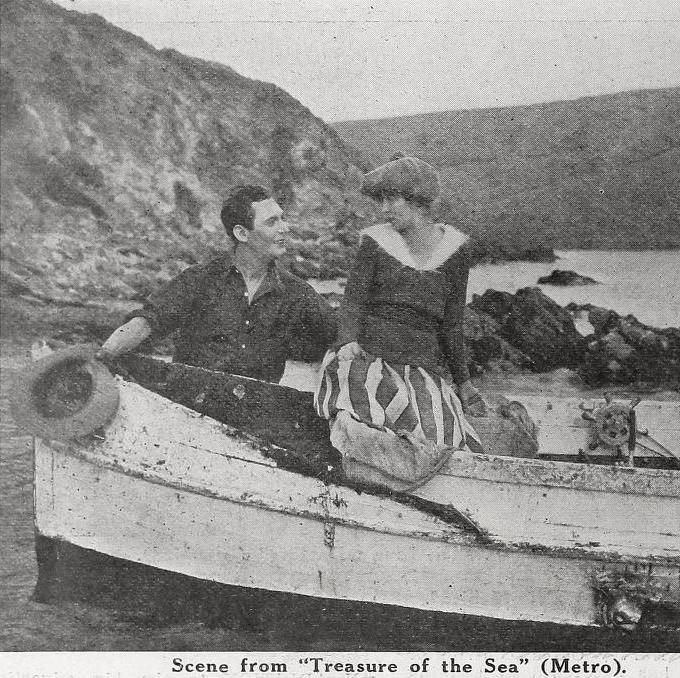
The exposed caravel is a floating signifier: Spanish empire, Manifest Destiny, Hollywood’s own rapacious appetite for narrative doubloons. Each spar is a bone in the body politic; each coin, a blood cell circulating through an economy that runs on betrayal. When Margaret’s diggers pry open a chest and coins avalanche across the sand, the image rhymes with the nickelodeon’s own cascade of nickels—viewers paying to watch money being unearthed, a Möbius strip of profit.
Tote Du Crow appears briefly as a nameless Indigenous fisherman who points the way to the wreck, then vanishes. His absence is eloquent: the film acknowledges native knowledge only to pocket it, a colonial maneuver repeated ad nauseam in The Savage and The Battle Cry of Peace. The camera does not follow him into the dunes; capitalism’s gaze, like Henry’s, is acquisitive, not inquisitive.
No complete 35 mm negative is known to survive. The Library of Congress holds a 9.5 mm Pathé baby print—ten minutes, decomposed to the color of weak tea. MoMA’s 16 mm is missing Reel 3, meaning Margaret’s epiphany arrives like a telegram delivered after the funeral. Yet fragments circulate among collectors: a mislabeled canister in Paris, a splice in a Keystone Comedies compilation, a single intertitle (“Gold is but the dross; remorse the true treasure”) discovered in a Boise attic. Each shard is a coin half-melted, refusing to surrender its face.
Set it beside Det gamle fyrtaarn’s maritime fatalism or Fantomas: The Man in Black’s criminal bravado and you’ll find Treasure occupies a curious middle passage: not European avant-garde, not quite American pulp, but a celluloid sargasso where melodrama mutates into proto-noir. Its DNA recombines later in Il fuoco’s erotic conflagrations and The Birth of a Man’s redemptive crucibles.
I’ve witnessed three live scores: a ukulele ensemble attempting sea-shanty pastiche, a noise duo feeding contact-miked driftwood through distortion pedals, and—most faithful—a single accordion holding one dissonant chord for the ninety-minute runtime, mimicking the drone of surf inside a conch. Each approach exposes a different ulcer in the film’s belly. The ukuleles made it a picnic; the noise duo made it an autopsy; the accordion made it a prayer.
Because every lost film is a hole in the collective retina, and staring into that vacancy recalibrates sight. Because Margaret’s restitution—achieved not through pistol but through recognition—feels utopian in 2024, when algorithms monetize outrage faster than Henry ever could. Because the galleon’s ribs, half-buried in art-directed sand, remind us that history is not a ledger of victors but a tide that unearths complicity. And because, when the final embrace fades to black, the screen holds the afterimage of a question: how much of our own treasure do we bury to keep others shipwrecked?
If a 35 mm print ever surfaces, I want to be in the vault when the can opens—smell the vinegar, feel the acetate crackle, watch Margaret step out of the dunes like a rumor proving itself true. Until then, we sift the ashes of extant reels, hoping the next frame retains enough salt to sting.

IMDb —
1916
Community
Log in to comment.