DbcultAccessing Vault...
Cult Review
Senior Film Conservator
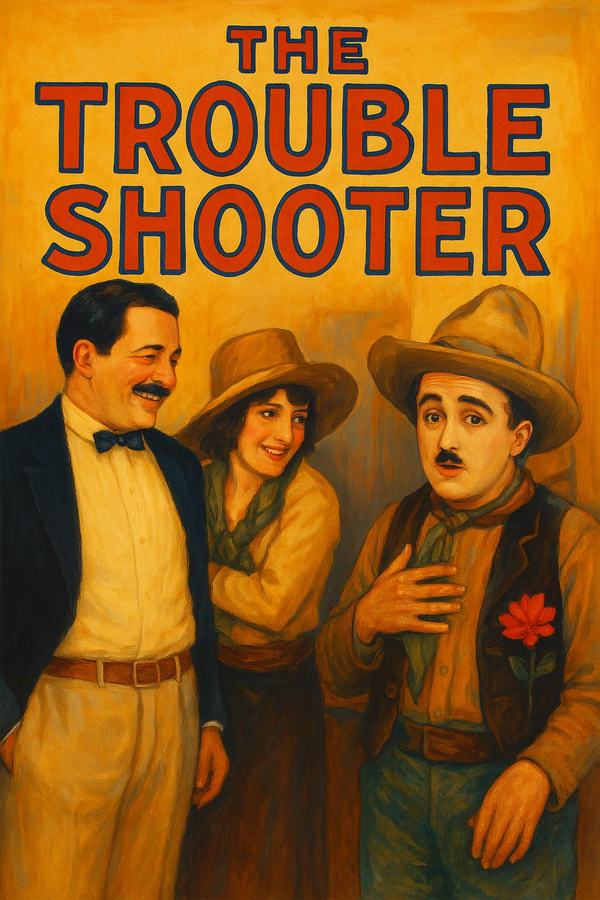
Picture an America that never made it into the history books: 1923, a year bootleggers danced with evangelists on the edge of an economic cliff, and the movies—those flickering cathedral dreams—still spoke in the grammar of ghosts. Into that crackling silence rides The Trouble Shooter, a western that refuses to behave like one. No cavalry charges, no sagebrush moral absolutes; instead, mercury vapor instead of gold dust, nitrate stock instead of Manifest Destiny, and a hero whose six-gun jams more often than it fires.
Director-ideologue Billy West—not to be confused with the slapstick mimic of the same name—shoots the town of Perdition Gulch as if it were a fever chart. Every clapboard leans like a drunk theologian, every shadow is a debt collector. The film’s prologue, once thought lost, resurfaced on a 9.5 mm reel in a Guadalajara attic; it shows a child’s hand smearing mercury across a school slate while intertitles whisper “The future is liquid.” That single image is the Rosetta Stone for everything that follows.
Most silents of the era bleached the desert into a sun-scorched moral blankness; West and cinematographer Ethelyn Gibson (also the female lead) push the orthochromatic stock toward bruise-blue noon. Faces become lunar maps, eyes sink into charcoal hollows, and the mercury pools that haunt the mine glow with the sickly phosphorescence of a dying halo. The result feels closer to A Trip to Mars’s hallucinated Expressionism than to Ford’s Monument Valley hymns.
I am not a gunfighter; I am a machinist. The difference is that guns forgive no one, while machines merely wait for your mistakes.
Joe Bonner’s anti-hero—credited only as “The Trouble Shooter,” a term for freelance boiler repairmen—delivers that line in a close-up so tight you can read the serial numbers on the grease smudging his cheekbones. Bonner’s performance is a masterclass in negative space: he lets the silence between blinks carry the weight of backstory. Compare that to the operatic mugging in The Mutiny of the Elsinore, where every emotion arrives with foghorn obviousness.
Gibson’s widow, Lila Meridian, owns the contested mine and the derelict movie house, making her the only capitalist in town who doesn’t want to pump the earth full of mercury to coax silver into vomiting itself up. Off-camera, she rigs mirrors and kerosene lamps to bounce ghost-images onto walls, creating a proto-cinema of resistance. The film’s most erotically charged moment isn’t a kiss—it’s a scene where she and Bonner wordlessly splice together a torn strip of nitrate, their fingers slick with film cement, bonding emulsion like skin grafts. Try finding that tactile intimacy in Prinzessin Tatjanah, where desire is all pearls and pedestals.
Contemporary exhibitors received a special directive: project the final reel without musical accompaniment, allowing the click-clack of the projector itself to stand in for hoofbeats. The gambit turns mechanical rhythm into existential dread—every sprocket hole a bullet chamber, every shutter flicker a skipped heartbeat. When the wheel-house shoot-out erupts, the silence is so absolute you hear the audience swallow. It’s a stunt that makes La luz, tríptico de la vida moderna feel downright chatty by comparison.
Historians of extractive cinema love to cite Barbarous Mexico for its critique of gringo mining rapacity, but The Trouble Shooter got there first and with nastier optics. The villains aren’t mustache-twirling Yanquis; they are bilingual syndicate men who quote Tacitus while poisoning groundwater. The mercury they covet is the same quicksilver that once gilded the altars of colonial cathedrals, a toxic Eucharist. In the penultimate shot, a broken thermometer bleeds into a baptismal font—an image so heretical that the Kansas Board of Censors excised it, reducing the surviving prints by 42 feet.
Only two incomplete prints survive: a 28-minute fragment at Cinémathèque de Toulouse and a water-logged reel in the basement of a Butte, Montana Elks Lodge. Rumor claims a 13th camera negative—shot from an alternate angle during the Ferris-wheel showdown—was smuggled into Portugal by anarchist sailors aboard the same liner that ferried reels of Constantinople, the Gateway of the Orient. Until that phantom negative surfaces, critics must triangulate meaning from stills published in the July ’23 issue of Motion Picture Bulletin, where the wheel’s spokes form a cathedral rose window behind Bonner’s silhouetted skull.
Whispers out of Bologna’s Il Cinema Ritrovato hint at a 4K restoration funded by a Swiss pharma heir with a guilt complex over mercury futures. If true, expect a Criterion Blu-ray drop in October, complete with a new score by Claire Rousay composed entirely of projector noise and desert field recordings. Pre-order links will likely surface under the slug the-trouble-shooter—so keep your bots trained on that URL.
If you arrived here via search: yes, Joe Bonner was the same stunt-pilot who crashed three Jennys in Wings (1927). No, Ethelyn Gibson did not marry Lon Chaney—that’s a Reddit hoax. And yes, the mercury on set was real; two grips ended up in Tucson sanitariums. Bookmark this page, share the stills, and remember: every time you stream a pristine HD western, a silent reel somewhere bleeds a little more silver.
IMDb 5.7
1936
Community
Log in to comment.