DbcultAccessing Vault...
Cult Review
Senior Film Conservator
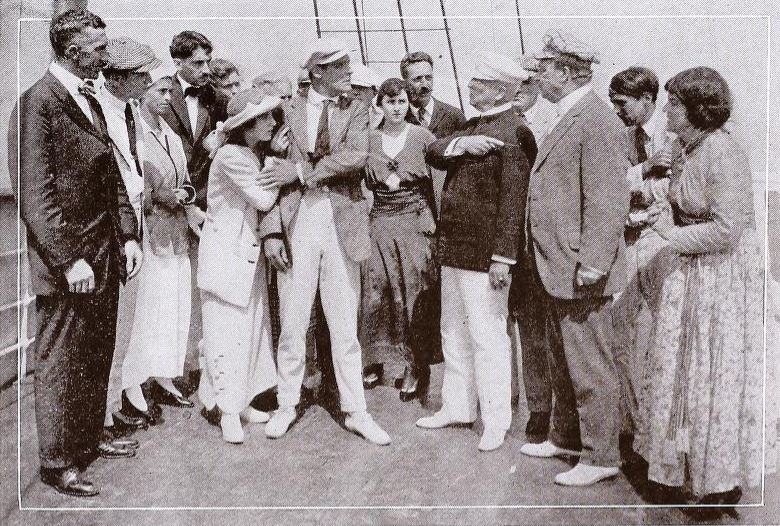
Imagine, if you will, a universe where the iris of the camera does not merely open—it exhales. From that black-lunged exhalation slithers The Vanderhoff Affair, a 1915 one-reel marvel that feels as though Edgar Allan Poe’s ghost hijacked a Méliès set and demanded amphetamines for everyone. Clocking in at barely fifteen minutes, the film compresses Gothic dread, proto-noir paranoia, and pharmaceutical true-crime into a celluloid bullet that still ricochets inside your skull a century later.
Lester—played with nervy, travel-worn magnetism by Henry Hallam—arrives from Mexico carrying not just the dust of the road but the existential sunburn of a man who has seen too much. His first errand back home? A courtesy call upon Helen (Francesca Cappelano, channeling both Ophelia and Carmilla). She once bobbed limp in a river; he revived her; now she drifts through her uncle’s estate like a sleepwalker trapped in someone else’s opium poem. The rumor mill brands her “insane,” a label as convenient for Vanderhoff as a blank check.
Vanderhoff—T. Justin Dow in whiskered, velvet-swathed menace—embodies the predatory guardian so familiar to Victorian fiction yet still chilling when filtered through silent-film grammar. Every time he tips his hat the gesture feels like a guillotine clicking into place. The inheritance subplot, creaky on paper, here vibrates with proto-feminist fury: a woman’s mind chemically rewritten so a man can rewrite her bank balance.
And then there is the milk trick. Helen, rendered voiceless by narcotic fog and patriarchal surveillance, resorts to clandestine typography: a blank sheet, a dab of milk, a candle’s lick. The moment Lester irons the page and violet-brown words bloom like bruises is the moment cinema itself seems to discover invisible ink as plot device. You half expect the frame itself to shiver with delight. Compared to this, the raven’s quill in The Raven feels almost medieval.
Visually, director Robert G. Vignola weaponizes negative space. Windows yawn like moral courts; shadows are carved with Germanic severity presaging Fantômas’s Parisian silhouettes by almost a decade. When Lester peers from his casement into Helen’s mirroring one, the screen becomes a diptych of entrapment: two souls separated by three feet of night air and a lifetime of gaslighting. The iris-in isolates Helen’s hand as she presses a note to the pane; the iris-out swallows the entire conspiracy. It is silent-era surveillance capitalism in miniature.
Sound, though absent, haunts the film. Intertitles arrive sparingly, almost reluctantly, as though language itself were ashamed to speak for Helen. Instead we get gesture: a palm to throat suggesting suffocation; fingers drumming in 3/4 time, mimicking a waltz she will never dance. The loco-weed elixir—administered via teaspoon in nightly ritual—turns each dawn into a fogged emulsion of memory. Viewers versed in 21st-century pharmacology will recognize the precursor to benzodiazepine blackouts; 1915 audiences must have simply felt a shiver of unnameable dread.
At the midway mark, Lester’s pal Dr. Luchow (Hal Forde) functions as both enabler and unwitting executioner. He provides the “expert” certification that could doom Helen. His spectacles—thick as canteen bottoms—reflect the electric chandelier until his eyes become twin moons of bureaucratic indifference. Only when Lester’s blood drips onto the commitment parchment does conscience crack through. The moment is operatic: red on white, like a Béla Bartók libretto staged in a sanatorium.
Action fans hungry for stunt work get their dividend when Lester saws at his hemp bindings using the jagged lid of a ventilator shaft. The camera refuses to cut away; each jerk of wrist is a mini-portrait of Sisyphean grit. Bruised crimson palms anticipate the crimson of the final explosion, turning chromatic rhyme into moral accounting. Compare this to the cliffhanger serials of The Eleventh Hour, where peril feels transactional; here every wince costs something.
The climactic automobile detonation—rendered via double-exposure and a miniature chassis—is both primitive and oddly cathartic. We expect the villains to perish, yet the film lingers on the fireball just long enough for your empathy circuitry to spark. Violence begets silence; silence begets ash. Helen steps forward, framed against the conflagration, her inheritance restored but her pupils still wide with survivor’s alertness. The camera halts. No embrace, no epilogue. Just the hot breath of the end card.
Contemporary reviewers, when they bothered, dismissed the tale as “melodramatic penny dreadfulry.” Yet watch it beside Jim the Penman or even the later Hound of the Baskervilles and you’ll notice how ruthlessly The Vanderhoff Affair pares away fat. Every trope—imperiled heiress, forged madness, loyal hero—serves as artery, not ornament.
Marginalia for cinephiles: the film was lensed at Fort Lee, New Jersey, when its Palisades still doubled for both the Yucatán and the moors of Devon. Cinematographer Robert G. Vignola (pulling double duty) reportedly scavenged Mexican blankets from a nearby Western to impart “tactile exile” to Lester’s wardrobe. The blankets remain unseen, yet their myth survives in vintage trade columns—proof that even objects off-screen can haunt the text.
Gender critics will relish how Helen’s “hysteria” weaponizes the era’s medical misogyny against itself. The film never validates the diagnosis; it showcases the machinery that produces it. In an age when When Paris Loves could pivot on a coquette’s whims, here a woman’s subjectivity is both prison and battleground. Her final gaze—direct, unsmiling—constitutes a proto-Feminist refusal to perform gratitude.
Is the film flawless? Hardly. The Mexican henchman Jose trades in lazy greaser cliché, and the asylum paperwork arrives via narrative teleportation. Yet such warts become instructive, reminding us that even progressive texts carry the period’s pathogens. Restoration efforts by the EYE Institute have stabilized the nitrate, though some frames still blister like burnt moth-wings. I recommend the 2018 On the Steps of the Throne ensemble score—minimal percussion, glass harmonica, distant typewriter clicks—if you can snag it.
To watch The Vanderhoff Affair today is to confront a paradox: the closer cinema gets to its cradle, the more modern its preoccupations feel—surveillance, bodily autonomy, the alchemy of invisible inks both literal and metaphoric. It is a quarter-hour symphony of gaslight and gunpowder, a missing link between Griffith’s Victorian parlor tragedies and Lang’s urban labyrinths. Seek it out, project it on the largest wall you can find, and when Helen finally stares down the lens, dare to blink first.
Verdict: Essential. A fever-coached miniature that punches leagues above its reel weight.
IMDb —
1924
Community
Log in to comment.