DbcultAccessing Vault...
Cult Review
Senior Film Conservator
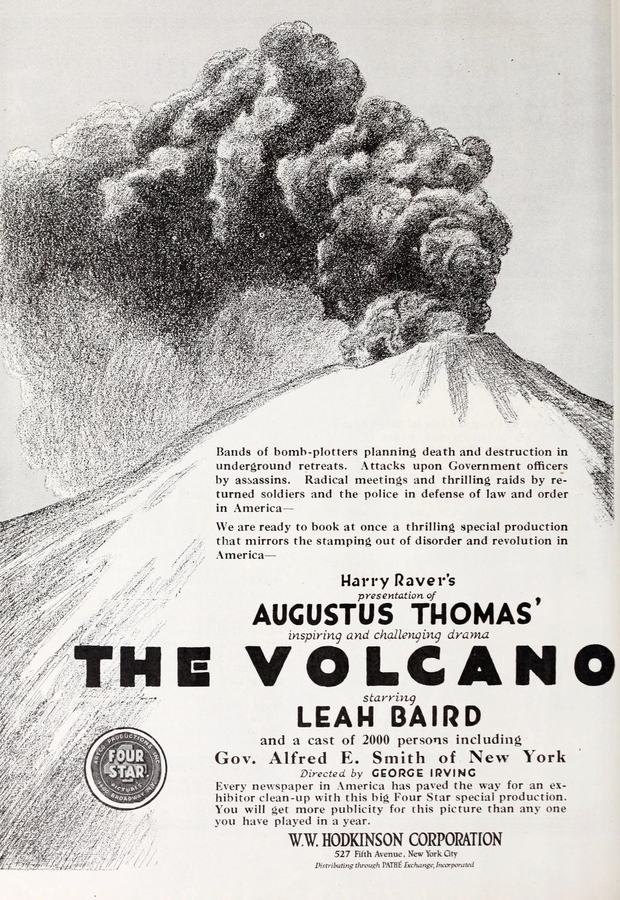
The cinematic landscape of the late 1910s, still nascent and finding its voice, often served as a pulsating mirror to the societal anxieties and transformative upheavals of its era. Among these fascinating artifacts emerges Augustus Thomas's *The Volcano* (1919), a film that, despite its silent nature, roars with the tumult of a nation grappling with the seismic aftershocks of the Great War and the unsettling rise of radical ideologies. This is not merely a melodrama; it is a trenchant socio-political commentary, cloaked in a narrative of romance, betrayal, and redemption, meticulously crafted to resonate with a public both wary and weary.
At its heart, *The Volcano* presents a vivid tableau of a society teetering on the precipice of ideological conflict. The film introduces us to Ruth Carroll, portrayed with earnest conviction by Leah Baird, a schoolteacher whose daily encounters with the undernourished children of New York's Lower East Side ignite a fervent desire for social justice. Her idealism, however, becomes a perilous vulnerability when she crosses paths with Alexis Minski, a charismatic Bolshevist, played by William Frederic, whose fiery rhetoric promises radical solutions to systemic inequities. Minski, a figure steeped in the burgeoning Red Scare paranoia, skillfully exploits Ruth's compassion. Her subsequent suspension from teaching, a direct consequence of her complaints and Minski's inflammatory pronouncements, pushes her further into the arms of the revolutionary movement. This swift descent into radicalism forms the film's initial dramatic thrust, painting a portrait of how easily genuine concern can be twisted into a conduit for extremist agendas.
Against this backdrop of simmering social unrest, we are introduced to Captain Nathan Levison, a war hero returning from the brutal battlefields of the Argonne, impeccably embodied by Edward Langford. Levison's assignment by the Secret Service to infiltrate and neutralize New York's radical elements immediately establishes a compelling counter-narrative. His mission, however, soon becomes deeply personal. A visit to the Carroll household, intended to announce the imminent arrival of Ruth's brother, Davy – a soldier who saved Levison's life at the cost of his own foot – unexpectedly blossoms into a profound romantic connection with Ruth. This entanglement creates an exquisite tension, pitting duty against desire, and patriotism against a love for someone seemingly on the wrong side of a rapidly dividing ideological chasm. The film masterfully exploits this dramatic irony, drawing the audience into a web of conflicting loyalties and concealed identities.
The principal characters of *The Volcano* are not mere archetypes; they are complex individuals, each navigating a moral and political labyrinth. Ruth Carroll’s journey is particularly poignant. She embodies the idealistic spirit of many young Americans post-WWI, eager for change but susceptible to manipulation. Her initial embrace of Bolshevist ideals, though misguided, stems from a genuine desire to alleviate suffering, making her eventual disillusionment all the more impactful. Leah Baird's performance, through the expressive medium of silent film, conveys this emotional arc with a compelling sincerity that transcends the limitations of spoken dialogue. Much like the protagonists in The Rack or Judge Not; or the Woman of Mona Diggings, Ruth's predicament is rooted in a deeply personal struggle within a larger societal framework.
Alexis Minski, as the manipulative antagonist, is a chilling portrayal of ideological extremism. William Frederic imbues Minski with a captivating intensity, making his rhetoric both alluring and dangerous. He is a master of deception, twisting truths and sowing discord, particularly evidenced when he convinces Ruth that Levison intends to arrest her and her grandfather. This act of perfidy pushes Ruth to a desperate plea for Levison’s demise, highlighting the perilous power of misinformation. Minski represents the 'volcano' of the title – a simmering, destructive force threatening to erupt and consume all in its path. His character, in its insidious charm and ultimate villainy, draws parallels to the cunning antagonists found in early thrillers like Fantômas: The False Magistrate, where manipulative figures orchestrate grand deceptions.
Captain Nathan Levison stands as the film's moral anchor. Edward Langford’s portrayal conveys a quiet strength and unwavering sense of duty, juxtaposed with a tender romanticism. His journey is one of covert operation, personal sacrifice, and ultimately, unwavering loyalty to both his country and the woman he loves. Levison’s character embodies the patriotic spirit that America sought to uphold in the face of perceived internal threats, making him a heroic figure in the traditional sense, yet one complicated by the emotional stakes of his undercover work. His steadfastness recalls the heroic resolve seen in films such as The High Hand, where protagonists often navigate dangerous political landscapes with unwavering integrity.
Crucially, Ruth’s brother, Davy, played by Jacob Kingsbury, serves as a pivotal agent of truth and redemption. His wartime sacrifice, having lost a foot saving Levison, imbues him with an undeniable moral authority. It is Davy who ultimately shatters Minski’s web of deceit, convincing Ruth of the Bolshevist’s true, malevolent intentions. Davy’s role is not merely that of a plot device; he represents the enduring power of familial bonds and the clear-eyed vision that can cut through ideological fog. His presence underscores the theme of loyalty, a stark contrast to Minski’s perfidy. The supporting cast, including Becky Bruce, Mlle. Elaine Amazar, W.H. Gibson, and Harry Bartlett, though perhaps less developed, contribute to the tapestry of the film's world, adding depth and texture to the bustling New York setting.
*The Volcano* is rich with thematic depth, exploring the volatile intersection of personal desire and political fervor. One of its most compelling themes is the dangerous allure of political extremism versus the more arduous path of genuine social reform. Ruth’s initial grievances are legitimate, reflecting the very real poverty and inequality prevalent in early 20th-century urban America. However, Minski’s radical ideology offers a seductive, albeit destructive, shortcut to change. The film cautions against the seductive simplicity of revolutionary promises, suggesting that true progress is often incremental and rooted in fundamental justice rather than violent upheaval. This was a particularly resonant message in 1919, a year marked by widespread labor unrest and the fear of Bolshevist infiltration following the Russian Revolution.
The theme of love and loyalty forms the emotional backbone of the narrative. The burgeoning romance between Ruth and Levison is constantly tested by the political machinations surrounding them. Their love story is not a mere saccharine subplot; it is integral to the film’s larger message about the human cost of ideological division. The loyalty between siblings, exemplified by Ruth and Davy, also plays a crucial role, ultimately serving as the catalyst for Ruth’s redemption. This emphasis on enduring human connections amidst external chaos can be seen in other melodramas of the era, such as Graziella or De forældreløse, which often explored how personal relationships withstand great adversity.
Moreover, the film delves into the pervasive power of propaganda and manipulation. Minski’s ability to sway Ruth and others to his cause, even to the point of inciting violence, serves as a stark warning. The film implicitly critiques the ease with which individuals can be led astray by charismatic leaders who exploit genuine grievances for nefarious ends. This was a critical concern during the Red Scare, where public opinion was heavily influenced by newspaper headlines and government rhetoric about the dangers of communism. The narrative also champions patriotism and duty through Levison’s character, presenting a clear dichotomy between the radical elements threatening the nation's stability and the steadfast individuals committed to its preservation.
Augustus Thomas, a prolific playwright turned screenwriter and director, brings a theatrical sensibility to *The Volcano*. His experience in crafting compelling narratives for the stage undoubtedly informed his approach to silent film, where visual storytelling, expressive acting, and carefully placed intertitles carried the entire weight of the plot and emotion. The direction is purposeful, employing visual cues and character blocking to convey tension and relationships without the aid of dialogue. The film’s pacing, while perhaps deliberate by modern standards, effectively builds suspense, particularly leading up to the Bolshevist plot to assassinate Governor Alfred E. Smith, the Mayor of Seattle, and Attorney General Alexander Palmer – a chilling reflection of real-world fears and events of the period.
Silent films relied heavily on the actors' ability to convey complex emotions through facial expressions and body language, and the cast of *The Volcano* rises to this challenge. Leah Baird, in particular, delivers a nuanced performance that allows the audience to understand Ruth's internal struggles. The dramatic confrontation scenes, where Davy exposes Minski’s perfidy, are particularly effective, relying on the raw emotion conveyed by the actors. While cinematography in 1919 was still evolving, Thomas likely used techniques common to the era, focusing on clear compositions and effective use of available light to enhance the narrative. The film, in its construction, mirrors the dramatic tension found in other contemporary works like The Masked Rider, which also used serialized suspense to captivate audiences.
*The Volcano* is undeniably a product of its time, steeped in the anxieties of post-World War I America. The Red Scare, a period of intense anti-communism and xenophobia, provides the socio-political backdrop for the entire narrative. The film’s depiction of Bolshevist cells plotting assassinations and inciting unrest directly taps into the widespread fear that radical foreign ideologies threatened to dismantle American democracy. The explicit mention of Governor Alfred E. Smith and Attorney General Alexander Palmer, real political figures, grounds the fictional plot in a tangible historical context, amplifying the sense of immediacy and danger for contemporary audiences. The signing of a bill making it illegal to display the Red flag further underscores the legislative and social pushback against perceived radical threats.
Yet, despite its specific historical moorings, *The Volcano* possesses a surprising and unsettling contemporary relevance. The themes of political manipulation, the seduction of extremist ideologies, the struggle for truth amidst a deluge of misinformation, and the enduring power of human connection resonate powerfully even today. In an age where information spreads rapidly and often unchecked, and where societal divisions frequently manifest along ideological lines, the film’s cautionary tale about the dangers of unquestioning adherence to radical dogma remains pertinent. It reminds us that the 'volcano' of social unrest can erupt from genuine grievances, but its destructive force is often guided by those with ulterior motives. This timeless quality allows *The Volcano* to transcend its silent era origins, offering insights into human nature and societal dynamics that remain enduring. Films like The Return of Mary or The Key to Yesterday, while perhaps not as overtly political, also explored themes of hidden identities and societal reintegration, albeit through a more personal lens.
In its ultimate resolution, *The Volcano* delivers a satisfying, if somewhat conventional, triumph of good over evil. Davy’s heroic intervention, the exposure of Minski’s perfidy, and the subsequent saving of Levison pave the way for a double wedding, attended by the very governor whose life was threatened. Ruth’s marriage to Levison, and Davy’s to a reformed Bolshevist, symbolize not just personal happiness but also the triumph of American ideals over radical subversion, and perhaps, a hope for national healing and reintegration. This celebratory conclusion, while typical of many films of the era (one might consider the uplifting resolutions in The County Chairman or Mrs. Black Is Back), does not diminish the potent journey that precedes it.
As a cinematic artifact, *The Volcano* offers invaluable insights into the social and political consciousness of its time. It serves as a stark reminder of the anxieties that gripped America after WWI and the ways in which popular culture reflected and shaped public discourse. While the acting styles and narrative conventions may appear dated to a modern eye, the film’s thematic core remains surprisingly robust. It is a compelling testament to the power of silent cinema to engage with complex social issues, delivering both entertainment and a powerful message. Films like Passion or A Venetian Night, though different in subject matter, share this commitment to heightened drama and emotional intensity, characteristic of the period. The film's examination of loyalty and betrayal, much like Bond of Fear or The Inner Ring, explores the intricate human connections that define our choices.
Ultimately, *The Volcano* is more than just a historical curiosity; it is a vibrant, if sometimes unsettling, piece of cinematic history that speaks to enduring human struggles. It reminds us that the forces of societal upheaval, political manipulation, and personal redemption are as potent now as they were a century ago, making its fiery narrative a timeless and thought-provoking experience for those willing to delve into the silent roar of its dramatic heart.
IMDb —
1934
Community
Log in to comment.