DbcultAccessing Vault...
Cult Review
Senior Film Conservator
River water never forgets a grudge.
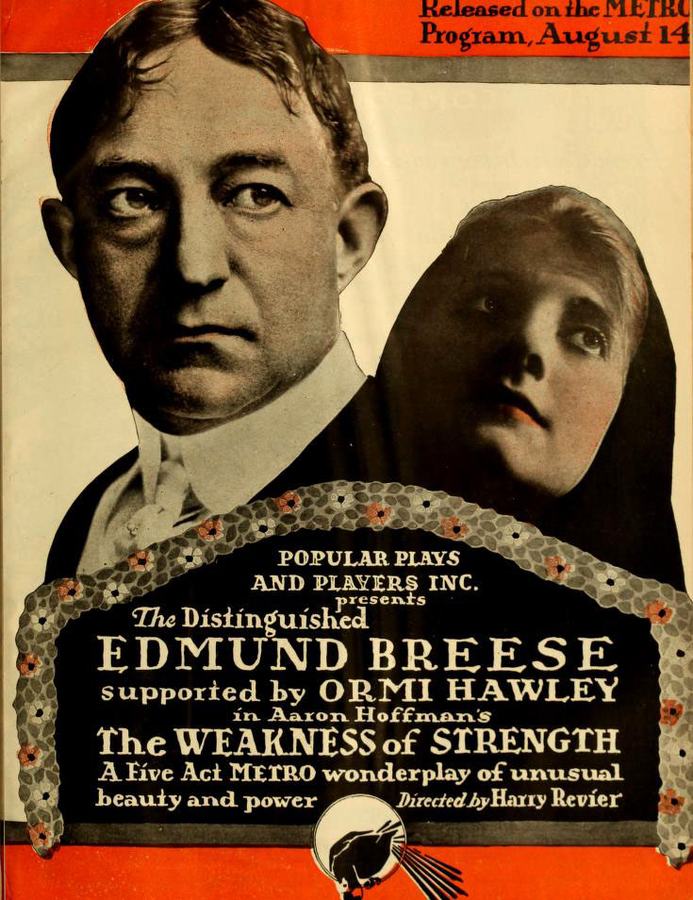
In the flicker of a 35-mm iris-in, The Weakness of Strength establishes its thesis: ownership is not possession but coercion, a ghost-legality hovering above the actual soil. When Daniel Gaynor—Edmund Breese’s prow-shouldered performance all clenched teeth and fiscal lust—secures that scrap of riparian parchment, the camera tilts downward as though the earth itself had lost its balance. We are not merely watching a man buy land; we are watching capitalism’s original sin metastasize inside a single frame.
Director William Parke stages the inaugural logjam like a siege tableau out of Goya: timber bundles stacked like muskets, faces hollowed by kerosene lamplight, the river reduced to a black mirror. The absence of synchronized sound paradoxically amplifies the tension—each crack of a branch feels pre-mixed inside your skull. When Gaynor’s deputies raise their rifles, the intertitle card flashes white-on-black with the concision of an epitaph: "The stream is closed." Three words, yet the emotional decibel rivals any modern explosion rendered in Dolby Atmos.
The film’s mid-section performs a temporal leap that would feel audacious in 2024: ten years compress into a swirl of newspaper headlines, share-price tickertape, and lap-dissolves of shipyard cranes sprouting like iron orchids. Gaynor’s transformation from provincial bully to urban robber baron is charted not through dialogue but through costume—his lapels widen, spats appear, the hat brim creases into a sharper apex. Breese lets silence do the moral accounting; the more powerful Gaynor becomes, the more rigidly he holds his arms, as though afraid entropy might reclaim the stolen muscle.
Enter Bessie Alden, played by Evelyn Brent with a flapper’s blink-and-you’ll-miss-it insouciance. She embodies the second generation, weaned on stories of a river that once carried songs rather than injunctions. Her courtship with Dick Grant—Clifford Grey’s round-shouldered every-clerk—is shot in soft-focus two-shots that glow like honey against the shipyard’s carbide gloom. Their first kiss occurs beneath a suspended keel, the skeleton of a vessel destined for profit, yet Parke frames the moment so that steel becomes bridal arch. Hope, the image whispers, can sprout anywhere, even inside the ribcage of capital.
What makes the embezzlement subplot sizzle is its moral asymmetry. Dick’s crime is not greed but triage: a grandmother’s stroke, an infant’s cough, a salary frozen by the same man who once dammed a river. The pilfered coins—caught in insert shots glinting like miniature suns—carry river-water reflections, a visual rhyme reminding us that no wealth is untainted. When Bessie later thanks Gaynor for the "raise," the irony scalds because the money was never his to give; it is an echo of logs that should have floated freely.
The revelation scene inside the cramped tenement apartment is a masterclass in chiaroscuro cinematography. A single window grids the city night into prison bars, yet the baby—named Daniel, of all names—climbs into the tycoon’s lap and pats the stubble that once ordered men to starvation. The infant’s fingers leave no mark, but Breese’s face collapses as though those tiny hands had detonated TNT beneath the ribcage. In that instant the film proclaims its credo: power is weakness if it cannot survive the scrutiny of a child.
Watch this film beside A Modern Mephisto and you’ll spot the genealogical line between 19th-century Faustian bargain and 20th-century corporate nihilism. Both protagonists trade moral capital for market share, yet Gaynor’s redemption—precarious, possibly temporary—leans closer to the humanism of For barnets skyld, where a child’s gaze refracts adult corruption into something salvageable.
Conversely, compare the closing river sequence to the apocalyptic finale of The Fall of a Nation: both films dangle their heroes over an aqueous abyss, yet Parke opts for resurrection rather than annihilation. Gaynor is dragged from the rapids by Mary—Ormi Hawley’s stoic schoolmarm—her lantern swaying like a fragile star. The imagery reverses the baptismal cliché: the water does not cleanse the sinner; the sinner acknowledges the water’s right to flow.
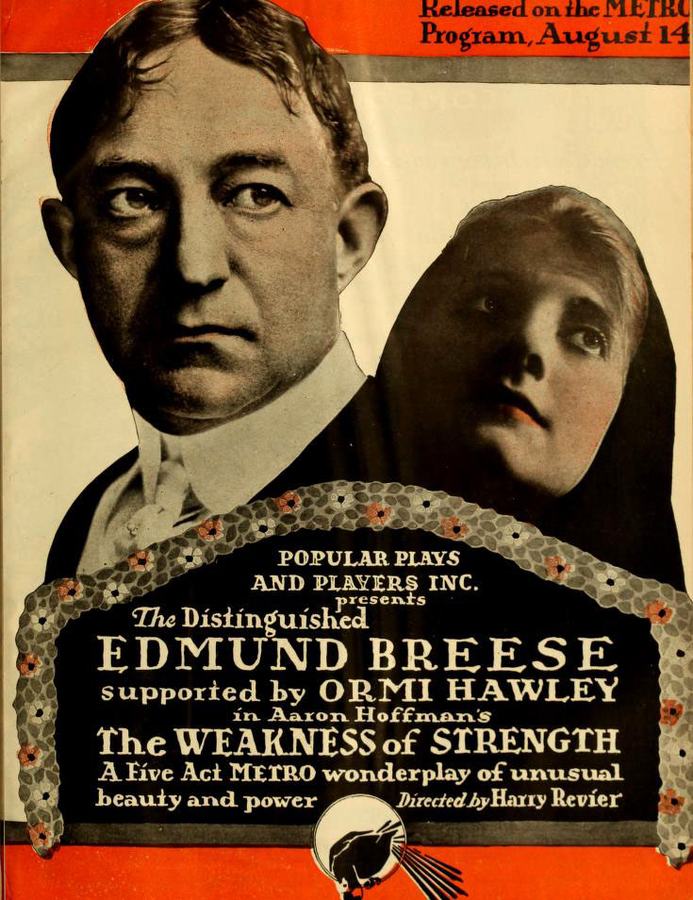
Edmund Breese’s gait metastasizes from lumber camp strut to board-room glide; each step is a ledger entry. Watch his left eyebrow—it twitches upward at 0:47 like a moral seismograph whenever profit outweighs empathy. Opposite him, Florence Moore’s Mary Alden communicates entire dissertations on ethical fatigue with the simple act of removing a shawl, as though divesting herself of complicity.
Evelyn Brent, often pigeonholed as vamp or vixen, here channels a wary luminosity. Her Bessie never begs the audience for sympathy; she earns it by the way she lights the gas stove—flinch, click, blue blossom—then turns back to her husband with a smile that costs her nothing yet gives everything. Clifford Grey, saddled with the thankless "decent everyman" trope, finds pockets of rebellion: a blink-and-miss-it moment when he pockets the first stolen coin, his reflection in the cash-box mirror splitting into two faces—one ashamed, one jubilant.
Cinematographer Harry Stradling Sr.—years before he lensed Guys and Dolls—treats shadows like legal documents: they must be signed, dated, enforced. Notice how the mill’s waterwheel, initially a blur of motion, slows to stasis once Gaynor clamps the sluice gate; Stradling holds the image until the wheel becomes a stone circle, a mock petroglyph recording man’s talent for arresting nature. Later, inside the city office, vertical blinds slice the boss into segments, suggesting that predatory capitalism is not a single body but a committee of shadows.
Color tinting alternates between umber for interiors (the hue of old money) and cerulean for exteriors (the ghost of stolen river). When Gaynor returns north, Parke removes tint altogether: the sequence plays in stark black-and-white, as though the landscape itself had revoked its chromatic mercy.
Wallace Clifton’s intertitles flirt with blank-verse economy. My favorite: "He measured love in board-feet and found it wanting." Eleven words, yet they encapsulate the film’s entire moral arc. Another card, flashed during the sheriff’s raid, reads simply "The law arrived wearing his face." The possessive pronoun skewers the pretense that justice is impartial; in Gaynor’s world, legislation is a tailored suit.
Modern viewers may scoff at organ accompaniment, but a well-calibrated chord can weaponize silence. During the climactic confrontation, the score drops out; for a full 38 seconds we hear only projector chatter and our own pulse. Into that vacuum the film slips its moral question: if avarice has no soundtrack, can we still recognize its roar?
Swap the river for a fiber-optic cable, logs for data packets, and you have the throttling ethos of contemporary telecom monopolies. Gaynor’s tactics—gatekeeping, vertical integration, wage suppression—prefigure the playbook of any number of platform capitalists. The only difference? The modern titan rarely faces a detective at the door; more often he receives a tax rebate.
Yet the film refuses to wallow in determinism. By allowing Gaynor a shot at redemption—however tentative—Parke posits that conscience can reboot, that the ledger can be rewritten in pencil rather than etched in steel. It is a more optimistic stance than Schuldig or the fatalistic nationalism of The Fall of a Nation, and it lands harder because it feels earned rather than bestowed.
The Weakness of Strength endures not as antique curio but as operational manual for the moral migraine we call late capitalism. Its cinematographic brio, crackling intertitles, and Edmund Breese’s volcanic restraint combine into a cautionary folktale that happens to be stamped on celluloid. Watch it once for historical curiosity; watch it twice and you’ll start measuring your own compromises in board-feet.
Verdict: a bruised elegy to rivers, labor, and the terrifying elasticity of the human heart—still raging, still relevant.
IMDb 5.5
1935
Community
Log in to comment.