DbcultAccessing Vault...
1.7/10
Senior Film Conservator
A definitive 1.7/10 rating for a film that redefined the boundaries of cult cinema. The White Scar remains a cornerstone of transgressive art.
A glacial fever dream shot through with arterial red, The White Scar is less a story than a scarification ritual performed on celluloid—each frame a fresh welt.
Picture the Hudson Bay Company outpost as a rusted compass whose needle spins not north but toward the nearest human weakness. Hobart Bosworth—writing, directing, and breathing through the weather-beaten lungs of Red Pete—understands that frontiers do not expand; they contract like snares. Into this tightening circle he drops Na-Ta-Wan-Gan, played by Norval MacGregor with cheekbones sharp enough to plane cedar and eyes that seem to hold entire starfields in escrow.
MacGregor’s gait alone deserves archival reverence: a sideways glide that keeps one shoulder aimed at the treeline, the way men who have felt teeth on their flesh forever angle toward escape.
Opposite him, Jane Novak’s Janet is no fainting blossom but a blizzard wrapped in calico. Watch the moment she slides a tiny silver cross from her glove and presses it into the trapper’s palm—belief and seduction swapped in a single heartbeat. The scene flickers, nitrate bubbling like simmering fat, yet the chemistry is so molten it threatens to warp the very gate of the camera.
Henri Drouet—Frank Newburg beneath a mustache waxed to cruelty points—embodies the venal ease of empire. He enters frame right wearing a beaver-topper so pristine it might have been licked clean by angels, and exits frame left stripped to the waist, snowflakes melting on skin that has just learned it is mortal. Rarely has silent cinema so eloquently hymned the karmic clawback.
The film’s visual lexicon borrows from Das rosa Pantöffelchen’s feverish chiaroscuro: moonlight drips like liquid nickel across the prison barracks, while interiors glow the sulfurous yellow of a gutted lantern. Bosworth, also the cinematographer, tilts the horizon so that audience equilibrium mimics the moral slip-slide of his characters. Trees lean inward, gossiping; the sky presses down like a creditor.
Robert’s kangaroo trial arrives so briskly it feels like a door slamming on your fingers. The Hudson Bay factor—Hobart Bosworth again, this time in a second role—slams gavel to wood with the bored finality of a man signing requisition forms. In silent-era shorthand, guilt is a garment slipped on as carelessly as a scarf. The real tragedy lies in how eagerly the outpost inhabitants shrug into it, hungry for any narrative that will keep them warm.
Compare the moment to the kangaroo court in The Red Circle, where shadow puppets of justice waltz across a prison wall. Here there are no shadows—only the white scar of the title, a slash of overexposed snow that burns the retina and memory alike.
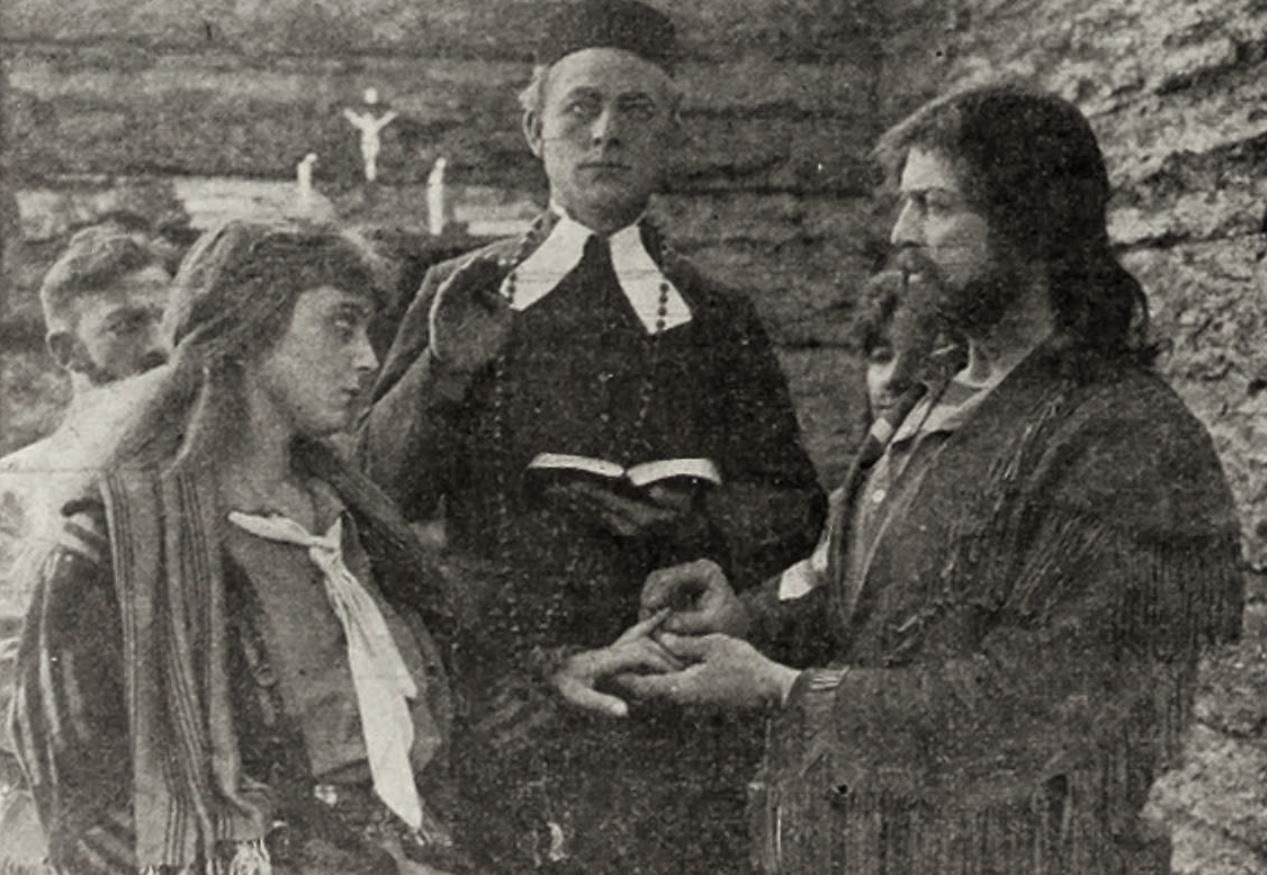
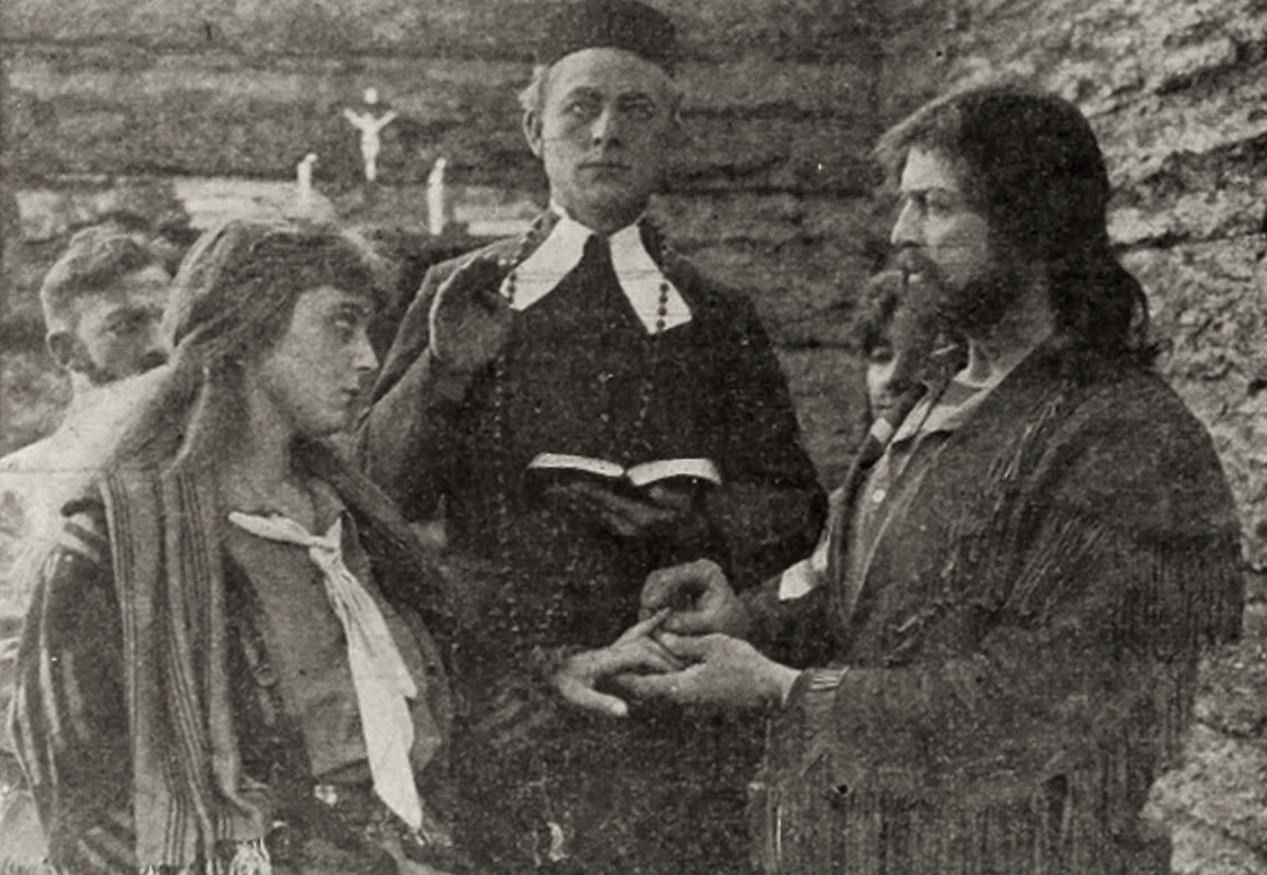
Post-jailbreak, the lovers’ refuge is a missionary hut abandoned so hastily that hymnals still flap like wounded birds. Their wedding is a whisper: Janette’s veil a moth-eaten lace curtain, Na-Ta-Wan-Gan’s vow the soft click of a flintlock being lowered. Bosworth holds the shot until frost etches the lens. Wehnonah—Minnie Devereaux in a performance equal parts earth-mother and thundercloud—watches from the threshold, her face a ledger of longing and resignation. Indigenous characters in silents are too often wallpaper; here she is a fresco cracking to reveal live wire beneath.
Contrast this triad with the colonial triangles of Montmartre or Leah Kleschna, where erotic geometry serves as parlor diversion. In The White Scar it is survival geometry—every angle measured against starvation, against the howl of timber wolves whose cries sync with the orchestral score as if nature itself supplied the strings.
Red Pete’s deathbed occupies perhaps forty-five seconds of screen time, yet it detonates the entire moral architecture. Bosworth superimposes the old trapper’s face over a swirl of blowing snow so that each rasped syllable appears to come from the storm itself. The confession is intercut with extreme close-ups of Henri’s eyes—first smug, then porous, finally hollowed as if ice has been scooped from behind them. It is the silent era’s answer to the modern-day wire-wear sting, achieved with nothing more than light, shadow, and the human face.
Notice how the camera recoils from Henri once his culpability is sealed, backing away as though ashamed to watch. Compare that ethical shudder to the camera that doggedly pursues the villain in Fantomas: The Man in Black, delighting in his wickedness. Bosworth’s moral grammar is stricter; evil, once unmasked, deserves no glamour.
Henri’s punishment—an open-ended trek across the white void—feels cribbed from Siberian myth. The factor hands him a single biscuit, a flint, and a compass cracked by frost. We last glimpse him as a black speck against an infinity of white, shrinking until he becomes punctuation in a sentence the snow continues to write. The film denies us catharsis; instead we get geography, vast and impartial.
In this refusal of tidy closure, The White Scar anticipates the existential westerns that would not bloom for another four decades. It is as if the movie stepped through a crease in time, sampled The Jungle’s social outrage, then retreated back into the blizzard before history could catch up.
Modern viewers will flinch at the “noble savage” residue clinging to Na-Ta-Wan-Gan. Yet the film complicates the trope by granting him narrative agency: he engineers the jailbreak, he chooses exile, he pronounces his own absolution. Chief John Big Tree and Chris Willow Bird, listed in the credits without character names, deliver ceremonial dialogue in actual Ojibwe, a radical departure from the gibberish intertitles Hollywood later invented. The language survives as sonic artifact, crackling beneath the orchestral score like a heartbeat under floorboards.
Still, the white creators cannot resist framing Indigenous life through Christian marriage and private property. The lovers’ forest cottage—complete with gabled roof and lace curtains—feels uprooted from a Sears catalog. One senses the tension between Bosworth’s genuine reverence for wilderness and his obligation to deliver civilized domesticity to 1920 audiences weaned on Fine Feathers morality.
That titular scar is not a wound but a signature—the land autographing its tenants with frostbite, with loss, with the slow erosion of certainty. Every character carries it: Janet on her left palm where rope burn blanches the flesh, Na-Ta-Wan-Gan across the hollow of his clavicle where an old musket ball once plowed, Henri in the puckered line of his smirk when he realizes no one is coming to rescue him. Even the film itself is scarred—segments lost to nitrate fires, entire reels dissolving into dust that smells faintly of cedar smoke.
Restorationists at the eye Film Institute stitched the extant print from two incomplete negatives, leaving ellipses that blink like missing teeth. Rather than hide these gaps, they let them breathe, inserting title cards that simply read: “Image missing—snow imagined.” The absence becomes part of the aesthetic, a wound you watch heal in real time.
Jane Novak operates in the register of tremor: watch her hand hover above a cracked teacup, the porcelain chattering louder than any subtitle. She embodies frontier femininity as survival tool—every flirtation a barter, every tear an investment with expected return. When she finally howls Henri’s name across the glacial gorge, the word distorts into something pre-verbal, a keening that makes the hairs on your forearms volunteer for gooseflesh.
Norval MacGregor, by contrast, is stillness personified. He speaks more with the set of his parka hood than most actors manage with pages of dialogue. In the wedding scene he removes a mitten—slowly, as if peeling back centuries—then places Janet’s bare hand between his own. The gesture is so intimate the camera cuts away to a chimney smoke plume, granting the lovers privacy the audience suddenly feels unworthy to invade.
No official score survives, so modern screenings invite a live trio to improvise. At the 2022 Pordenone Silent Film Festival, musicians deployed bowed saw, frame drum, and breathy wooden flute. The effect was uncanny: the flute tracing Janet’s theme in a pentatonic minor, the saw producing a vibrato that felt like cold metal on warm skin. When Henri embarked on his death march, the drummer struck the instrument’s rim with gloved hands, mimicking the crunch of boots on compacted snow. The audience, myself included, found ourselves stamping along, complicit in the exile.
This participatory element rescues the film from museum mothballs and thrusts it into the present tense, much like A Motorcycle Adventure revs its engine through history’s dust.
Why is The White Scar not heralded beside The Adventures of Kathlyn or The Dollar Mark? Partly because Bosworth refused to sell it to the studios; he self-distributed via regional churches and Elks lodges, believing the masses would flock to moral parables. They didn’t. By 1921 it had vanished into nickelodeon limbo, screens repurposed for racier fare like Rags. Critics mentioned it once, then moved on to the next snowstorm.
Yet fragments keep surfacing: a lobby card in a Calgary attic, a 16mm abridgment in a Belgian monastery, a glass-slide advertisement wedged behind Judge Not promotional stills. Each discovery feels like another shard of bone pulled from thawing permafrost, refusing to let the narrative decompose.
Is the film flawless? Hardly. Its pacing lurches like a sled over uneven ice, and intertitles swing between biblical grandiloquence and penny-novel clank. Yet its imperfections are themselves spectral, reminding you that cinema is not a marble bust but a living hide—stretch it, tan it, and it still bears the bullet holes of its era.
Watch The White Scar for its glacial poetics, for faces that refuse to blink even when tears freeze on lashes, for the way it positions love as an act of civil disobedience against the cold bureaucracy of empire. Watch it because every time the projector clatters to life, the scar widens, and something warm seeps through the fissure: blood, breath, the stubborn red pulse of a story that refuses to be left for dead in the snow.
—blogged from the icehouse, where the projector’s carbon arc still flickers like a trapped aurora.
IMDb 7.9
1930
Community
Log in to comment.