DbcultAccessing Vault...
Cult Review
Senior Film Conservator
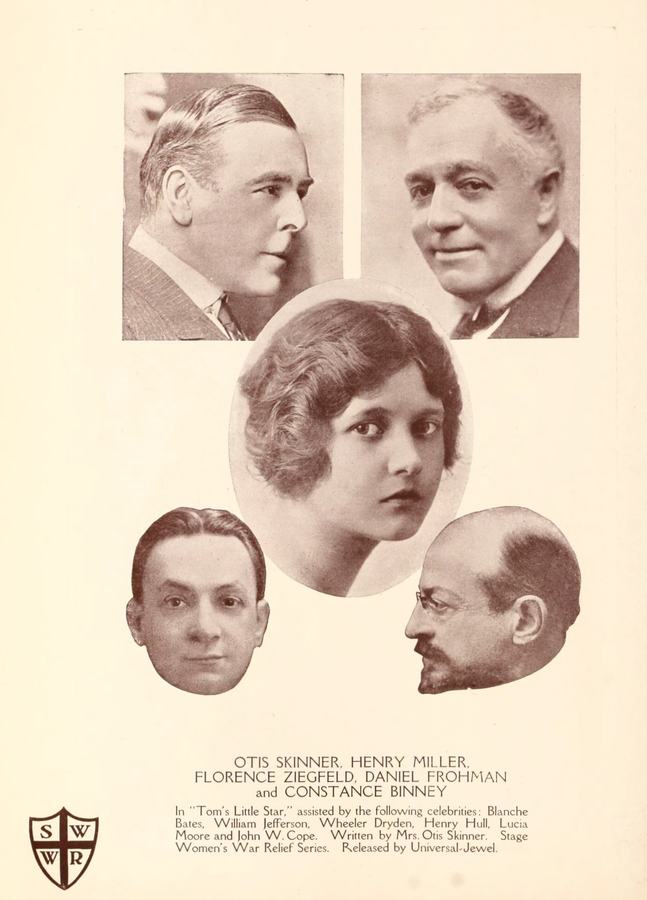
The year 1919 stands as a pivotal epoch in the history of the moving image, a time when the medium began to grasp the full extent of its expressive potency. Amidst this transition, Tom's Little Star emerges not merely as a relic of the silent era, but as a sophisticated meditation on the nature of performance itself. While many films of the period, such as The $5, 000, 000 Counterfeiting Plot, leaned heavily into the mechanics of the thriller or the visceral thrills of early action, this collaboration between writers Maud Durbin and Calder Johnstone seeks a more interior resonance. It is a film that breathes through the nuances of its cast, anchored by the formidable presence of Otis Skinner.
"The silent screen demanded a different kind of soul-baring, one where the eyes carried the weight of the spoken word, and Skinner, a titan of the stage, found a haunting rhythm in this new silence."
The narrative architecture of the film is deceptively simple, yet it harbors depths of social commentary that remain startlingly relevant. We are introduced to a world where the theatrical stage is the ultimate arbiter of value. Unlike the frantic pacing found in Shot in the Dumbwaiter, the director here allows the scenes to unfold with a deliberate, almost literary cadence. This pacing is essential to capture the crumbling dignity of its central characters. The 'Little Star' of the title is a double-edged sword—a symbol of hope for a father whose own dreams have perhaps curdled, and a weight for a daughter caught in the machinery of an industry that views youth as its primary currency.
Otis Skinner’s performance is a masterclass in restraint. Having spent decades dominating the stage, one might expect a degree of histrionics, yet he adapts to the camera with a surprising delicacy. His interactions with Wheeler Dryden and John W. Cope create a friction that propels the story forward without the need for excessive intertitles. This film serves as a fascinating counterpoint to the more overtly epic sensibilities of Veritas vincit, which sought grandeur through historical scale. In contrast, Tom's Little Star finds its grandeur in the microcosm of a single family’s aspirations.
The inclusion of Blanche Bates and Thomas Jefferson further elevates the production. Jefferson, carrying the weight of his lineage, brings a certain gravitas that mirrors the film’s themes of legacy and the burdens of the past. There is a specific scene, bathed in the soft, flickering light characteristic of the era, where the characters sit in a dimly lit parlor—a moment that evokes the same sense of impending domestic fracture seen in The Supreme Sacrifice. The cinematography, while limited by the technology of the day, utilizes shadow to articulate the emotional isolation of its protagonists, creating a visual language that predates the more celebrated German Expressionism by several years.
Maud Durbin’s influence on the script cannot be overstated. As Skinner’s wife and a talented writer in her own right, she understood the specific anxieties of the theatrical life. Her collaboration with Calder Johnstone results in a screenplay that prioritizes character over spectacle. While a film like For the Freedom of the World focused on the external pressures of global conflict, Tom's Little Star is an internal war. It is a battle for the soul of the artist, a theme also explored with varying degrees of success in A Petal on the Current.
The dialogue—conveyed through the carefully placed intertitles—possesses a lyrical quality. It avoids the stilted, overly formal language of many 1910s dramas, opting instead for a vernacular that feels grounded in the reality of the New York stage. This groundedness is what makes the eventual descent into melodrama feel earned rather than forced. We see the influence of the social realism that would later define the works of directors like Vidor, yet here it is filtered through a late-Victorian lens of propriety and moral consequence.
When analyzing the visual composition of Tom's Little Star, it is useful to compare it to A Corner in Cotton. Where the latter uses the industrial landscape to frame its narrative, Skinner’s vehicle uses the claustrophobia of the theater—the cramped dressing rooms, the vast, empty auditoriums—to emphasize the loneliness of the performer. This sense of place is almost supernatural, bordering on the atmospheric dread found in The Haunted Manor, though the ghosts here are not spirits, but the echoes of failed performances and forgotten names.
The film also touches upon the spiritual and the ethereal, themes that were immensely popular at the time. While not a supernatural film per se, there is a sequence involving a medium that feels like a precursor to the themes in Vera, the Medium. This suggests a cultural preoccupation with what lies beneath the surface of reality—whether it be the spirit world or the hidden motivations of the human heart. The 'Star' of the title becomes a celestial object, distant and cold, much like the fates that govern the characters in Beckoning Roads.
Despite its focus on the arts, the film is not immune to the social pressures of its era. There is a subtle critique of class mobility and the 'get-rich-quick' mentality that permeated post-WWI America. This aligns it with films like Up or Down?, which examined the moral cost of ambition. The characters in Tom's Little Star are constantly navigating their social standing, aware that a single bad review or a missed opportunity could send them spiraling into the obscurity depicted in The Sable Blessing.
Furthermore, the film’s portrayal of the female protagonist, played with a luminous intensity by Constance Binney, offers a nuanced look at the agency of women in the early 20th century. She is not merely a pawn in her father's game; she possesses a burgeoning self-awareness that threatens the established patriarchal order. This proto-feminist streak is a common thread in Durbin’s writing, providing a depth that is often missing from contemporary male-centric narratives like Zhizn i smert leytenanta Shmidta or the French melodrama La comtesse de Somerive.
Why does Tom's Little Star deserve our attention a century later? It is because the film captures the exact moment when the art of acting was being redefined. It bridges the gap between the grand theatricality of the 19th century and the psychological realism of the 20th. It lacks the absurdist humor of It's a Bear, but in its place, it offers a profound sincerity that is rare in any era. The film is a reminder that the 'star' we chase is often an internal light, one that can easily be extinguished by the very world that seeks to celebrate it.
The technical execution, from the costume design to the set decoration, reflects a meticulous attention to detail. The textures of the fabrics, the grime on the stage doors, and the artificiality of the stage makeup are all rendered with a clarity that survives even in surviving degraded prints. This tactile quality grounds the film’s more abstract themes in a tangible reality. It is a work of significant historical value, not just for the fans of Otis Skinner, but for anyone interested in the evolution of cinematic storytelling.
In the final analysis, Tom's Little Star is a haunting, beautiful, and occasionally harrowing look at the cost of fame. It avoids the easy resolutions of lesser dramas, choosing instead to leave its characters—and its audience—in a state of contemplative grace. It is a film that demands to be watched with the same quiet attention that its creators poured into every frame, a shimmering jewel in the crown of silent cinema that continues to cast a long, elegant shadow over the history of the medium.
IMDb 6
1934
Community
Log in to comment.