DbcultAccessing Vault...
Cult Review
Senior Film Conservator
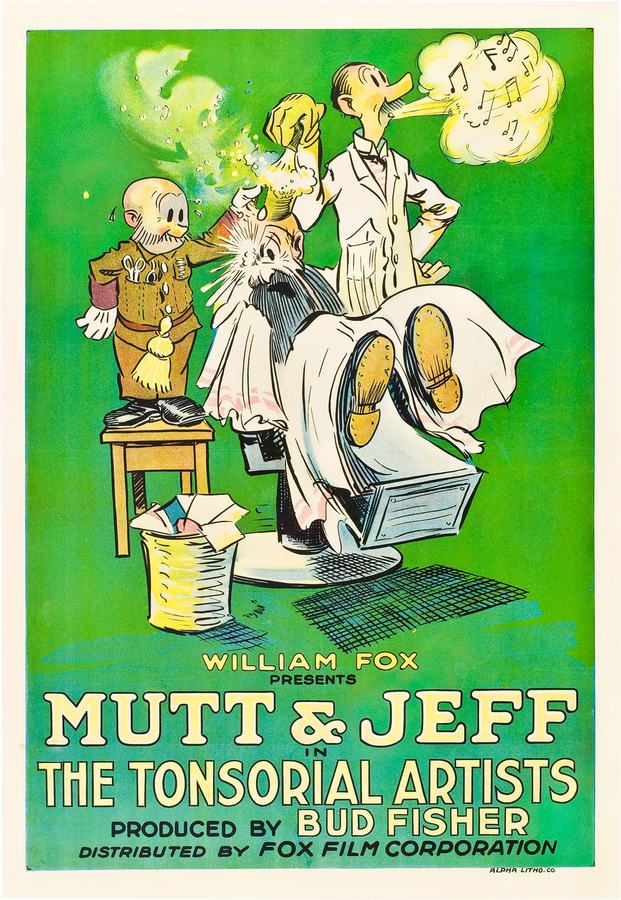
Ah, the silent era. A time when storytelling transcended spoken words, relying instead on the eloquent ballet of physical comedy, exaggerated expressions, and the evocative power of a well-placed intertitle. It was a period ripe for innovation, a canvas upon which visionaries like Bud Fisher painted vibrant, often uproarious, narratives. And among these, Tonsorial Artists stands as a particularly delightful, albeit perhaps underappreciated, testament to the era's unique comedic genius. To approach this film is to step into a time capsule, to witness a craft honed by necessity and imagination, where the absence of dialogue only amplifies the universal language of laughter.
From its very premise, Tonsorial Artists promises a romp. The title itself, a charmingly archaic descriptor for barbers, hints at a world where the act of grooming was elevated to an art form, a craft demanding precision, flair, and often, a hefty dose of showmanship. Bud Fisher, a name more commonly associated with the pioneering comic strip 'Mutt and Jeff,' takes on the dual role of writer and lead actor here, channeling his keen understanding of character and situation into a live-action spectacle. His performance as Figaro, one of the two central, competing barbers, is a masterclass in silent comedic acting – a nuanced blend of earnest dedication, subtle exasperation, and ultimately, a wonderfully expressive descent into chaotic desperation. Fisher imbues Figaro with a relatable humanity, making him more than just a caricature; he is a craftsman, proud of his trade, yet vulnerable to the pressures of ambition and the insidious lure of rivalry.
The narrative core of Tonsorial Artists is a classic tale of rivalry, elevated by its specific setting and the larger-than-life personalities involved. On one side, we have Figaro, Fisher’s character, presiding over a barbershop that exudes an aura of traditional elegance. His tools are polished, his movements precise, his philosophy rooted in the timeless art of the perfect shave and a dignified trim. Across the bustling thoroughfare, however, a stark contrast emerges: 'The Modernist,' Figaro’s flamboyant competitor. This character, a whirlwind of avant-garde ideas and electric contraptions, represents the encroaching tide of modernity, eager to discard established norms for flashier, often riskier, innovations. The visual juxtaposition of their establishments alone speaks volumes – Figaro’s shop, perhaps dimly lit with a comforting, old-world glow, against The Modernist’s, likely gleaming with chrome and buzzing with newfangled machinery. It’s a microcosmic battle for the soul of the tonsorial art, a struggle between heritage and innovation.
The catalyst for this simmering tension to boil over is the formidable Mrs. Vandergelt, a socialite whose reputation for discerning taste and equally demanding expectations precedes her. Her quest for a new personal stylist becomes the ultimate prize, a golden ticket to professional renown and financial prosperity for whichever barber can win her favor. This plot device, simple yet effective, immediately raises the stakes, transforming a mere professional rivalry into a high-stakes competition. Both Figaro and The Modernist, driven by ambition and perhaps a touch of professional insecurity, see Mrs. Vandergelt not just as a client, but as a symbol of ultimate validation. Their subsequent antics, initially subtle acts of professional espionage and slight sabotage, quickly escalate into a wonderfully choreographed symphony of slapstick. The film cleverly uses the tools of their trade – lather, razors, hair tonics, and the very chairs they work in – as instruments of comedic chaos.
What truly distinguishes Tonsorial Artists is its masterful execution of physical comedy. Bud Fisher, with his deep roots in visual storytelling, understands the power of a well-timed pratfall, an exaggerated reaction, or a prop used in an entirely unexpected way. The film’s comedic set pieces are meticulously crafted: a runaway lather machine engulfing a customer, bottles of tonics being accidentally switched with disastrous results, or the elaborate, yet ultimately futile, attempts by each barber to outshine the other with increasingly outlandish demonstrations of their skill. The climax, a veritable maelstrom within the barbershop, is a triumph of silent-era chaos. It’s a sequence that likely involved careful choreography and multiple takes, yet it feels spontaneous and utterly hilarious, a testament to the performers’ dedication and Fisher’s directorial vision.
Beyond the guffaws, however, Tonsorial Artists subtly delves into deeper thematic waters. It's a commentary on the relentless march of progress versus the steadfast appeal of tradition, a theme explored with varying degrees of success in many films of the era, from the industrial anxieties sometimes hinted at in shorts like A Corner in Cotton to the nostalgic portrayal of an older way of life in films like The Adventures of Buffalo Bill. Here, the barbershop serves as a microcosm for this broader societal shift. Figaro represents the comfort of the familiar, the tried-and-true, while The Modernist embodies the thrilling, yet sometimes perilous, allure of the new. The film suggests that an uncritical embrace of either extreme can lead to folly. Ultimately, the shared humiliation of both barbers, stripped of their professional pride and forced into a reluctant partnership, speaks volumes about the human condition. It’s a poignant, humorous reminder that sometimes, the most valuable lessons are learned in moments of shared failure, leading to unexpected collaboration and a more balanced perspective.
Bud Fisher's involvement is crucial to understanding the film's particular charm. As the creator of 'Mutt and Jeff,' he was a pioneer in sequential art, a medium that, much like silent film, relies heavily on visual storytelling, character design, and the economical use of space and action to convey narrative and humor. This background clearly informs his approach to Tonsorial Artists. The film feels like a live-action comic strip, with clearly defined characters, escalating gags, and a punchline-driven structure. Fisher’s performance as Figaro is a testament to his understanding of physical comedy, allowing his body language and facial expressions to convey a rich tapestry of emotions – from dignified pride to utter despair – without uttering a single word. This ability to translate the essence of his comic strip characters into moving images is a rare gift, and it makes Tonsorial Artists a fascinating artifact for those interested in the cross-pollination of early 20th-century popular media.
The supporting cast, though perhaps less individually prominent, plays their roles with commendable energy, particularly the actor portraying The Modernist, whose exaggerated gestures and theatrical flair provide an excellent counterpoint to Fisher’s more grounded, albeit still comedic, portrayal of Figaro. Mrs. Vandergelt, too, is cast perfectly as the demanding client, her expressions of disdain and eventual bewilderment serving as excellent reactions to the barbers' escalating antics. The film’s success hinges on these performances, and the ensemble delivers a cohesive, entertaining experience.
For a film of its vintage, Tonsorial Artists demonstrates a surprisingly sophisticated understanding of visual storytelling. The cinematography, while not groundbreaking by later standards, is effective in capturing the fast-paced action and the subtle nuances of character expression. Close-ups are used judiciously to highlight reactions or key props, enhancing the comedic impact. The editing is crisp, maintaining a brisk pace that prevents the gags from overstaying their welcome and keeps the audience engaged in the escalating absurdity. The set design, particularly of the two barbershops, is commendable, clearly delineating the contrasting philosophies of Figaro and The Modernist through visual cues – the ordered simplicity of one versus the cluttered, gadget-filled exuberance of the other.
Intertitles, the lifeblood of silent cinema, are employed with precision, often delivering punchlines or exposition in a concise, witty manner. They serve not just to convey dialogue but also to enhance the comedic timing, allowing the audience to absorb the visual gag before a textual explanation or reaction reinforces the humor. This careful balance between visual and textual information is a hallmark of effective silent filmmaking, akin to the narrative economy found in films like The Invisible Power, where plot clarity is paramount, or even the more dramatic Fate's Boomerang in its ability to quickly establish stakes.
While Tonsorial Artists may not possess the epic scope of a D.W. Griffith production or the profound social commentary of something like Gatans barn, its legacy lies in its pure, unadulterated entertainment value. It’s a film that reminds us of the universal appeal of human foibles, of the humor inherent in ambition gone awry, and the unexpected camaraderie that can arise from shared misfortune. It belongs to a proud tradition of silent comedies that, like those of Chaplin or Keaton, found humor in everyday situations and exaggerated human behavior, albeit on a smaller, more intimate scale. It's a charming example of how early cinema could captivate audiences with simple, well-executed premises.
The film’s conclusion, where the two rival barbers, stripped of their individual pride, are forced to pool their talents in a single, more humble establishment, provides a satisfying and subtly profound resolution. It’s a testament to the idea that collaboration, even born from necessity, can often be more fruitful than cutthroat competition. This message, delivered with a light touch and a final, knowing wink, resonates even today. It’s a narrative arc that speaks to resilience, adaptability, and the sometimes-painful lessons learned on the path to self-improvement. While not a dramatic powerhouse like Sins of the Parents or a character study like The Soul of a Child, it offers its own brand of insight into human nature, wrapped in a delightful comedic package.
In an era that also produced films exploring grander themes or more dramatic narratives, such as the social justice undertones of Martha's Vindication or the wartime narratives like A Long, Long Way to Tipperary, Tonsorial Artists carves out its own niche. It's not trying to change the world; it's simply trying to make you laugh, and in that, it succeeds brilliantly. It's a reminder that sometimes, the most enduring art is found in the simplest, most human of stories, told with wit, charm, and a generous helping of well-orchestrated mayhem. For anyone seeking a glimpse into the joyful, inventive spirit of early silent comedy, Bud Fisher's Tonsorial Artists is an absolute treat, a film that continues to cut through the decades with its timeless humor and endearing characters. It’s a small film with a big heart and an even bigger laugh, worthy of rediscovery by modern audiences.
IMDb 7.7
1937
Community
Log in to comment.