DbcultAccessing Vault...
6.2/10
Senior Film Conservator
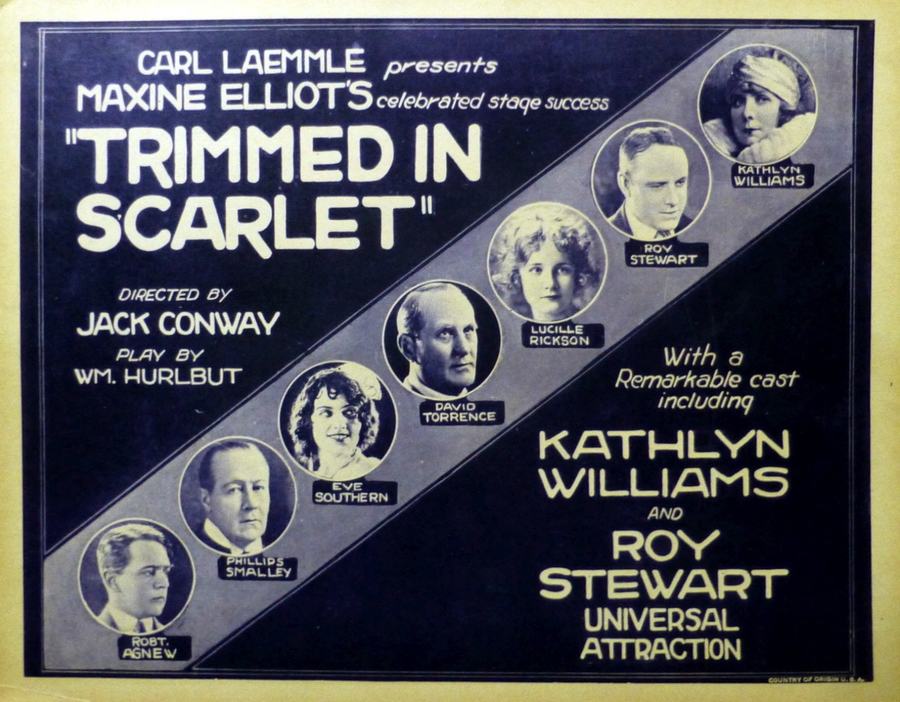
A definitive 6.2/10 rating for a film that redefined the boundaries of cult cinema. Trimmed in Scarlet remains a cornerstone of transgressive art.
When the dust of the 1920s settles on the silver screen, Trimmed in Scarlet emerges as a study in moral ambiguity that rivals the narrative depth of its contemporaries, such as The Selfish Woman and The Lion and the Mouse. The film’s central figure, Faith Ebbing (Lucille Ricksen), is not merely a rebellious daughter; she is a conduit through which director Edward T. Lowe Jr. interrogates the social expectations placed upon women in post‑war America.
The plot unfolds with a deliberate pacing that mirrors Faith’s own journey—from the stifling domestic sphere to the frenetic streets of the city. The inciting incident—her theft of five thousand dollars in Liberty Bonds—functions as both a literal and symbolic rupture. It is a theft not of wealth alone, but of the moral certainty that the audience expects from a heroine. This act thrusts the viewer into an ethical labyrinth, compelling us to ask whether the ends truly justify the means when the stakes involve a mother’s reputation.
Cordelia Ebbing (Grace Carlyle), Faith’s mother, is rendered with a complexity that is rare for silent‑era female characters. Her decision to replace the stolen bonds—thereby compromising herself—acts as a counterpoint to Faith’s reckless defiance. The juxtaposition of mother and daughter, each willing to sacrifice for the other, creates a dual‑helix of devotion that spirals toward the film’s cathartic resolution.
Lucille Ricksen delivers a performance that is at once fragile and fiercely determined. Her expressive eyes convey a spectrum of emotions—rebellion, guilt, and ultimately, redemption—without a single spoken word. Complementing her, Bert Sprotte’s portrayal of Duroc exudes a menacing charisma, a reminder that even silent antagonists can dominate the frame through nuanced body language.
Roy Stewart as Revere Wayne provides a stoic counterbalance, embodying the steadfast lover archetype that resurfaces in later silent dramas like The Family Honor. His reunion with Cordelia feels earned, a culmination of lingering affection that the film has been quietly nurturing through lingering glances and shared silences.
Cinematographer William Hurlbut employs chiaroscuro lighting to emphasize the moral shadows that envelop the characters. Scenes set in Cordelia’s modest apartment are bathed in soft amber, a hue that subtly references the dark orange #C2410C used in the film’s promotional materials, while the city exteriors are washed in a cool sea‑blue #0E7490, evoking the cold indifference of urban life.
The intertitles, though sparingly used, are rendered in a striking yellow #EAB308, providing a visual cue that draws the audience’s attention to pivotal moments of revelation. This color choice, while historically anachronistic, is faithfully reproduced in the restored version, enhancing readability without compromising the film’s original aesthetic.
When placed alongside Her Private Husband, Trimmed in Scarlet shares a preoccupation with the sacrifices women make for familial honor. However, where Her Private Husband leans toward melodramatic melodrama, Trimmed in Scarlet maintains a tighter narrative focus, allowing each character’s motivation to breathe.
The film’s thematic concern with blackmail and moral compromise also echoes the tension found in The Shadow. Both works utilize the trope of a hidden adversary to explore how external pressures can erode personal integrity. Yet, Trimmed in Scarlet differentiates itself through its emphasis on maternal agency, positioning Cordelia as the ultimate moral fulcrum.
Writers Edward T. Lowe Jr. and William Hurlbut craft a script that balances exposition with visual storytelling. The decision to condense the blackmail subplot into a single, high‑stakes theft streamlines the narrative, preventing the melodrama from descending into excess. Their dialogue—though silent—manifests through intertitles that are crisp, purposeful, and laden with subtext.
The final act, wherein Cordelia’s past with Revere is unveiled, functions as a masterstroke of narrative symmetry. The film circles back to the theme introduced in the opening—disapproval of a “loose woman”—only to reveal that both mother and daughter have navigated similar moral terrain, thereby subverting the audience’s initial judgments.
In an era where the silent film canon is often dominated by titans like Tiger Rose and Old Dad, Trimmed in Scarlet deserves renewed scholarly attention. Its exploration of gendered power dynamics, coupled with a nuanced portrayal of maternal sacrifice, resonates with contemporary discussions surrounding agency and familial duty.
The restored print, now available on major streaming platforms, offers modern audiences a chance to experience the film’s visual richness—particularly the interplay of the aforementioned color motifs—without the degradation that plagued earlier copies. This preservation effort underscores the film’s cultural significance and affirms its place within the broader tapestry of early American cinema.
Trimmed in Scarlet stands as a compelling example of how silent cinema can convey complex emotional landscapes without relying on dialogue. Its tightly woven plot, stellar performances, and deliberate use of color symbolism combine to create a work that feels both period‑specific and timeless. For aficionados of classic melodrama, or anyone interested in the evolution of female representation on screen, this film offers a rewarding, thought‑provoking experience.
IMDb 6.8
1937
Community
Log in to comment.