DbcultAccessing Vault...
Cult Review
Senior Film Conservator
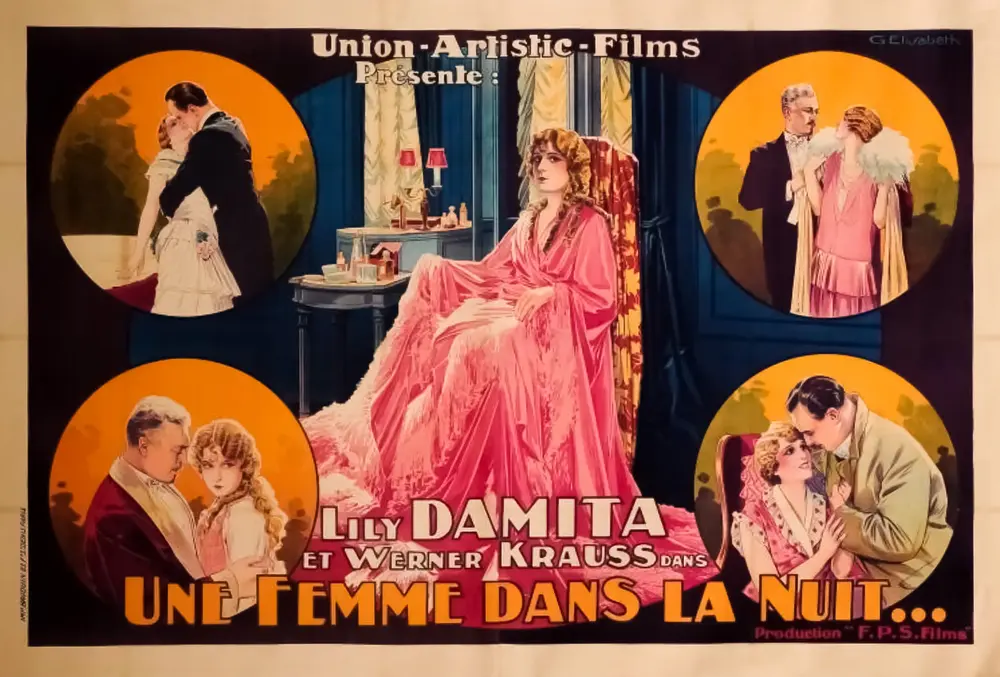
To witness Une femme dans la nuit is to observe the silent era reaching its most decadent, visually articulate zenith. Directed by the visionary Robert Wiene, a man whose name is forever etched into the annals of Expressionism, this 1928 production represents a fascinating pivot point. It moves away from the jagged, distorted geometries of his earlier work and toward a more nuanced, psychologically dense realism that nonetheless retains a spectral, haunting quality. The film serves as a canvas for two of the era's most magnetic presences: the luminous Lili Damita and the formidable Werner Krauss.
The narrative architecture of the film is deceptively simple, yet it is adorned with layers of subtextual complexity. Damita portrays a woman caught in the crosscurrents of social expectation and visceral desire. Unlike the protagonists in The Average Woman, who often serve as mere archetypes of domestic struggle, Damita’s character possesses a mercurial quality—a blend of vulnerability and iron-willed survivalism. She is the 'woman in the night,' a title that suggests both mystery and marginalization. The 'night' here is not merely a temporal setting but a metaphorical space where the rigid hierarchies of the day dissolve into something more fluid and dangerous.
Werner Krauss, an actor whose physiognomy alone could command the screen, provides a performance of staggering weight. His movements are deliberate, almost predatory, evoking the same sense of unease he perfected in earlier German masterworks. In Une femme dans la nuit, he embodies the oppressive structures of the patriarchy—not through cartoonish villainy, but through a terrifyingly calm sense of entitlement. His chemistry with Damita is combustible; it is a dance of power where every glance is a gambit and every silence is heavy with unspoken threats.
When comparing this dynamic to the romantic tensions found in The Desired Woman, one notices a distinct lack of melodrama in Wiene’s approach. Where other directors might have leaned into histrionics, Wiene relies on the *kammerspiel* tradition—focusing on the intimate, suffocating proximity of his characters. The tension is built through composition: the way a shadow falls across a face, or the way a door frame bisects the screen, isolating the characters in their own private hells.
The cinematography in Une femme dans la nuit is nothing short of revolutionary for its time. The use of light is not merely functional; it is narrative. Wiene employs a chiaroscuro effect that rivals the best of the French Impressionist school, creating a world that feels perpetually caught in the gloaming. This visual style serves to emphasize the protagonist's isolation. Even in crowded rooms, she is often framed in such a way that she appears utterly alone, a solitary figure navigating a sea of indifferent faces.
In many ways, this film anticipates the brooding atmosphere of early sound thrillers like Blackmail, yet it possesses a poetic fluidity that sound would initially stifle. The camera moves with a ghost-like grace, gliding through sets that feel both opulent and tomb-like. There is a specific sequence involving a staircase—a recurring motif in Wiene’s oeuvre—where the verticality of the architecture reflects the social ascent and descent of the characters. It is a masterclass in using space to tell a story of aspiration and ruin.
To truly appreciate the sophistication of Une femme dans la nuit, one must look at the broader landscape of 1920s cinema. While films like Peg o' My Heart or Daddy-Long-Legs found success through sentimental charm and clear moral binaries, Wiene’s work inhabits a gray area. It shares a certain thematic DNA with Mothers of Men in its exploration of female agency, but it eschews the overt political messaging for a more visceral, emotional resonance.
Even when compared to the grand spectacles of the era, such as Ruslan i Lyudmila, this film stands out for its interiority. It is a 'small' story told with 'large' visual ambition. It doesn't need the epic scale of a mythic quest because the stakes—the survival of a woman's soul in a world designed to crush it—are already monumental. There is a recurring sense of 'the trap,' a feeling also present in The Secret of the Swamp, though here the swamp is one of silk, crystal, and social obligation.
Lili Damita’s performance deserves a dissertation in its own right. Often remembered more for her off-screen life than her professional output, here she proves why she was one of the most sought-after stars of the international circuit. Her face is a landscape of shifting emotions; she can transition from a mask of aristocratic poise to a look of sheer, unadulterated terror with the slightest adjustment of her gaze. She brings a modern sensibility to the role, a sense of self-awareness that makes her character’s plight all the more tragic.
Unlike the more traditional heroines found in St. Elmo or Gyermeksziv, Damita’s character does not wait for rescue. Her agency is limited, yes, but she operates within those limits with a calculated intelligence. She understands the currency of her beauty and the volatility of her position. In the film's most quiet moments, we see her reflecting on her own commodification, a theme that feels startlingly contemporary.
The film also functions as a fascinating cultural artifact. Produced at the tail end of the Weimar era's influence, it carries the weight of a world on the brink of collapse. The opulence on display feels fragile, as if the entire social order could be undone by a single misplaced secret. This sense of impending doom is something Wiene excels at capturing. It is less about the 'roundup' of emotions seen in Cupid's Roundup and more about the slow, agonizing realization of one's own entrapment.
Even the supporting elements, from the set design to the costuming, contribute to this atmosphere of claustrophobic luxury. The fabrics seem heavy, the jewelry like shackles. When compared to the rugged individualism of Captain Swift, the world of Une femme dans la nuit is one of stagnation and artifice. It is a world where everyone is performing, and the tragedy lies in the moments when the performance slips.
In the final analysis, Une femme dans la nuit is a testament to the power of pure cinema. It does not need the crutch of dialogue to convey the most intricate of human emotions. Through the alchemy of Wiene’s direction, Krauss’s intensity, and Damita’s radiance, the film transcends its melodramatic roots to become something universal. It is a study of power, a critique of class, and above all, a deeply moving portrait of a woman refusing to be eclipsed by the shadows that surround her.
While it may not have the name recognition of *The Cabinet of Dr. Caligari*, it is, in many ways, a more mature and refined work. It demonstrates a filmmaker in full command of his craft, using the medium to explore the darkest corners of the human psyche with elegance and empathy. For any serious student of film history, or indeed any lover of atmospheric storytelling, this film is an essential experience. It reminds us that even in the deepest night, there is a flickering light of human spirit—tenuous, perhaps, but undeniably there.
Historical context note: During the production of this film, the transition to sound was already beginning to reshape the industry in Hollywood. However, in Europe, the silent aesthetic was being refined to an almost supernatural degree. This film stands as one of the final, perfect blossoms of that era before the 'talkies' fundamentally altered the grammar of the moving image. It shares a lineage with works like The Story of the Jaguar in its use of animalistic metaphors for human behavior, though Wiene's approach remains uniquely psychological.

IMDb 5
1930
Community
Log in to comment.