DbcultAccessing Vault...
Cult Review
Senior Film Conservator
I. The Smell of Brine and Burning Hair
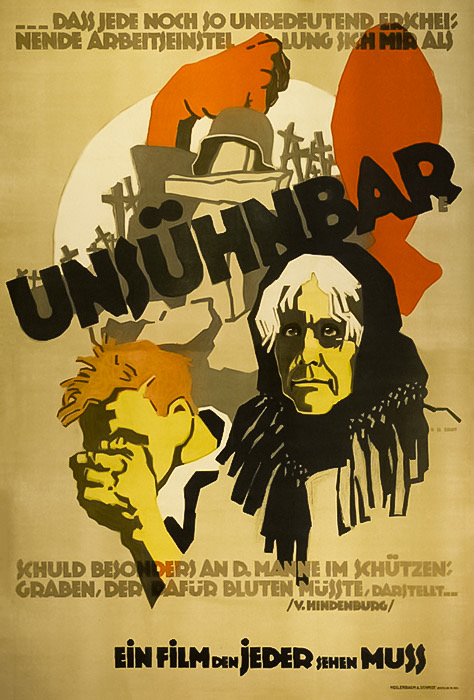
Imagine celluloid soaked in brackish water; that is the texture of Unsühnbar minutes after the opening iris-in. Hans Brennert, writing with the same quill he once used to indict aristocratic decadence in The Three of Us, refuses to let the audience settle. Instead he weaponises silence: the first dialogue arrives at the four-minute mark, and when it does—Diercks whispering “Er ist wieder da” to no one in particular—the subtitle feels redundant; the terror is already nesting under your clavicle.
Cinematographer Willy Gildemeister floods the frame with a sodium glow that borders on jaundice. Every interior looks feverish, as though the house contracted trench-flu in 1918 and never fully recovered. Note the wallpaper: cabbage-rose patterns bruised by damp, their petals sagging like tired eyelids. You can almost smell mould blooming through the nitrate.
II. Grete Diercks: Marble Statue with a Hairline Fracture
Modern viewers, nursed on naturalistic acting, may misread Diercks’ performance as stilted. Resist the reflex. Her rigidity is a deliberate mortis; she moves like someone who has already been embalmed by grief. Watch her hands during the séance scene—fingers splayed as if gripping an invisible throat—then compare the subtle tremor in her left pinkie when the bricklayer brushes past. That microscopic twitch is the performance; everything else is a mausoleum.
Cinephiles hunting for intertextual breadcrumbs will recall The Glory of Yolanda, where the heroine’s radiance was suffocated by societal laces. Diercks inverts the formula: her radiance has long since bled out; only the laces remain.
III. Adele Sandrock: Matron, Martyr, Monster
Sandrock, 53 at the time of shooting, carries the angular severity of a New Testament prophetess carved into a ship’s prow. Brennert gives her lines that feel like psalms recited backwards—“Blessed are the merciless, for they shall be forged in mercy’s absence.” She delivers them without blinking, pupils dilated like someone staring into a solar eclipse of guilt.
The erotic charge between housekeeper and mistress is never declared, yet every frame vibrates with it. When Sandrock laces Diercks into her mourning corset, the camera lingers on the eyelets tightening, skin swelling over whalebone. A fraction slower and the sequence would collapse into exploitation; a fraction faster and the subtext would evaporate. Brennert nails the tempo, then pans to a mirror where both women’s reflections overlap—two mourning widows fused into a single, hydra-headed Fury.
IV. Johannes Müller: Bricklayer as Angel of Annunciation
Müller, better known for swashbuckling in Richard the Brazen, strips away bravado to play a man whose shoulders carry kilotons of unspoken culpability. His tool belt clinks like spurs, yet he walks as if perpetually kneeling. The screenplay denies him a backstory; instead we read his history through calloused palms slapped against wet mortar. Each swipe repairs the hearth, but also entombs evidence: a scorched locket, a molar still crowned with gold. He is both saviour and sin-eater, and when he finally confronts Diercks in the third act, the dialogue is mercilessly sparse.
DIERCKS: “Can stone forgive?”
MÜLLER: “Stone remembers. That is why it cracks.”
The line drew nervous titters at the 1923 Berlin première—viewers thought it a gag. By 1946, after the rubble of Cologne, the same line would be quoted in occupation newspapers as epitaph for an entire civilisation.
V. Toni Zimmerer: Fiddler of the Apocalypse
Zimmerer’s character arrives announced only by music—a repetitive motif in Phrygian mode that climbs, stalls, plummets. His violin substitutes for a Greek chorus, warning, lamenting, mocking. In the silent era, such leitmotifs risked cliché; yet Zimmerer’s frantic glissandi sync perfectly with the film’s accelerating montage. During the climax, as the mansion’s ballroom ignites (don’t ask how—Brennert stages combustion like a fever dream), the fiddler keeps playing, eyebrows singed, strings screeching into dissonance. The image cements Unsühnbar’s thesis: art does not halt calamity; it merely annotates it.
VI. Weimar Context: When the Republic Still Breathed
Historical hindsight tempts us to read every 1923 German film as omen of National-Socialist horror. Unsühnbar resists such teleology. Its dread is intimate, domestic, matriarchal. Yet the shadows it casts are unmistakably proto-fascist: the obsession with purity, the fear of contamination, the scapegoating of unseen enemies. Brennert, a left-leaning pacifist, claimed in a lost Lichtbild-Bühne interview that he wanted to “x-ray the marrow of guilt, not wave flags.” Still, when the house finally collapses, one thinks of the fractured republic, of street battles in Hamburg, of seeds being sown.
Compare the film’s finale to that of De Voortrekkers, where the sun sets on reconciliation. Unsühnbar offers no such balm; its last shot freezes on a half-built wall, trowel stuck upright like a crucifix in calvary clay. The camera pulls back, snow falls, fade to black. No iris-out, no card, no “The End.” The audience, breathing hard, understood the narrative would seep into their own night.
VII. Censorship & Lost Footage
The film was butchered almost immediately. Regional boards trimmed close-ups of the child’s shoe, arguing the imagery “excited morbid self-accusation in mothers.” A 1926 American release, retitled Unpardonable Sin, inserted English flash cards that moralised the story into a cautionary tale against Bolshevism—an ideological somersault that would be comedic if not for the lost 14 minutes. Scholars still hunt the excised reel; only two production stills survive, both showing Sandrock cradling a bundle that might be a child, or merely linen. The ambiguity is itself a censor’s wound.
VIII. Sound of Silence: Contemporary Score Recommendations
If you’re lucky enough to catch a 35 mm print at Filmmuseum München, expect a live trio. Ask for something spectral—perhaps a recombination of Hauschka’s prepared-piano and Hildur Guðnadóttir’s halos. Avoid orchestras that swell triumphally; triumph is treason to this film’s DNA.
IX. Legacy & Afterlife
Unsühnbar never spawned sequels, only echoes. You can trace its DNA in Bergman’s Cries and Whispers, in Haneke’s The White Ribbon, even in the creeping domestic horror of Memoria dell'altro. Yet the film remains commercially unavailable on Blu-ray; a 2006 VHS rip circulates among torrent archivels, watermarked with East German TV logos. Each generation rediscovers it like a half-remembered sin, and that feels apt—guilt, after all, is a hereditary disease.
Grete Diercks retired from acting in 1931, citing “the camera’s gaze grew heavier than any spouse.” She died in 1944 during an air-raid, sheltering beneath the very marble balustrade that features in the film’s penultimate scene. Adele Sandrock fled to Switzerland, where she reportedly watched Allied bombers reflect in Lake Zurich like fireflies of atonement. Johannes Müller became a character actor under Goebbels’ studio, a decision that stained his legacy beyond detergent. Toni Zimmerer vanished—some say into the Spanish Civil War, guitar slung like a rifle.
X. Final Projection
Great films do not merely entertain; they testify. Unsühnbar testifies that some crimes calcify, becoming structural, load-bearing. You can brick them over, repaint the parlour, invite new tenants, yet on windless nights the mortar still whistles with the breath of those immured. Watch it, not for nostalgia, but for warning: forgiveness is architecture, not theology, and some blueprints are drawn without doors.
If this review feels overwrought, good. The picture demands it. Anything less would be—well—unpardonable.
IMDb —
1926
Community
Log in to comment.