DbcultAccessing Vault...
Cult Review
Senior Film Conservator
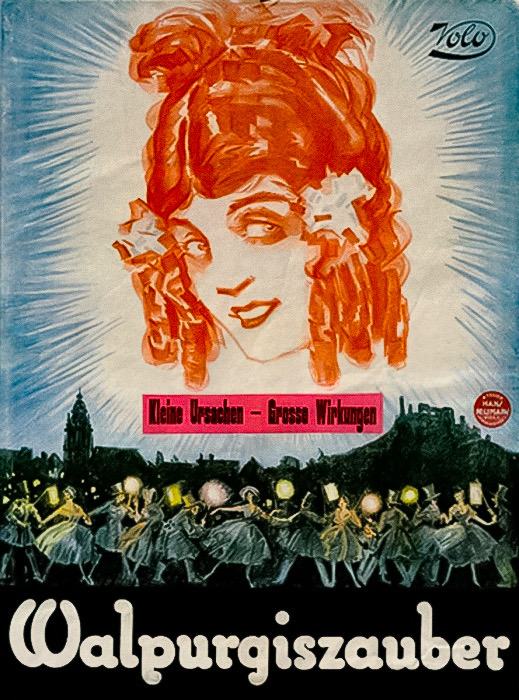
The silent era of the 1920s was not merely a period of technical gestation; it was a fever dream of visual storytelling that reached its zenith in the mystical landscapes of Central European cinema.
Hans Steinhoff’s Walpurgiszauber (1923) stands as a monumental, if occasionally overlooked, pillar of this evocative epoch. To view this film today is to step into a time capsule where the grain of the celluloid serves as a mist through which the ghosts of the past dance. Unlike the industrial precision we see in contemporary pedagogical shorts like How Animated Cartoons Are Made, Steinhoff’s work is an organic, breathing entity, pulsating with the rhythms of the earth and the erratic heartbeat of human desire.
The cinematography in Walpurgiszauber is nothing short of revolutionary for its time. The way Steinhoff and his camera crew capture the rugged terrain of the Harz Mountains suggests a visual kinship with the experimental framing found in The Mystery of the Rocks of Kador. There is a deliberate use of light to define the moral and spiritual boundaries of the characters. Lilly Marischka, whose screen presence is both fragile and formidable, is often bathed in a soft, diffused glow that contrasts sharply with the jagged, high-contrast shadows of the mountain peaks.
This interplay of light is not merely aesthetic; it is ontological. As the characters ascend the mountain toward the inevitable Walpurgis night, the lighting becomes more erratic, mirroring the psychological disintegration of the protagonists. In this regard, the film shares a thematic DNA with Resurrezione, where the external environment reflects the internal state of spiritual upheaval. However, where other films might lean into melodrama, Steinhoff maintains a certain distance, allowing the folklore to speak for itself.
Lilly Marischka’s performance is a masterclass in silent expressionism. In an age where many actors relied on broad, theatrical gestures—often seen in more populist fare like The Misleading Lady (1920)—Marischka utilizes her eyes and the subtle tilt of her head to convey a labyrinth of emotion. She embodies the 'magic' of the title, not as a sorceress of cliché, but as a vessel for the inexplicable. Hermann Benke, as the foil to her ethereal energy, provides a performance of stoic desperation. His character represents the 'old world'—a man of science and structure who finds himself utterly ill-equipped to handle the irrationality of the mountain’s call.
The chemistry between them is fraught with a tension that transcends the screen. It is a dance of attraction and repulsion that reminds one of the complex social dynamics explored in Hans hustrus förflutna. Yet, in Walpurgiszauber, the stakes are not merely social; they are existential. The characters are not just hiding secrets; they are being consumed by them.
When we look at the cinematic landscape of the early 1920s, the diversity of output is staggering. While Treasure Island sought to capture the spirit of maritime adventure, and Mama's Cowpuncher offered a more rugged, Western sensibility, Walpurgiszauber delved into the deep, dark well of European mythos. It possesses a gravitas that is perhaps only matched by the historical scale of Giuliano l'apostata, though Steinhoff’s focus is more intimate, more focused on the soul than the empire.
The pacing of the film is deliberate, eschewing the rapid-fire editing of modern cinema for a more rhythmic, almost hypnotic flow. This is a far cry from the brevity and levity of Wet and Weary or the social vignettes of R.S.V.P.. Instead, Steinhoff demands the viewer's absolute presence. He invites us to linger on a shot of the wind moving through the trees, or the way a candle flame flickers in a drafty hallway, suggesting that these small details are the true conduits of the narrative.
At its core, Walpurgiszauber is a film about the struggle to find meaning in a world that has been torn asunder. Much like the characters in Rebuilding Broken Lives, the figures in Steinhoff’s world are searching for a sense of wholeness. The 'magic' they seek on the Brocken is a desperate attempt to reconnect with something primal, something that hasn't been touched by the industrial carnage of the preceding decade. It is a search for A Taste of Life in a landscape that feels increasingly sterile.
The film’s exploration of the 'foreigner' or the 'newcomer' in a tight-knit, superstitious community also mirrors the themes found in New Folks in Town. There is a palpable sense of xenophobia and fear of the 'other' that permeates the village scenes, creating a claustrophobic atmosphere that only the mountain peaks can alleviate. This tension between the communal and the individual is a recurring motif in Steinhoff’s early work, and it is executed here with surgical precision.

The lack of spoken dialogue in Walpurgiszauber is not a limitation; it is its greatest strength. The intertitles are poetic and sparse, acting as signposts rather than crutches. This allows the visual language—the 'magic'—to take center stage. The film’s ability to convey complex emotional arcs through purely visual means is a testament to the sophistication of the 1923 cinematic audience. It reminds us that cinema, in its purest form, is a visual medium that speaks to the subconscious.
In comparing this to the narrative sweep of Vingt ans après, we see two different approaches to the passage of time. While the latter focuses on the linear progression of history and character, Walpurgiszauber feels cyclical, almost timeless. It exists in a perpetual 'now', where the past is always present, and the future is a looming, uncertain shadow. This sense of emotional momentum is also found in Der Zug des Herzens, where the 'train of the heart' moves with an unstoppable, if tragic, force.
As the final frames of Walpurgiszauber flicker and fade, the viewer is left with a profound sense of melancholy. The 'magic' has been witnessed, but at what cost? The film does not offer easy answers or a comfortable resolution. Instead, it leaves us in the same state as its protagonists: standing on the edge of a precipice, looking out into the dark, wondering what lies beyond the next ridge.
In the grand tapestry of silent cinema, this film is a thread of deep crimson and midnight blue. It is a work of immense courage and visual audacity. It challenges the viewer to look beyond the surface of the image and engage with the deeper, more primal currents of the human psyche. To ignore Walpurgiszauber is to ignore a vital piece of the cinematic puzzle—a film that captures the soul of an era and the enduring power of myth.
Ultimately, Steinhoff has crafted a work that remains as hauntingly relevant today as it was a century ago. It is a reminder that while technology may change, the human fascination with the unknown, the mystical, and the transformative power of the night remains eternal. This is not just a film; it is an incantation.

IMDb —
1928
Community
Log in to comment.