DbcultAccessing Vault...
Cult Review
Senior Film Conservator
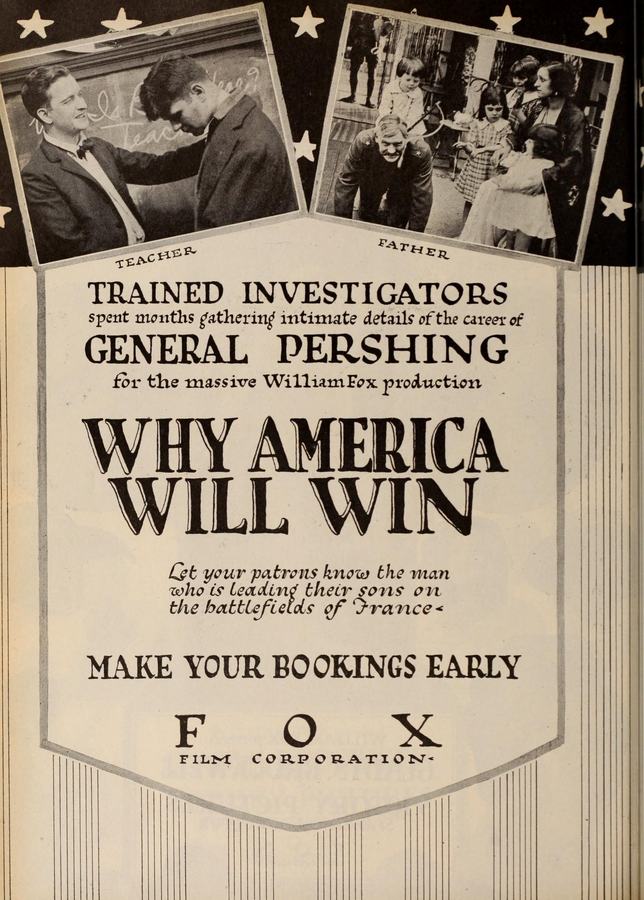
To view Richard Stanton's 1918 magnum opus, Why America Will Win, is to step into a time capsule where the flickering celluloid serves as both a weapon of war and a testament to national identity. This isn't merely a motion picture; it is a rhythmic, visual manifestation of the American spirit during one of the most precarious moments of the twentieth century. While contemporary audiences might initially dismiss it as mere propaganda, such a reductive view ignores the sophisticated narrative architecture Adrian Johnson employed to humanize a figure who, at the time, was more monument than man.
The film operates on a dual plane: the grand historical sweep of the Great War and the intimate, often agonizing, development of John J. Pershing. In an era where the medium was still discovering its grammar, Stanton utilizes a pacing that feels remarkably modern. The transition from the idyllic Missouri landscapes to the disciplined, almost sterile environment of West Point creates a visual dichotomy that underscores the protagonist’s evolution from civilian innocence to military precision. It’s a thematic resonance often missed in other contemporary works like Lille Teddy, which focused on far more parochial concerns.
Henry Warwick’s portrayal of Pershing is a masterclass in silent-era restraint. In a period often characterized by histrionic gestures and exaggerated facial expressions, Warwick opts for a stillness that commands the frame. He occupies the screen with a gravity that suggests the weight of millions of lives resting upon his epaulets. This performance provides a fascinating counterpoint to the more emotionally volatile characters found in Fatal orgullo, where the drama is worn on the sleeve rather than held in the jaw.
The casting of Harris Gordon and Johnny Hennessey as the younger iterations of Pershing allows for a cohesive character arc that feels earned. We see the seeds of leadership planted early, not through dialogue, but through action and interaction. The scenes involving the Apache campaigns and the Moro Rebellion are staged with a verisimilitude that, while colored by the era’s perspectives, showcases a technical ambition rarely seen in the 1910s. The cinematography captures the vastness of the American frontier and the claustrophobic tension of jungle warfare with equal dexterity, a feat that rivals the scenic documentation found in California Scrap Book.
Perhaps the most poignant segment of the film deals with the 1915 fire at the Presidio, which claimed the lives of Pershing’s wife and three daughters. Stanton handles this with a surprising degree of sensitivity, avoiding the maudlin traps that ensnared films like The Victory of Virtue. Instead, the tragedy is presented as a transformative fire—a crucible that leaves Pershing with nothing but his duty and his country. This personal devastation is framed as the ultimate sacrifice, positioning his subsequent command in France not just as a strategic assignment, but as a redemptive mission.
The narrative then pivots to the "ruthless Hun," a common trope of the time, yet here it is given a specific edge. The conflict is personalized. The war in Europe is not just a clash of empires; it is a battle for the very soul of civilization, a theme echoed in the grandiose staging of The Life of Our Saviour; or, The Passion Play. The film argues that America will win because its leader has already survived the worst that life can offer; he is an immovable object against the Teutonic force.
Technically, Why America Will Win is a marvel of its age. Adrian Johnson’s script utilizes title cards that are more than just dialogue placeholders; they are rhetorical devices that guide the viewer’s emotional response. The editing, particularly in the battle sequences, creates a sense of forward momentum that is almost exhausting. It lacks the domestic stasis of The Dazzling Miss Davison, opting instead for a kinetic energy that mirrors the industrial might of a nation mobilizing for war.
The use of actual military footage interspersed with staged drama creates a proto-documentary feel. This blend of reality and fiction serves to ground the hagiography in the tangible world. When we see Pershing on the screen, we are seeing the man who was, at that very moment, making the decisions that would define the twentieth century. It is a level of immediate relevance that Brigadier Gerard could only hope to achieve through historical distance.
When comparing this work to other patriotic biopics like Betsy Ross, one notices a distinct shift in the portrayal of American heroism. While Betsy Ross looks back at the foundational myths of the revolution, Why America Will Win is forward-looking. It is an assertion of current power. It shares more DNA with the ideological fervor of The Revolutionist, though its goals are restoration and order rather than upheaval.
Furthermore, the film’s exploration of the "personal account to settle" provides a grit that is often missing from the more sentimental war narratives like The Little Yank. Pershing is not a wide-eyed soldier looking for glory; he is a professional, a builder of military infrastructure much like the protagonist in The Builder of Bridges. His victory is calculated, logical, and inevitable.
In the final act, the film focuses on the American forces in France. The scale is immense. We see the result of the discipline instilled in the earlier Missouri and West Point sequences. The film successfully argues that the character of the leader dictates the character of the army. This moral alignment is a recurring theme in silent cinema, often explored in a domestic context in films like Happiness of Three Women, but here it is writ large on the global stage.
The "ruthless Hun" is portrayed with the necessary villainy to justify the scale of the American response, yet the film remains focused on Pershing’s resolve. The cinematography during the trench sequences captures a claustrophobia that contrasts sharply with the open Missouri plains of the first act. This visual journey—from light to dark, from open space to the constricted reality of modern warfare—mirrors the loss of innocence for both the man and his country. It avoids the simplistic morality of Boston Blackie's Little Pal, opting instead for a narrative of grim necessity.
Ultimately, Why America Will Win is a fascinating artifact that occupies the intersection of art, history, and propaganda. It is a film that understands the power of the image to shape public perception. By the time the final frames roll, the viewer is left with an indelible image of Pershing as the personification of American resilience. The film doesn't just ask why America will win; it provides a comprehensive, multi-decade answer through the life of a single man.
Unlike The Silent Partner, which explores the quiet machinations of power, this film is loud, proud, and unapologetic. It is a stentorian blast of cinematic energy that remains essential viewing for anyone interested in the history of the medium or the psychology of a nation at war. The performances, the direction, and the sheer scope of the production make it a landmark of 1918 cinema. It stands alongside Herod in its attempt to capture the epic scale of historical figures, yet it feels infinitely more grounded in the immediate pulse of its time.
As we look back over a century later, the film’s techniques—the cross-cutting, the use of archival footage, the psychological depth of its protagonist—reveal a sophistication that paved the way for the future of the biopic. It is a stern, beautiful, and occasionally harrowing journey through the life of a man who became a symbol. In the end, the film suggests that victory is not just about firepower, but about the iron will of those who lead. It is a message that remains as potent today as it was when the first audiences sat in the dark, watching the story of Pershing unfold.
"A cinematic triumph of the silent era, Stanton's work is a visceral exploration of the martial spirit and the personal sacrifices that define the corridors of power."
IMDb —
1936
Community
Log in to comment.