DbcultAccessing Vault...
Cult Review
Senior Film Conservator
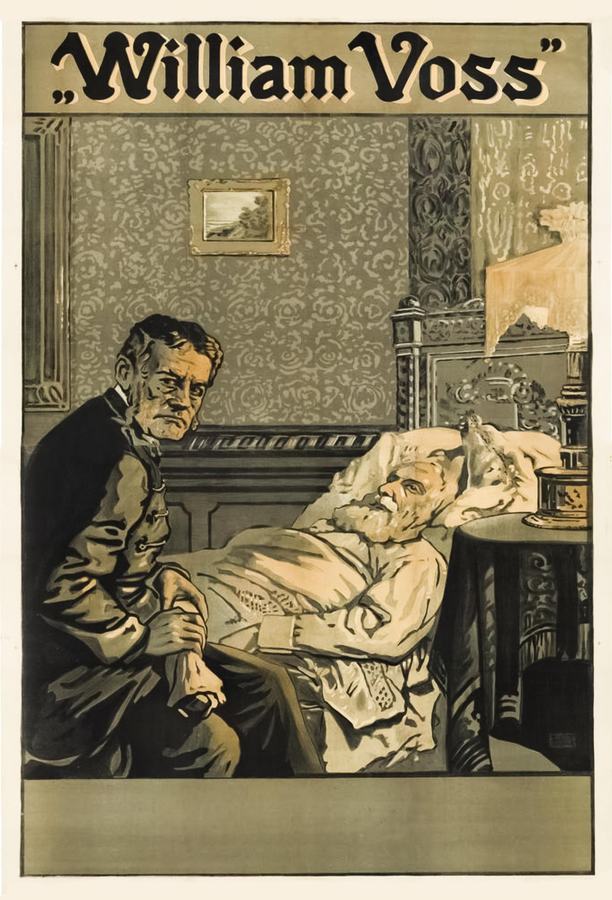
In the annals of early cinematic history, where the flickering images told stories with an eloquence often lost in the clamor of sound, certain films emerge as more than mere entertainment; they become cultural artifacts, windows into a bygone era's anxieties and aspirations. Rudolf Meinert's 'William Voß. Der Millionendieb' stands as one such fascinating relic, a silent crime drama that, despite the passage of time, retains a compelling power, a testament to the universal allure of the master criminal and the relentless pursuit of justice. To truly appreciate this film, one must strip away modern sensibilities and immerse oneself in the visual poetry and dramatic intensity that defined the German silent era.
At its core, 'William Voß. Der Millionendieb' is a thrilling exploration of a criminal mastermind, a figure whose very name conjures images of daring and defiance. William Voß, brought to life with an almost hypnotic intensity by Victor Colani, is not merely a thief; he is an architect of elaborate schemes, a phantom who glides through the upper echelons of society, leaving a trail of meticulously executed heists and bewildered authorities in his wake. The narrative, crafted by Rudolf Meinert and Ladislaus Turszinsky, unfolds with a precision that belies the inherent chaos of its subject matter. Each robbery is less an act of violence and more a chess move, a calculated maneuver on a grand board where the stakes are reputation, fortune, and freedom.
The film excels in building suspense through its visual storytelling. Without dialogue, the burden of conveying intricate plots falls entirely upon the actors' expressions, the set design, and the editing. Meinert, a director known for his keen eye for detail and dramatic staging, masterfully uses these elements to draw the audience into Voß's world. We witness the meticulous planning, the audacious execution, and the subsequent frantic efforts of the police, led by Karl Thiemann's perpetually exasperated detective, to apprehend the elusive thief. The pacing is a delicate balance, alternating between moments of quiet, tense preparation and bursts of dynamic action, a rhythm that keeps the viewer perpetually on edge. The film’s ability to sustain this tension over its considerable runtime is a testament to its directorial prowess and the strength of its narrative backbone.
The performances in 'William Voß. Der Millionendieb' are a masterclass in silent-era acting, relying heavily on gesture, posture, and the subtle nuances of facial expression. Victor Colani, in the titular role, is nothing short of captivating. He imbues William Voß with an elegant menace, a suavity that makes him both villain and anti-hero. Colani's Voß is not a brute force criminal; he's an intellectual, a charmer, a man who understands the psychology of his victims and his pursuers alike. His eyes, often gleaming with a mixture of cunning and amusement, convey more than a thousand words ever could. It’s a performance that demands attention, a magnetic presence that anchors the entire film.
Opposite Colani, Karl Thiemann delivers a compelling portrayal of the dogged detective, a man whose life becomes inextricably linked with the capture of Voß. Thiemann's character arc is one of escalating frustration and growing obsession. His furrowed brow, his exasperated gestures, and his moments of quiet contemplation effectively communicate the mental toll of chasing a ghost. The silent battle of wits between Colani's smooth criminal and Thiemann's relentless investigator forms the dramatic spine of the film, elevating it beyond a simple crime story to a psychological thriller. The supporting cast, including Emil Wittig, Leopold Bauer, Herr. Strahl, and Theodor Burghardt, provide crucial texture to the film's world. Their reactions, whether of fear, awe, or indignation, serve to amplify the impact of Voß's actions and ground the fantastical elements of the plot in a believable social context. Each actor, through their distinct mannerisms and visual cues, contributes to the rich tapestry of early 20th-century German society, creating a vibrant backdrop against which the central drama unfolds.
Rudolf Meinert's direction is a study in visual sophistication. The film predates the full blossoming of German Expressionism, yet it contains nascent elements of that movement's shadowy aesthetic and psychological depth. Meinert utilizes stark contrasts of light and shadow, particularly in scenes depicting Voß's clandestine activities, to create an atmosphere of mystery and danger. The camera work, while perhaps not as overtly experimental as later Expressionist masterpieces, is remarkably fluid and expressive for its time. Close-ups are employed judiciously to highlight key emotional moments or crucial details, drawing the audience deeper into the characters' inner worlds. Long shots establish the grandeur of Voß's targets and the sprawling urban landscape that serves as his playground.
The set designs are equally impressive, meticulously crafted to convey both opulence and vulnerability. From the glittering interiors of banks and mansions to the grimy back alleys where secrets are whispered, every detail serves a purpose, enhancing the film's immersive quality. The use of props, such as Voß's ingenious tools or the tell-tale clues left behind, are integrated seamlessly into the narrative, functioning as visual shorthand in the absence of spoken dialogue. Meinert understands that in silent cinema, every frame must tell a story, and he ensures that 'William Voß. Der Millionendieb' is a feast for the eyes, a ballet of movement and emotion rendered in monochrome.
To fully grasp the significance of 'William Voß. Der Millionendieb,' it's helpful to consider it within the broader context of early cinema. The fascination with master criminals was a popular theme, tapping into societal anxieties about wealth disparity and the perceived breakdown of order. One might draw parallels, though perhaps distant, to films like By Power of Attorney, which also delves into the intricacies of legal and criminal maneuvers, albeit with a different focus. However, 'Der Millionendieb' distinguishes itself through its embrace of the charismatic anti-hero, a figure who challenges the audience to question their own moral compass. The film's emphasis on cleverness over brute force also sets it apart from more straightforward action-adventure narratives.
The 'million' theme itself was not uncommon; films like Der Millionenonkel explored the allure and perils of sudden wealth, albeit from a comedic or dramatic perspective rather than a criminal one. What 'William Voß' achieves is a sophisticated blend of suspense and character study, foreshadowing later, more complex portrayals of anti-heroes in cinema. It’s a film that understands the psychological underpinnings of crime, the thrill of the chase, and the peculiar magnetism of a figure who operates outside the conventional bounds of society. While not as overtly political as some of its contemporaries, the film subtly critiques the systems that create both immense wealth and the desire to subvert it.
The script by Meinert and Turszinsky, even without spoken dialogue, manages to convey a rich tapestry of motivations and conflicts. Their understanding of dramatic structure and character development is evident in the film's sustained engagement. This collaborative effort between a visionary director and astute writers results in a film that feels both grand in scope and intimate in its character focus. It's a testament to the power of pure visual storytelling, where every gesture, every glance, and every carefully placed object carries narrative weight. The film avoids the melodramatic excesses that sometimes plagued early cinema, instead opting for a more restrained yet impactful approach that allows the audience to project their own interpretations onto the silent drama unfolding before them.
'William Voß. Der Millionendieb' is more than just a historical curiosity; it is a vital piece of cinematic heritage that deserves renewed attention. Its influence, though perhaps not as overtly celebrated as that of later Expressionist works, can be seen in the development of the crime genre, particularly in its emphasis on the intellectual duel between criminal and detective. The film's ability to craft a compelling narrative purely through visual means serves as a powerful reminder of cinema's fundamental strengths. It challenges modern viewers to engage with film on a different level, to appreciate the artistry of silent acting and direction, and to find meaning in the absence of spoken words.
Beyond its technical merits, the film offers a timeless exploration of themes: the allure of forbidden wealth, the thrill of outwitting authority, and the complex motivations that drive individuals to transgress societal norms. Voß is a character who resonates because he embodies a certain fantasy of freedom and power, a figure who refuses to be constrained by conventional limitations. His story, despite its criminal premise, taps into a universal desire for agency and self-determination. The tension between Voß's audacity and the detective's unwavering resolve creates a dynamic that remains eternally fascinating, a dance between order and chaos that continues to captivate audiences across generations. While other films of its era, such as The Curious Conduct of Judge Legarde, might explore legal intricacies, 'William Voß' leans into the sheer spectacle of the heist and the personality cult of the criminal.
In a world saturated with special effects and rapid-fire dialogue, 'William Voß. Der Millionendieb' provides a refreshing counterpoint, a film that demands patience and rewards close observation. It is a testament to the enduring power of storytelling, a reminder that the most compelling narratives often lie in the subtle interplay of light and shadow, the expressive gaze of an actor, and the universal language of human emotion. Rudolf Meinert's vision, combined with the talents of Victor Colani, Karl Thiemann, and the entire production team, forged a film that, even a century later, continues to steal our attention and captivate our imagination, proving that true cinematic genius transcends the limitations of its medium.

IMDb 6.8
1929
Community
Log in to comment.