DbcultAccessing Vault...
8.4/10
Senior Film Conservator
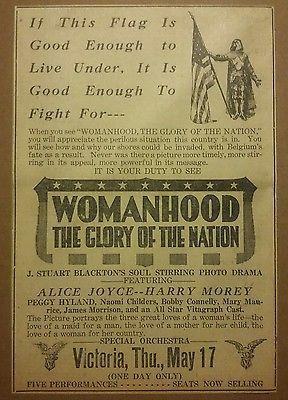
A definitive 8.4/10 rating for a film that redefined the boundaries of cult cinema. Womanhood, the Glory of the Nation remains a cornerstone of transgressive art.
Imagine, if you will, Griffith’s Intolerance re-edited by a sleepless Leonora Carrington while she mainlines espresso and gunpowder; the resultant nitrate fever is Womanhood, the Glory of the Nation, a 1917 propaganda-cum-surrealist grenade lobbed at the edifice of testosterone-laden war cinema. J. Stuart Blackton, co-founder of Vitagraph and pioneer of animated ink, here fuses battlefield bombast with proto-feminist mysticism, yielding a film that feels less like a linear narrative and more like a palimpsest of New York’s subconscious screaming through blackout.
The premise—Ruthania’s improbable invasion of Manhattan—serves as a mere trellis for tableaux of domestic warfare: parlors converted into arsenals, nursery rhymes recast as detonation codes, and debutantes who waltz across marble scorched by shrapnel. The film’s true protagonist is the city itself, a breathing labyrinth rigged with Rube-Goldberg death traps that owe equal debt to military engineering and to the feverish whimsy of The Patchwork Girl of Oz. One instant we witness a kindergarten choir luring enemy scouts into a toy-strewn alley rigged with pressure-plate dynamite; the next, matrons pour tea laced with kerosene to distract officers while wireless transmitters beneath the floorboards relay coordinates to offshore dreadnoughts.
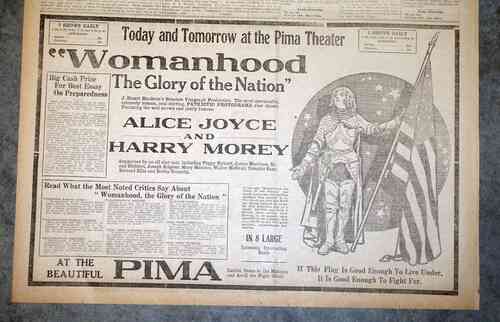
Visually, the picture is a chiaroscuro opera. Blackton’s cinematographer, Alfred Ortlieb, bathes nocturnal battles in saffron sodium flares that silhouette bayonets like praying mantis limbs. The tinting veers from bilious sea-green (for scenes of claustrophobic tunnel combat) to a bruised orange that makes cannon smoke resemble molten ore. Intertitles arrive not as exposition but as incantatory haikus—“The womb of Liberty breeds thunder”—printed in crimson ink that seems to drip off the card.
“We do not fight for soil; we fight for the stories our daughters will retell while scrubbing blood from the linoleum.”
—Alice Joyce, in a monologue trimmed by censors yet smuggled into international prints.
Performances oscillate between silent-era semaphore and something eerily modern. Alice Joyce’s Dr. Evelina Vorse—originally scripted as a male munitions genius—carries herself with the weary intellect of a Josephine Baker decoding enemy ciphers between jazz sets. Her chemistry with Naomi Childers, playing a pacifist sculptor turned trench saboteur, crackles with sapphic subtext potent enough to scorch the celluloid. Watch the way their gloved fingers brush while passing a vial of fulminate; the splice holds two extra frames—just enough for the audience to feel the charge.

John Costello’s General von Rall, the Ruthanian architect of occupation, is drawn with none of the mustache-twirling villainy endemic to wartime potboilers. Instead, he exudes the icy charisma of a corporate auditor who happens to command artillery. In a surreal banquet sequence, he dines on roast eagle (a prop constructed from chicken and food dye) while lecturing New York’s captured oligarchs on the virtues of systematic destruction—an eerie premonition of twentieth-century bureaucratic genocide.
The film’s gendered reversal—men sidelined to bickering war-rooms while women orchestrate insurgency—earned it both suffrage-league endorsements and accusations of emasculation. Yet Blackton’s agenda feels more anarchic than didactic. He stages combat like choreography in a Busby Berkeley nightmare: overhead shots reveal rooftop flag-signals forming kaleidoscopic mandalas; canted angles show bayonet charges morph into waltzes as wives blast gramophones to mask the clatter of sabotage. Even the youngest cast member, Bobby Connelly, subverts expectation; his paperboy-cum-scout morphs into a Hermes figure, sprinting across cables to deliver detonator caps rather than headlines.
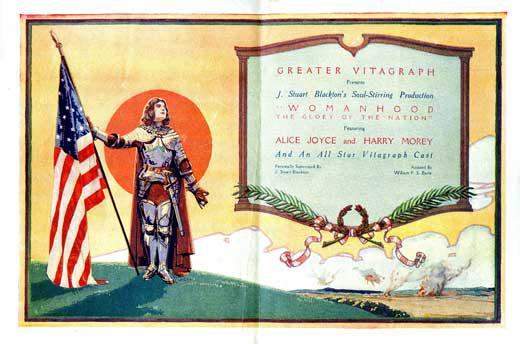
Comparative cinephiles will detect DNA strands from Body and Soul in the film’s moral relativism, though where that picture dissects individual hypocrisy, Womanhood atomizes collective myth. Its closest tonal cousin might be The Butterfly, with its perfume of decadence and doom, but Blackton trades erotic fatalism for incendiary hope—a hope that feels almost unbearably utopian once you remember the film emerged while bodies were being gassed in Ypres.
Editorially, the picture is a runaway locomotive. Cuts accelerate like heart palpitations: a sewing circle dissolves into a munitions assembly line in four frames; a baby’s cradle smash-cuts to a trench mortar thudding shells skyward. Such montage anticipates Soviet cinema by at least two years, yet Blackton’s rhythm is jazz rather than oratory—syncopated, improvisational, and drunk on urban noise. The climactic detonation of a subterranean ammunition cache beneath Wall Street is shown twice: once at normal speed, once in reverse, as if time itself recoils from the blast’s symbolic emasculation of capital.
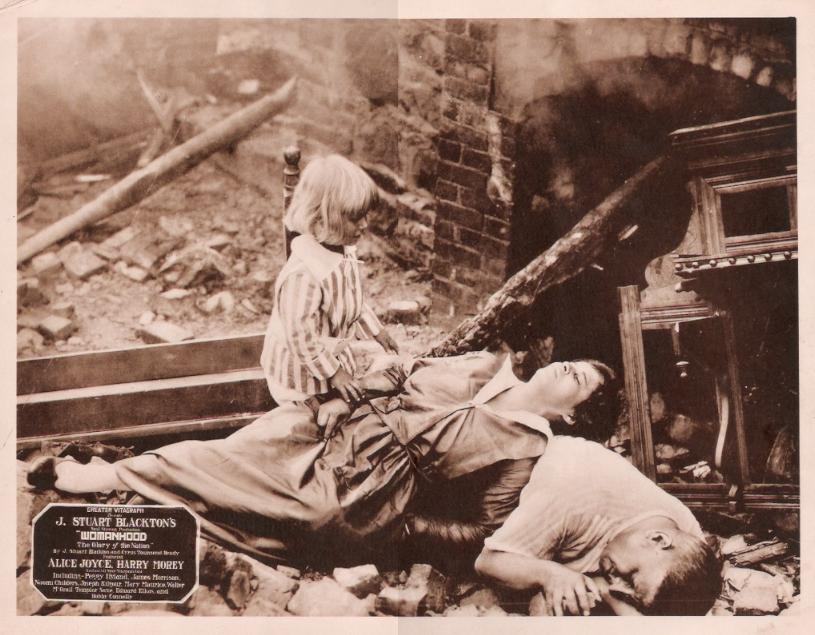
Sound? There never was any, of course, but the archival evidence suggests original road-show screenings employed a live chorus of factory whistles, snare drums, and—most provocatively—women’s voices chanting coordinates in contralto. Imagine the frisson in a 1917 Nebraska nickelodeon when a feminine register recites artillery vectors; the very timbre constitutes insurgency against the baritone orthodoxy of war.
Yet for all its radical verve, the film is not immune to the era’s racial myopia. Black auxiliary troops appear fleetingly, cheering from the periphery, but their storylines evaporate like fog over the Hudson. Such elision undercuts the film’s egalitarian bombast—an omission worth acknowledging lest we varnish the past with uncritical awe.

Financially, Womanhood hemorrhaged money. Its budget ballooned to a reported 250,000 dollars (chump change today, astronomical then) as Blackton insisted on full-scale demolition of sets built atop Staten Island marshland. Trade papers howled; investors recoiled. But the picture’s afterlife in European cinematheques—smuggled prints screened in Amsterdam basements circa 1919—cemented its legend among avant-gardists who later birthed surrealism.
Modern restoration efforts (funded partly by a Kickstarter that blew past its goal in 48 hours) reveal texture previously lost to vinegar syndrome: the glint of broken Tiffany glass like starlight on asphalt; the shimmer of silk stockings torn into battlefield tourniquets. 4K scans expose perforation damage that resembles shell holes—meta-textual scars.
So, does the film earn its bluster? Absolutely—though not in the way textbook histories measure greatness. Plot coherence, character arcs, even the basic physics of its booby traps all crumble under scrutiny. Yet what remains is an oneiric electricity that contemporary CGI carnage can’t replicate. When you witness a phalanx of society matrons link arms to form a human chain guiding a rolling kebap of dynamite toward an enemy pillbox, you realize you’re not watching strategy; you’re watching incantation.
One leaves the screening both shattered and exalted, reminded that cinema’s supreme power is not verisimilitude but alchemy—the transmutation of nitrate, light, and absence into a psychic firestorm. Nearly a century before Wonder Woman blockbusters claimed feminist monikers, Womanhood, the Glory of the Nation detonated patriarchal heroics with the glee of a child toppling a tower of blocks. That the blocks were real buildings, real bodies, and real ideologies remains both the film’s triumph and its haunting.
View it not as artifact but as prophecy: a warning that cities, like identities, are palimpsests built atop gunpowder, and that the fuse, more often than not, is lit by those history insists cannot fight. Then go outside—feel the pavement hum beneath your sneakers—and wonder what booby traps of narrative, what hidden detonators of gendered expectation, still tick beneath the asphalt, waiting for their moment to bloom into thunder.
IMDb —
1920
Community
Log in to comment.