DbcultAccessing Vault...
Cult Review
Senior Film Conservator
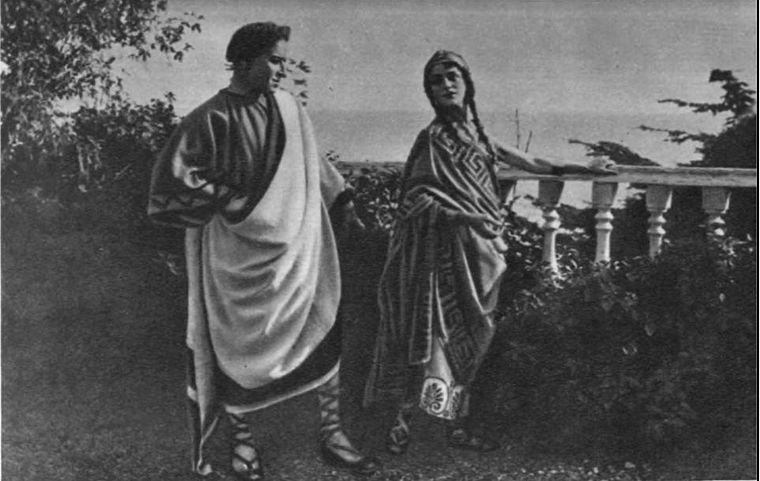
The year 1917 stands as a titanic fissure in the Russian consciousness, a moment when the tectonic plates of history shifted with such violence that the cultural output of the era often feels like a transmission from a vanishing world. Amidst this upheaval, Yulian Otstupnik (Julian the Apostate) emerged not merely as a motion picture, but as a monumental synthesis of literature, philosophy, and the burgeoning grammar of silent cinema. Directed by Vladimir Kasyanov and adapted from the intellectually dense prose of Dmitri Merezhkovsky, the film is a haunting meditation on the death of the old gods and the birth of a new, perhaps more austere, moral order.
To understand the gravitational pull of this film, one must first grapple with Merezhkovsky’s obsession with the dualism of the 'Flesh' and the 'Spirit.' In the character of Julian, the director finds the perfect vessel for this conflict. Julian is a man who seeks to harmonize the aesthetic splendor of Hellenism with the ethical rigor of the soul, yet he is constantly thwarted by the reality of a world that has moved beyond the sun-drenched myths of Olympus. Unlike the more traditional moral dilemmas presented in Grekh, where sin is a personal transgression, the 'sin' in Yulian Otstupnik is historical—the sin of being an anachronism.
The film’s narrative structure is less a linear progression and more a series of theological vignettes. We see Julian, played with a feverish intensity by Ye. Devilier, moving through the halls of power with the weary gait of a philosopher-king. The casting is inspired; Devilier possesses a face that seems etched from the very marble Julian so desperately wishes to reanimate. His performance eschews the broad, pantomimic gestures often found in contemporary works like The Barnstormers, opting instead for a brooding, interiorized stillness that suggests a mind perpetually in dialogue with the divine.
Kasyanov’s visual palette is one of chiaroscuro and decadent shadows. The Roman Empire is presented not as a vibrant civilization, but as a mausoleum of its own past. The sets, while constrained by the technical limitations of 1917, achieve a sense of scale through clever composition and a focus on architectural detail. There is a palpable sense of weight to the costumes and the environments, a far cry from the lighter, more ephemeral settings of Even As You and I. Here, every pillar and every toga feels heavy with the burden of centuries.
The use of light is particularly striking. Julian is often bathed in a harsh, unforgiving glow, symbolizing his desire for the 'sun-god' Helios, while his Christian adversaries are frequently shrouded in the gloom of catacombs and austere churches. This visual dichotomy reinforces the film’s central theme: the struggle between the radiant clarity of the pagan mind and the mystical, often suffocating, darkness of the early Church. It is a conflict that resonates with the same psychological depth found in Værelse Nr. 17, though on a much grander, more civilizational scale.
When we place Yulian Otstupnik alongside its international contemporaries, its unique intellectual rigor becomes even more apparent. While American cinema was often preoccupied with the rugged individualism of The Lone Star Rush or the survivalist narratives of Burning Daylight, the Russian school was exploring the soul's relationship with history itself. The film’s exploration of social and religious hierarchy shares some DNA with the British exploration of social strata in Caste, but Kasyanov elevates the discussion to a metaphysical level.
There is also a fascinating parallel to be drawn with the melodrama of Her Reckoning. In both films, the protagonist is forced to confront the consequences of their ideological choices, though Julian’s 'reckoning' involves the collapse of an entire theological framework rather than a personal scandal. Even the suspenseful elements of the plot, which involve court intrigue and betrayal, feel more substantive than the genre exercises found in Trapped by the London Sharks or the espionage of In the Diplomatic Service.
The ensemble cast brings a necessary texture to this historical tapestry. Illarion Pevtsov delivers a performance of chilling ideological certainty, representing the rising tide of Christianity with a gravitas that makes Julian’s resistance seem all the more futile. The presence of Margerita Froman and A. Nikolaeva adds layers of emotional complexity, highlighting the human cost of Julian’s divine ambitions. Their roles, though secondary to the Emperor’s journey, provide a grounded counterpoint to the film’s loftier philosophical inquiries, much like the grounded reality of A Factory Magdalen provides a foil to its more sensational elements.
The film also manages to capture the sense of a world in flux, a 'human driftwood' (to borrow a title from Human Driftwood) where individuals are swept away by the currents of historical necessity. Whether it is the soldiers in the Persian campaign or the citizens of Antioch, there is a collective sense of anxiety that permeates the background of every scene. This atmospheric dread is perhaps the film’s greatest achievement, reflecting the real-world tensions of 1917 Russia as much as it does the Rome of the 4th century.
As the film moves toward its inevitable, tragic conclusion, the cinematography becomes increasingly bleak. The Persian desert is rendered as a void, a place where Julian’s dreams of a pagan palingenesis are finally buried under the sand. The final moments, where Julian famously (if apocryphally) declares, "Thou hast conquered, O Galilean," are handled with a surprising lack of melodrama. Instead, there is a profound sense of exhaustion. Julian is not so much defeated by a superior deity as he is by the sheer weight of time.
In this regard, Yulian Otstupnik transcends the boundaries of historical epic and enters the realm of the existential. It asks whether beauty can survive in a world that demands utility, and whether the individual can ever truly stand against the tide of collective belief. These are the same questions that haunt the edges of The Desire of the Moth and the moral quandaries of The Inner Shrine, but they are articulated here with a uniquely Russian intensity.
It is a tragedy in itself that such a sophisticated piece of cinema is not more widely recognized in the global canon. Perhaps it is because the film was born at the very moment its culture was being dismantled. Yet, for those who seek it out, Yulian Otstupnik remains a vital, pulsing document of a time when cinema was reaching for the stars of philosophy. It is a film that demands to be seen not just as a relic, but as a living piece of art that continues to speak to our own era of shifting values and crumbling certainties.
In comparison to the more straightforward sentimentality of For barnets skyld, Kasyanov’s work is a difficult, demanding, and ultimately rewarding experience. It is a reminder that even in the infancy of the medium, filmmakers were capable of tackling the most profound questions of human existence. Yulian Otstupnik is a testament to the power of the image to capture the invisible—the death of a god, the birth of an era, and the enduring struggle of the human spirit to find meaning in the ruins of the past.
Final Verdict:
A masterpiece of pre-revolutionary Russian cinema that combines the intellectual depth of Merezhkovsky with the visual flair of Kasyanov. It is an essential viewing for anyone interested in the intersection of philosophy and film, offering a haunting look at the last stand of the pagan world. The performance of Ye. Devilier is a career-defining turn that anchors the film's lofty ambitions in a deeply felt human reality.

IMDb —
1924
Community
Log in to comment.