DbcultAccessing Vault...
Cult Review
Senior Film Conservator
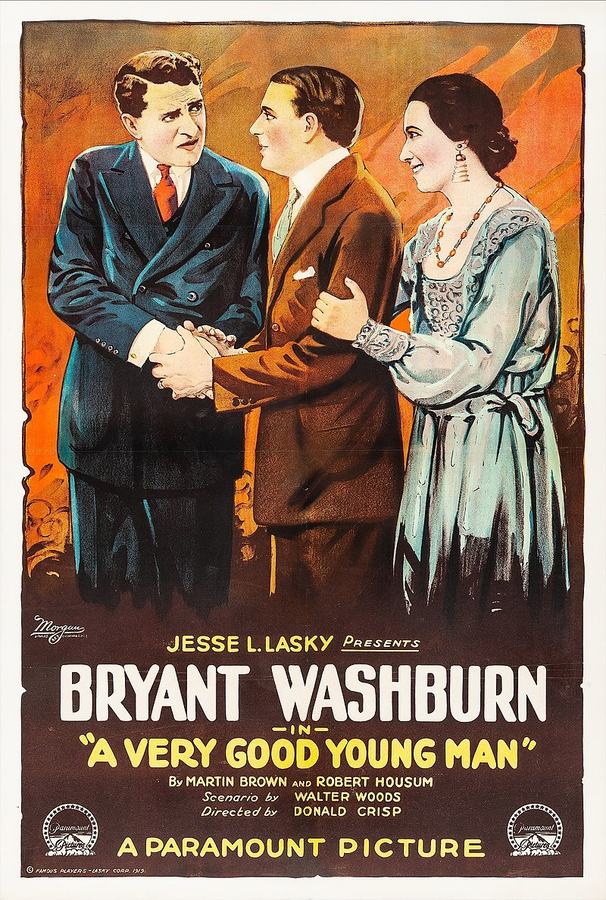
In the shifting sands of 1919 American social mores, where the Victorian hangover collided with the nascent ebullience of the Jazz Age, A Very Good Young Man emerges as a fascinating, if somewhat overlooked, specimen of domestic satire. Directed with a keen eye for situational irony, the film tackles the bizarre notion that a man’s virtue might actually be a liability in the eyes of his intended. Bryant Washburn, an actor whose screen presence often oscillated between the earnest and the frantic, finds here a role that perfectly leverages his capacity for bewildered exasperation. Unlike the high-stakes moralism found in Pilgrim's Progress, this film operates in a lighter, more cynical register, suggesting that the journey toward righteousness is far less complicated than the journey toward a convincing facade of sin.
The central conflict is sparked by Helene Chadwick’s Ruth, a character who embodies a peculiar brand of early 20th-century anxiety. Her insistence that LeRoy 'sow his wild oats' is not an invitation to freedom, but a defensive maneuver. It reflects a cultural distrust of the 'untested' man—a fear that a repressed youth will inevitably lead to a mid-life catastrophe. In this sense, the film shares a thematic DNA with The Cup of Life, where the choices made in one’s formative years dictate the architectural stability of their future happiness. However, while The Cup of Life leans into melodrama, A Very Good Young Man finds humor in the sheer laboriousness of being 'bad' when one is fundamentally 'good.'
The middle act of the film is a masterclass in the comedy of errors. LeRoy’s attempts to engage in 'wild' behavior are hampered by his innate decency. He is a man who cannot help but be polite to the very people he is supposed to be corrupting. This reminds one of the lighthearted chaos in All Night, another Washburn vehicle that explores the absurdities of romantic obligation. As LeRoy traverses the city’s nightlife, the audience is treated to a vivid portrayal of 1919 urban spaces—the cafes, the dimly lit street corners, and the interiors that reflect the transition from ornate traditionalism to a sleeker, more modern aesthetic. The cinematography, while constrained by the technical limits of the era, manages to capture the frantic energy of LeRoy’s mission.
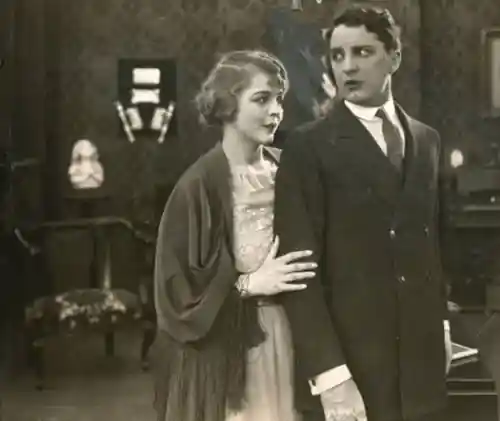
The supporting cast provides a rich tapestry of archetypes that populate LeRoy’s world. Noah Beery, often associated with more menacing roles, brings a grounded presence, while Anna Q. Nilsson adds a layer of sophisticated allure that serves as a foil to Ruth’s more domestic anxieties. The interaction between these characters creates a social ecosystem where everyone is performing a role. This performative aspect of identity is a recurring theme in silent cinema, often seen in more experimental works like La dixième symphonie, though here it is played for laughs rather than tragic resonance. The writers—Walter Woods, Robert Housum, and Martin Brown—deserve credit for a script that avoids the saccharine pitfalls of many contemporary romances, opting instead for a sharper, more observational tone.
There is an undercurrent of gender role subversion that shouldn't be ignored. By having the female lead demand that the male lead behave recklessly, the film flips the traditional script of the woman as the moral guardian. It echoes some of the playful gender-bending found in A Florida Enchantment, albeit in a more subtle, socially acceptable framework. Ruth’s desire for a 'wild' LeRoy is a desire for a man who possesses a certain 'primitive' edge, a theme explored more literally in The Primitive Woman. The irony, of course, is that LeRoy’s true strength lies in his steadfastness, not in his capacity for simulated rebellion.
The pacing of A Very Good Young Man is remarkably brisk. It avoids the lethargic exposition that plagues many films of the late teens. The editing emphasizes the ticking clock—the one-night deadline LeRoy has to ruin his reputation. This temporal pressure creates a sense of urgency that carries the viewer through the various vignettes of his 'night of sin.' While it lacks the sweeping naturalistic grandeur of something like Glacier National Park, its focus on the claustrophobia of social expectation is equally effective. The film understands that the most daunting landscapes are often the ones we navigate within the confines of our own social circles.
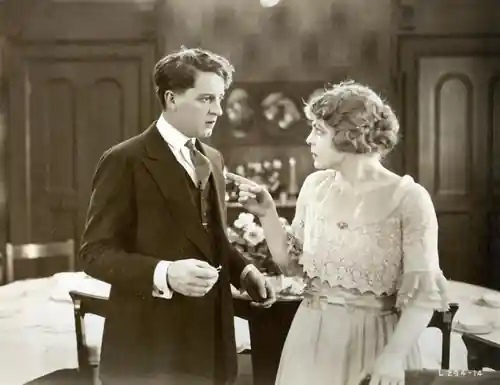
As the night concludes, the film reaches a conclusion that is both satisfying and slightly subversive. It doesn't necessarily punish LeRoy for his failure to be 'bad,' nor does it fully vindicate Ruth’s bizarre experiment. Instead, it highlights the absurdity of the entire premise. The resolution feels more grounded than the moralistic endings of Shall We Forgive Her? or the melodramatic turns in The Purple Lily. It suggests that character is not something that can be donned or shed like a tuxedo, but is an intrinsic quality that resists even the most determined efforts at self-sabotage.
To fully appreciate A Very Good Young Man, one must view it as a product of its time. The year 1919 was a hinge point in history. The Great War had ended, the Spanish Flu was receding, and the world was eager for a return to 'normalcy,' yet 'normalcy' had been irrevocably altered. Cinema was evolving from short-form novelties into sophisticated feature-length narratives. This film sits comfortably in that transition, offering a glimpse into the domestic anxieties of a generation trying to redefine virtue. It lacks the overt mystery of The Hidden Hand or the religious fervor of Heroes of the Cross, choosing instead to focus on the quotidian struggles of the middle class.
Ultimately, A Very Good Young Man is a testament to the enduring power of character-driven comedy. It proves that the themes of identity, social pressure, and the performance of masculinity are timeless. While some of the specific social conventions may seem dated, the central irony remains potent. Bryant Washburn’s performance is a highlight, anchoring the film’s more farcical elements in a relatable human experience. It may not have the historical weight of La luz, tríptico de la vida moderna, but it possesses a charm and a wit that make it a vital piece of the silent film canon. For those interested in the evolution of the American screen comedy, it is an essential watch—a reminder that sometimes, being 'very good' is the most difficult role of all.
In comparison to other films of the era like Checkers or After the Ball, this film feels remarkably modern in its skepticism of traditional moral narratives. It doesn't lecture the audience; it invites them to laugh at the ridiculousness of a culture that demands its saints first be sinners. It is a light, airy, yet intellectually stimulating piece of work that deserves a place on the shelf next to Well, I'll Be. In the end, LeRoy remains a 'very good young man,' but he—and the audience—are much wiser for the journey into the night.
IMDb —
1917
Community
Log in to comment.