DbcultAccessing Vault...
Cult Review
Senior Film Conservator
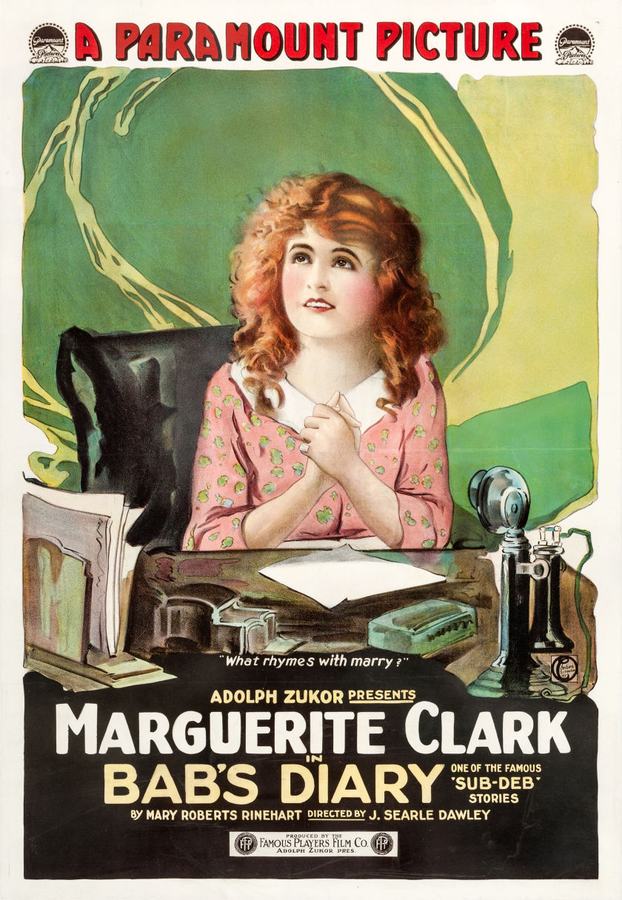
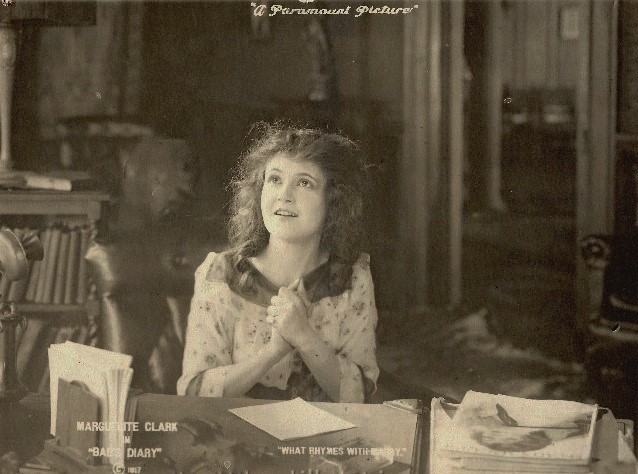
There is a moment—wordless, of course—when Marguerite Clark’s Bab stands in the threshold of her family’s parlor, the gas-jets haloing her like a reluctant angel, and the entire film tilts on the fulcrum of her pupils. The camera dares not cut away; it lingers until the girlish smirk calcifies into something older than sin. That flicker, no longer than a heartbeat, is why Bab’s Diary survives the compost heap of 1917 one-reelers to converse with us across the century.
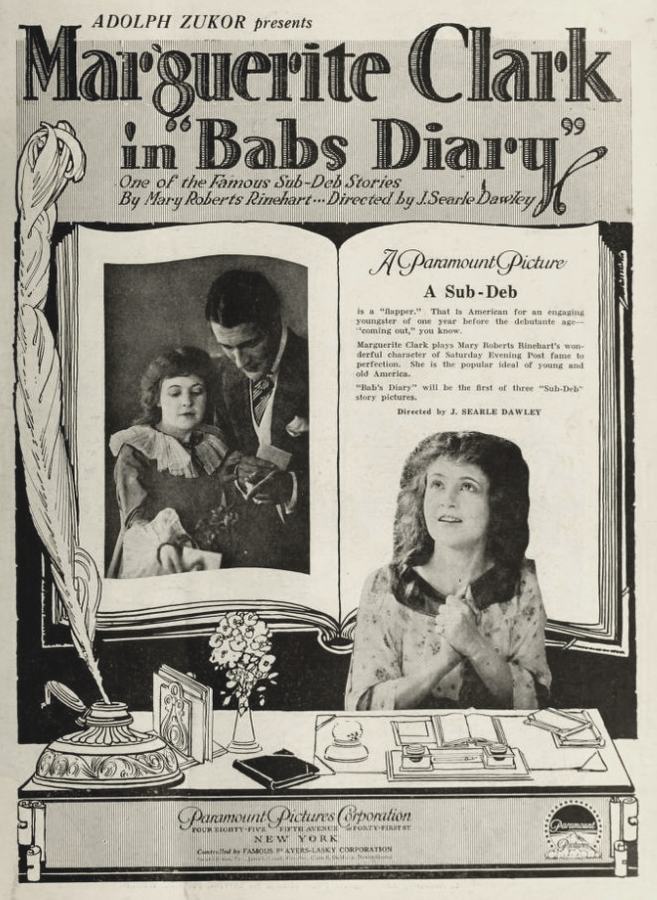
Adapted from Mary Roberts Rinehart’s serial squibs and streamlined by scenarist Margaret Turnbull, the picture distills the uneasy season between childhood’s expiry date and womanhood’s forced entry. Director John B. O’Brien—fresh from mentoring a teenage Griffith—opts for long, observational takes, trusting Clark’s micro-gestures to haul the narrative up the stairs. The result feels closer to a Lubitsch social comedy than to the nickelodeon slapstick that padded Saturday matinées of the era.
Winter, 1917. Outside, the world rehearses for influenza; inside, the Archibalds rehearse for a wedding. Note the symmetry: global calamity will soon cancel debutante balls, but for now the drawing-room rituals persist—pianola jingles, plum-pudding theology, and the unspoken credo that a girl’s value is measured by the price on her trousseau. Bab arrives with a steamer trunk, a hockey stick, and a head full of Kipling and suffragette pamphlets. Her parents see only the trunk.
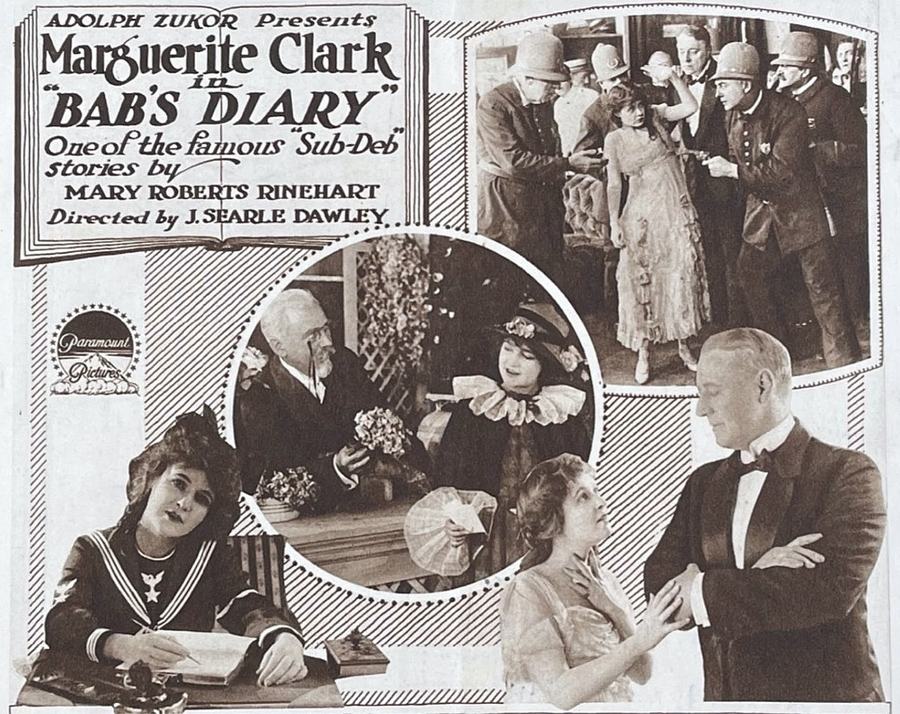
Turnbull’s intertitles, dainty but venomous, needle this hypocrisy. When Leila—played by Leone Morgan with the porcelain self-satisfaction of a Gibson Girl—declares that marriage is “the only career open to a lady,” the subtitle burns white-on-black like a cigarette scorch on lace. The film may masquerade as light confection, yet each bonbon contains a thimbleful of strychnine.
Enter the photograph: a glossy lobby card of stage heart-throb Harold Valentine (John B. O’Brien in delicious self-caricature). Bab pins it inside her diary like a relic. The gag is ancient—Twelfth Night via The Importance of Being Earnest—but Clark’s trembling satisfaction when she signs a forged love-letter “Ever thine, H.V.” transmutes cliché into ache. The pen scratches; the ink pools; the camera edges closer until the viewer becomes complicit voyeur.
Carter Brooks, privy to the prank, dispatches a telegram. Cue the actor’s arrival, silk-hatted and odalisque-eyed, ready to play Pygmalion to Bab’s Galatea. The masquerade thrums with erotic peril: an unmarried girl, an unmarried room, and a reputation one slammed door away from combustion. O’Brien blocks the confrontation in a single hallway shot: deep focus, mirror on one wall, door on the other, Bab reflected ad infinitum—each iteration smaller, more fragile. No iris-out necessary; the mise-en-abyme says you will never be old enough to command this space.
Third act detonates into farce. Bab, desperate to retrieve her mash-notes, sneaks from her own party—past the carolers, past the mistletoe, past the dozing butler whose whiskers twitch like a faulty alarm. She descends the service staircase, hails a hansom, and barrels through gaslit streets while the orchestra’s pizzicato mimics her pulse. Inside Valentine’s flat she fumbles through drawers, discovers silk stockings that are not her own, and registers—Clark’s face is a master-class in delayed comprehension—that male appetite is not the swooning poetry of fan magazines.
Then the burglar alarm brays. Red flash-cuts (hand-tinted for select prints) strobe across her petrified mug. The constable arrives; the party disperses; the family crest falls with the finality of a guillotine. Bab is chauffeured home in a paddy wagon, her white tulle dress ballooning through the iron bars like a cruel joke about prison weddings.
Compare this sequence to the climactic theft in The Burglar (1914): both hinge on a woman transgressing domestic borders, both end in public shaming. Yet where that earlier film moralises, Bab’s Diary wallows in the hypocrisy of penalising curiosity while pardoning deceit.
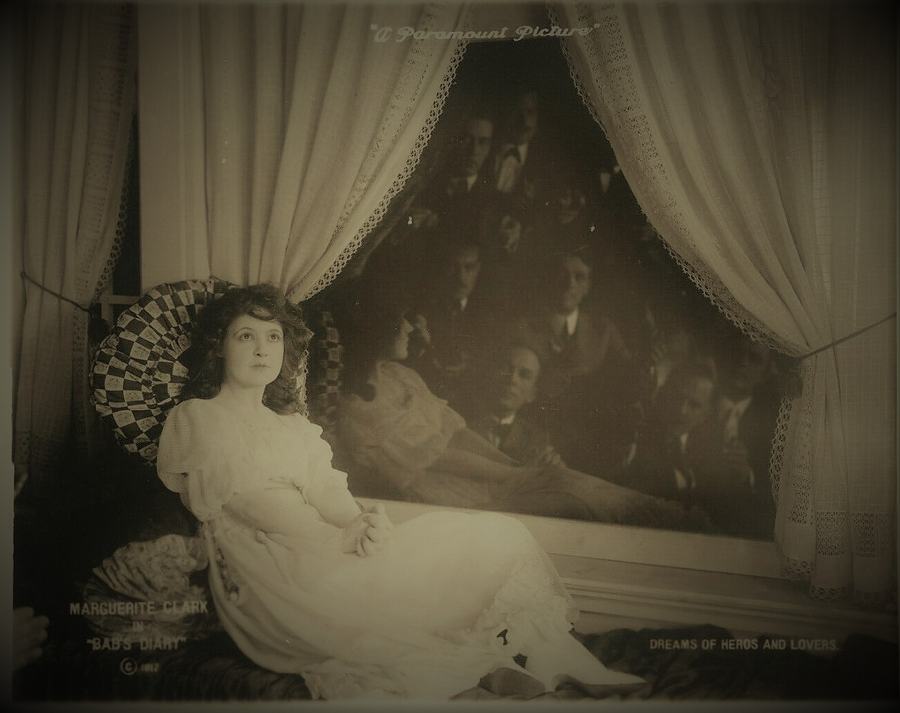
History remembers Pickford’s ringlets and Talmadge’s athleticism; Clark, diminutive and deceptively childlike, slips through the cracks. At 4’10” she specialised in perpetual adolescents—Seventeen, Prunella, Rebecca of Sunnybrook Farm. Bab, however, requires her to age in stop-motion: the eager bobbing walk of a schoolkid morphing into the stiff-backed gait of a woman who has tasted the metallic tang of disgrace. Watch her hands: they start fluttering like trapped sparrows, then knot into fists, finally dangle at her sides—dead weight.
Her voice, of course, is missing; but silence was her ally. The close-up becomes confession booth. In the penultimate shot, headed for the dawn train that will ferry her back to scholastic exile, she stares past the lens until tears bead. No title card intrudes. The audience is left to read whatever guilt, defiance, or smothered libido it cares to project. That chasm of interpretation is the birthplace of modern screen acting.
Art director George Gibson drapes the mansion in a palette of bruised plums and surgical whites—colors that anticipate the German Kammerspielfilm of the twenties. Holly wreaths cast jagged shadows like barbed wire. The wedding gown of the elder sister looms in the hallway for two reels before it is worn; its train, twenty feet of Belgian lace, becomes a specter of commodified femininity. When Bab finally darts beneath it to escape detection, the image compresses every theme—youth versus custom, virginity versus transaction—into a single visual epigram.
Cinematographer Lucien Andriot lenses winter windows so that they reflect characters superimposed upon snow-covered shrubs, creating ghostly palimpsests. The gag of mistaken identity occurs literally in the glass: two faces, one body. Meanwhile, the tinting scheme—amber for interiors, cerulean for exteriors, rose for moments of libidinal panic—supplies emotional subtext the titles dare not articulate.
Studio publicists sold the picture as “A Yuletide romp of mischief and mirth.” True, if your idea of mirth includes public shaming, patriarchal gaslighting, and the carceral threat hanging over any girl who dares author her own desire. The film belongs to a curious pre-Hays cycle of “bad girl” comedies—see also The Fibbers and The Amazons—where patriarchal order is restored only after the heroine has demonstrated its absurdity.
Yet O’Brien refuses the moralising epilogue demanded by exhibitors. The final shot eschews reintegration: Bab on the train, window fogged, tracing an imaginary heart that melts. No chastened smile, no shot of parents waving forgiveness. The form itself rebels: iris opens to black, not closed. One leaves the cinema suspicious that the joke, once again, is on the audience.
Original road-show engagements travelled with a small pit orchestra and a cue sheet that calls for Scriabin preludes during Bab’s diary scenes and ragtime for the chase. Modern restorations often substitute saccharine pastiche. Seek out the 2019 Library of Congress 4K restoration—piano by Dr. Philip Carli—which resurrects the ragtag dissonance between Slavic melancholy and cakewalk swagger. The clash mirrors Bab’s split self: half finishing-school deportment, half jazz-age tinder.
In the same year, Les Misérables offered grandiose suffering, while The Clodhopper mined rural pathos. Bab’s Diary stakes out the antipode: intimate, feminine, urban. Its DNA splinters forward to Claudine at School (1937) and backward to Little Women; sideways, it rhymes with the anarchic gender-bending of La falena.
Yet unlike European counterparts, the American film hedges its bets. The wedding must proceed, the rebel must be exiled. The strategy anticipates the post-Code “fallen woman” cycle of the early thirties, where retribution is aestheticised into ritual. Bab handcuffed is a dress-rehearsal for Stanwyck night-court perp walks.
Zoomers will recognise in Bab’s forged DMs the ancestor of catfishing, parasocial romance, and the Instagram boyfriend who exists only in Valencia filters. The film prefigures the influencer economy: identity as self-authored commodity, liable to collapse the instant the brand meets the body. When Bab’s avatar steps through the door corporeal, the horror is not that he is false, but that he is true—a living reminder that desire, once commodified, owns you.
Is the picture flawless? Hardly. The comic drunk subplot (featuring a slumming Nigel Barrie) clanks like a rusty dumbwaiter. A few interior sets wobble when doors slam. And the editorial decision to spare Bab a courtroom sequence robs the narrative of its potential Brechtian indictment.
Yet these blemishes pale beside the film’s granular empathy and visual bravura. It is a Christmas fable that smells of tallow instead of pine, a comedy that laughs through clenched teeth, a proto-feminist memo smuggled inside a valentine. Watch it for Clark’s face—an uncharted continent of mirth and dread. Watch it for the decor that anticipates Art Deco before the world knew the term. Watch it because history, written by the victors, relegates such treasures to footnotes, and every retrieval is a tiny revolution.
Rating: 9/10 – a peppermint truffle laced with arsenic, wrapped in nitrate, tied with a ribbon of yearning.
Streaming: Currently on Criterion Channel (restored 4K); Blu-ray from Kino Lorber with commentary by Dr. Shelley Stamp. Public-domain dupes on YouTube are watchable only if you enjoy looking at a snowstorm through a frosted monocle.
IMDb 7.1
1919
Community
Log in to comment.