DbcultAccessing Vault...
7/10
Senior Film Conservator
A definitive 7/10 rating for a film that redefined the boundaries of cult cinema. Bombs and Bums remains a cornerstone of transgressive art.
Is this film worth watching today? Short answer: yes, but only if you are a dedicated student of animation history or a fan of the surreal. It is definitely not for viewers who require a modern narrative structure or high-fidelity production values.
This film represents a raw, unpolished era of cinema where the rules were still being written in real-time. It is a fascinating look at how early animators used violence as a primary comedic language.
This film works because it captures a specific, frantic energy that modern animation often polishes away in favor of smoothness.
This film fails because its lack of a cohesive plot makes it feel like a series of disconnected shocks rather than a story.
You should watch it if you want to see the exact moment when the newspaper comic strip began to evolve into the cinematic slapstick tradition.
For the casual viewer, the answer is likely no. The visual language of 1917 is a difficult bridge to cross for those used to the fluidity of Pixar or Ghibli. However, for the cinephile, it is an essential text. It serves as a bridge between the static panels of Bud Fisher's comic strip and the later, more sophisticated work of the Fleischer brothers.
It is a curiosity. It is a relic. It is occasionally baffling. But it is never boring, which is more than can be said for many of its contemporaries.
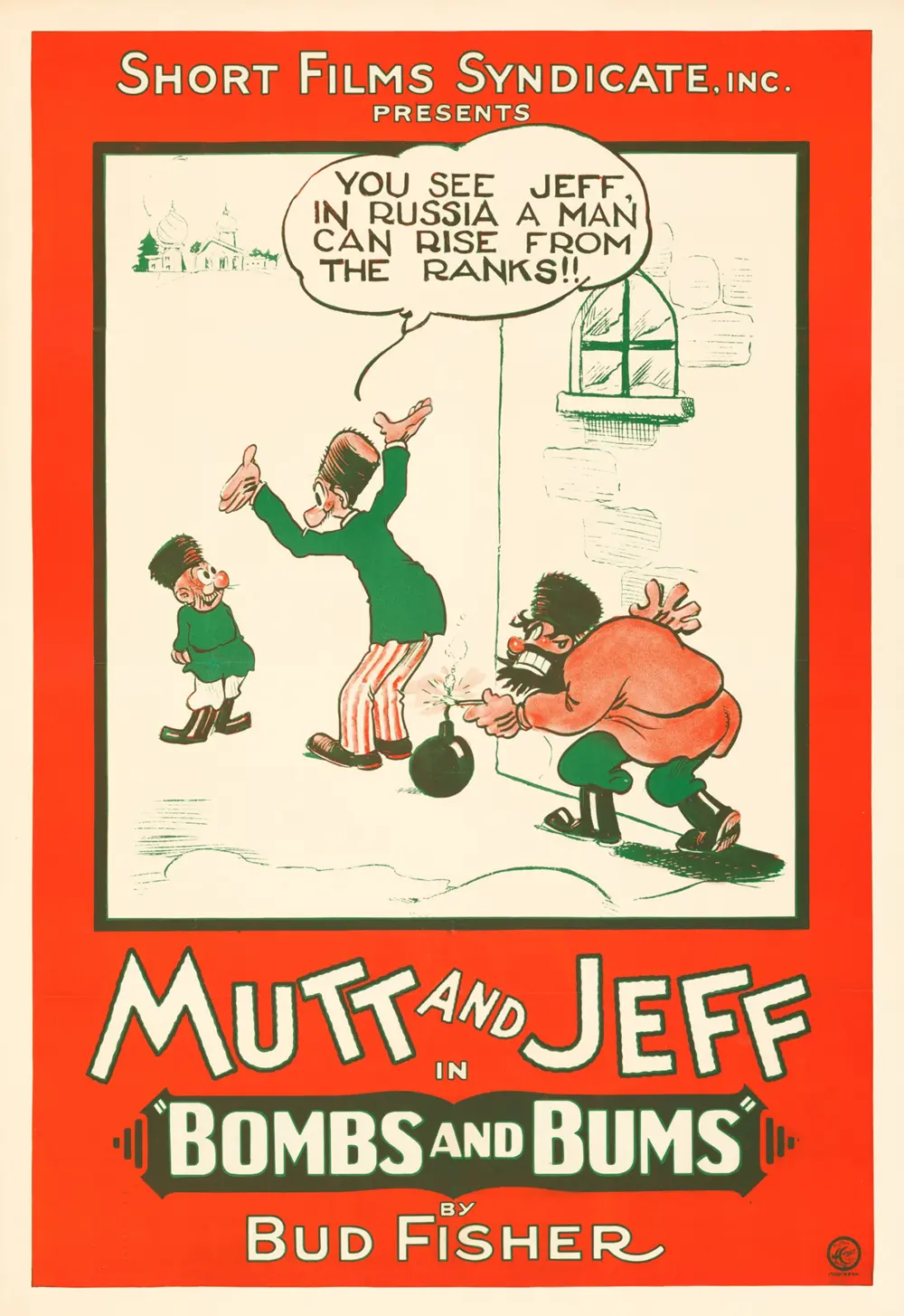
Charles R. Bowers was not a normal filmmaker. His work often feels like it was beamed in from a different dimension where physics are merely a suggestion. In 'Bombs and Bums', this manifests as a total disregard for the human form.
Mutt and Jeff are stretched, flattened, and exploded with a nonchalance that would later become a staple of the Looney Tunes era. But here, in 1917, it feels more dangerous. There is a grit to the line work that suggests a world that is fundamentally unstable.
Consider the scene where the bomb first appears. It isn't just a prop; it is a ticking character that dictates the movement of every other figure on screen. This is a level of environmental storytelling that was quite advanced for its time.
Bud Fisher was a businessman as much as an artist. By the time this film was released, Mutt and Jeff were already a global phenomenon. This film represents the peak of their cultural saturation.
Unlike the more dramatic themes found in Sandra or the psychological tension of Tyrant Fear, 'Bombs and Bums' is focused entirely on the immediate gag. It is a commercial product designed to elicit a quick laugh in a crowded theater.
However, Fisher’s writing retains a certain sharpness. The dialogue cards, though sparse, reflect the dry, cynical wit of the original strip. It’s a stark contrast to the more wholesome humor of Penrod and Sam.
Technically, the film uses the 'slash system' of animation, which allowed for faster production by cutting holes in the paper to show the characters underneath. This gives the film a jittery, nervous quality.
The backgrounds are minimalist, almost stark. This forces the viewer to focus entirely on the movement of the characters. It is a primitive form of minimalism that actually enhances the comedy. When there is nothing else to look at, the absurdity of a man being chased by a bomb becomes much more apparent.
Compared to the lush, atmospheric visuals of While London Sleeps, this short looks skeletal. But that skeleton is what gives it its strength. It is all bone and muscle, no fat.
When we look at the other films of the era, like Smarty or Body and Soul, there is often an attempt at moralizing or emotional resonance. 'Bombs and Bums' has none of that.
It is refreshingly nihilistic. The 'bum' in the title is treated with the same lack of empathy as the bomb. In the world of Mutt and Jeff, everyone is a target. This lack of sentimentality is what makes the film feel surprisingly modern.
It shares more DNA with the frantic pacing of A Gun Fightin' Gentleman than it does with the domestic dramas of the period like The Neglected Wife.
The most surprising thing about 'Bombs and Bums' is how it handles the concept of the 'other'. The vagrant character is not just a punchline; he is a force of nature that Mutt and Jeff cannot control.
In many ways, the film is a meditation on the loss of control in an increasingly mechanized world. The bomb is the ultimate symbol of this. It is a machine that only knows how to do one thing: destroy. This reflects the looming shadow of World War I, which was at its height during the film's production.
While films like Titanenkampf or Flygande holländaren dealt with mythic struggles, 'Bombs and Bums' brought that struggle down to the gutter.
'Bombs and Bums' is a fascinating, if somewhat jarring, trip into the past. It shows us a world where the line between a comic strip and a movie was still blurry. It lacks the sophistication of Paris or the narrative depth of The Man Who Wouldn't Tell, but it makes up for it with sheer, unadulterated energy.
It is a film that exists in the moment. It doesn't care about the future. It doesn't care about you. It just wants to blow something up and see what happens. There is a certain beauty in that kind of honesty.
Final thought: It works. But it is deeply flawed. Watch it once, then read about it for an hour. That is the best way to experience this piece of history.
IMDb 5.9
1915
Community
Log in to comment.