DbcultAccessing Vault...
7.4/10
Senior Film Conservator
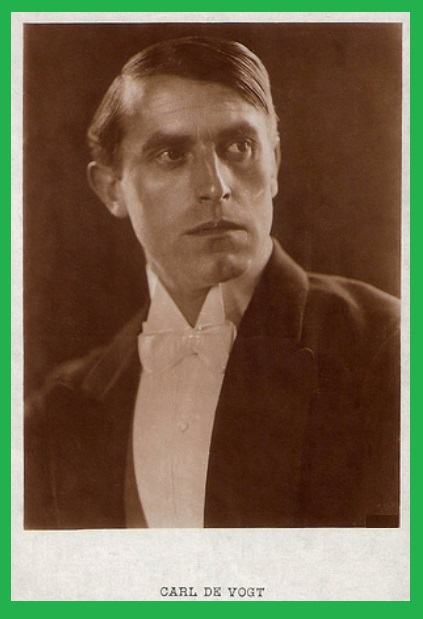
A definitive 7.4/10 rating for a film that redefined the boundaries of cult cinema. Caravan of Death remains a cornerstone of transgressive art.
Imagine the Sahara not as landscape but as liquid malevolence—each dune a slow-moving wave poised to drown cameras, celluloid, and the fragile myth of white supremacy. Caravan of Death, shot on location in 1919 when the sun still bleached filmstock faster than any lab timer, weaponises that liquidity. Director Marie Luise Droop, fresh from adapting Karl May’s orientalist pulp, refuses to let the desert merely host the drama; she lets it seep into the sprocket holes, warping the very grammar of continuity. The result feels like a fever dream sutured by scorpions: silhouettes ripple, dissolves melt into heat-halations, and Bela Lugosi’s Halid steps through the frame as though exiting a fresco that has tasted blood.
Long before Dracula caped him into immortality, Lugosi understood that seduction and menace share a hinge: the pause between syllables. Listen to his Arabic-inflected German—each consonant a bronze bell, each vowel a silk noose. When he welcomes the travellers to his “hospitality tent,” the camera dollies inward until only his eyes fill the iris, twin black olives glinting with reflected torchlight. In those pools you glimpse not desire but the annihilation of desire, a negation colonial cinema usually reserves for faceless hordes. Yet here the face is luminous, European, unmistakably the star; the inversion scalds.
Yes, the print is monochrome, yet cinematographer Erwin Baron (doubling onscreen as the cynical cameraman) tints sequences like a man possessed. European interiors drip with Prussian-blue tones—steel maps, starched uniforms, the engineer’s drafting ink—while exterior nocturnes glow sulphur-yellow, as though the screen itself suffers jaundice. The clash peaks when the Sheikh unveils his water vault: a limestone cistern awash in aquamarine tint, its surface littered with crimson rose petals. One intoxicating overhead shot renders the Europeans as pale, flailing insects trapped inside a turquoise chalice. The metaphor is blunt—colonial thirst literalised—but the chromatic shock scalds the retina.
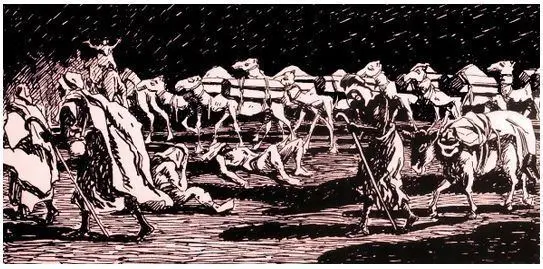
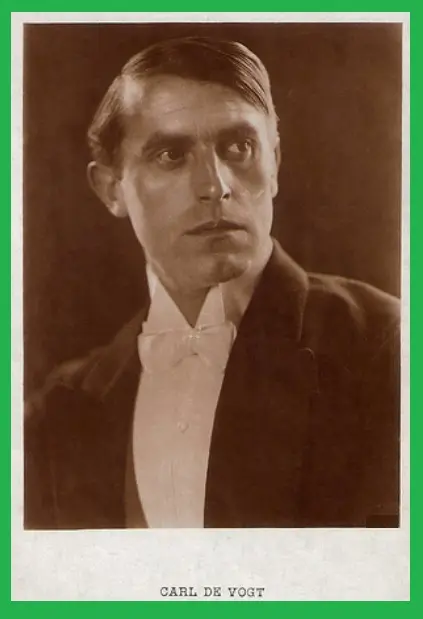
Silent cinema excelled at turning objects into fetish: think of the ruby sacrificial stone in The Scarlet Crystal or the submersible hull in The Secret of the Submarine. Here, water operates as liquid stock exchange. Every sip rewrites power balances; every denial mints new cruelties. The Sheikh’s courtiers—played by Carl de Vogt and Gustav Kirchberg—keep ledgers of mouthfuls, tallying them against sexual favours, mechanical expertise, and eventual corpses. The film’s intertitles (some penned by Karl May himself) grow terse as hydrophobia sets in: “One cup. One kiss. One corpse.” The arithmetic is as transparent as it is brutal.
Claire Lotto’s aristocrat begins draped in Edwardian muslin, a portable civilisation sweating at the seams. By midpoint she’s traded pearls for a burnoose, yet the garment hangs off her collarbones like a verdict. Droop lingers on her unpainted face—no Keystone exaggeration here—capturing every sun-slapped freckle. The Sheikh’s desire is never for her body per se but for the emblematic deflation of her empire. Meanwhile, Erna Felsneck’s missionary nurse, a secondary character, stages the film’s quietest rebellion: she pockets a vial of strychnine, kisses her crucifix, and poisons the ledger-keepers, whispering a single intertitle: “Thy kingdom gone.”
Contemporary exhibitors often accompanied desert pictures with Debussy or improvised oud flourishes. Yet surviving cue sheets suggest Caravan originally screened with a barrage of percussion—military snares, temple blocks, the occasional cymbal scraped with violin bows—to simulate sandstorm cacophony. Restorers at Cinémathèque Munich reconstructed this assault in 2018, and the effect is galvanic: every eye-cut feels percussive, every Lugosi smirk syncopated to a rattle that could be bones or dice. If you’ve experienced the sonic minimalism of The Silent Voice, imagine its inverse: a film that refuses to hush even when no one speaks.
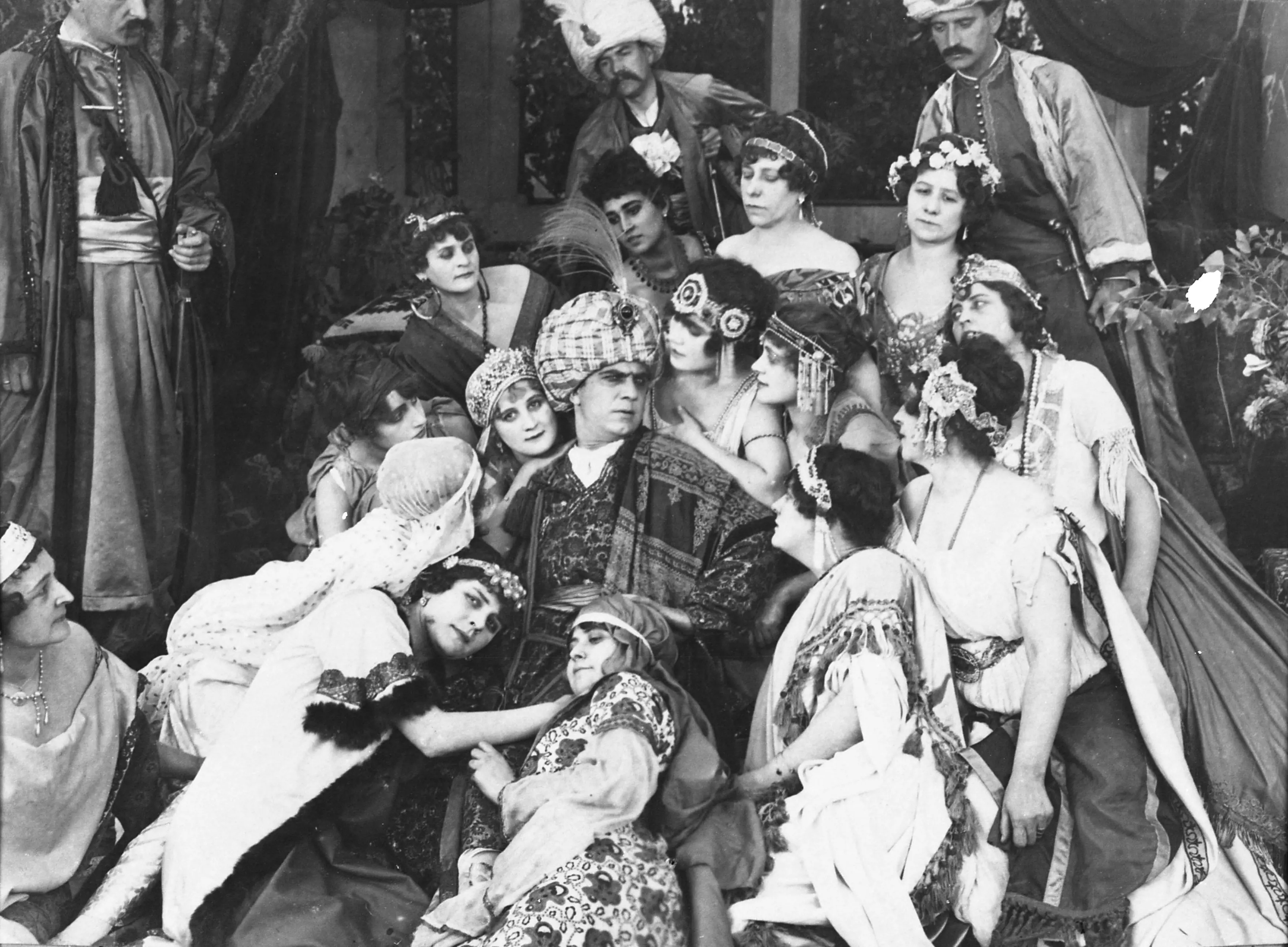
While Hollywood westerns framed horizons as Manifest Destiny lines, Droop tilts her camera askew, diagonals slicing the 1.33:1 frame like sabres. Tents become trapezoids; the caravan’s pack-camels march in zig-zag patterns that recall Expressionist woodcuts. Compare this to the rectilinear interiors of Quicksand or the claustrophobic galleys of The Escape—here the mise-en-scène externalises psychological disorientation. The desert refuses to be tamed by Euclidean certainty; it swallows straight lines the way it swallows bones.
Like many silents, Caravan arrived in multiple export cuts. British censors excised a 300-foot sequence—allegedly a brazier-branding ritual—deeming it “calculated to impair relations with our Egyptian protectorate.” The trimmed negative vanished in a 1927 Ufa vault fire, and for decades scholars relied on a Russian-language cut retitled Karavan Smerti, itself incomplete. Then, in 2021, a Buenos Aires collector uncovered a 16mm reduction print with Spanish intertitles. Digital reconstruction married the Buenos Aires footage to Munich’s percussion tracks, yielding a 97-minute hybrid that glides from sepia to cobalt like a chameleon with blood on its tongue. Purists howl about “revisionist tinting,” yet the result feels truer to Droop’s feverish intent than any pristine but gutted archive copy.
Anna von Palen’s scheming courtesan flickers between triumph and terror—watch her pupils dilate when she realises her jewels buy no exit. Arthur Kraußneck’s shell-shocked officer, convinced sand grains are lice, scratches himself raw; the camera captures his bleeding cuticles in clinical close-up. Even the animals perform: Meinhart Maur’s trained falcon swoops across scenes like a feathery death omen, its wings brushing the lens so we taste grit. These miniature arcs accumulate into a mosaic of imperial panic, a danse macabre where every dancer wears someone else’s skin.
Adventure serials of the era—Dinty’s Irish tenement hijinks or Bogatyr Dukha’s Cossack bravado—treat landscape as playground. Caravan instead anticipates the claustrophobic fatalism of later chamber pieces like The Gun Fighter, only here the chamber is boundless. The paradox chafes: open space as suffocation. When the final lovers feign death, their collapsed silhouettes resemble the double exposure ghosts that haunt The False Friend, yet the desert refuses to grant them the urban afterlife of crowded streets; they become fossils baked into dune-glass.
Modern viewers, sensitized to climate anxiety, will read the drought-struck camp as prophecy. The Sheikh’s hoarding of water foreshadows Nestlé’s aquifer raids; the Europeans’ blueprints for “irrigation” echo today’s pipeline imperialism. Meanwhile, the Berber extras—non-professionals recruited from Ouarzazate—rarely speak on intertitles, yet their impassive stares corrode the narrative’s racist scaffolding. Their silence accuses louder than any manifesto, turning the film into a dialectic: can a colonial product undermine its own ideology? The answer flickers like heat-lightning—yes, but only if the desert itself conspires in the sabotage.
Caravan of Death is not a comfortable watch; it is a voluptuous wound. Its politics are as dated as the Ottoman Empire’s maps, yet its aesthetic venom remains evergreen. You will swoon at Lugosi’s cadence, gag at the orientalist caricatures, marvel at the sand-mottled cinematography—sometimes within a single scene. Approach it the way you approach a mirage: expect revelation, prepare for thirst, and when the credits finally fade, spit out the grit—you’ll find it tastes of silver nitrate and your own complicity.
IMDb —
1934
Community
Log in to comment.