DbcultAccessing Vault...
8.8/10
Senior Film Conservator
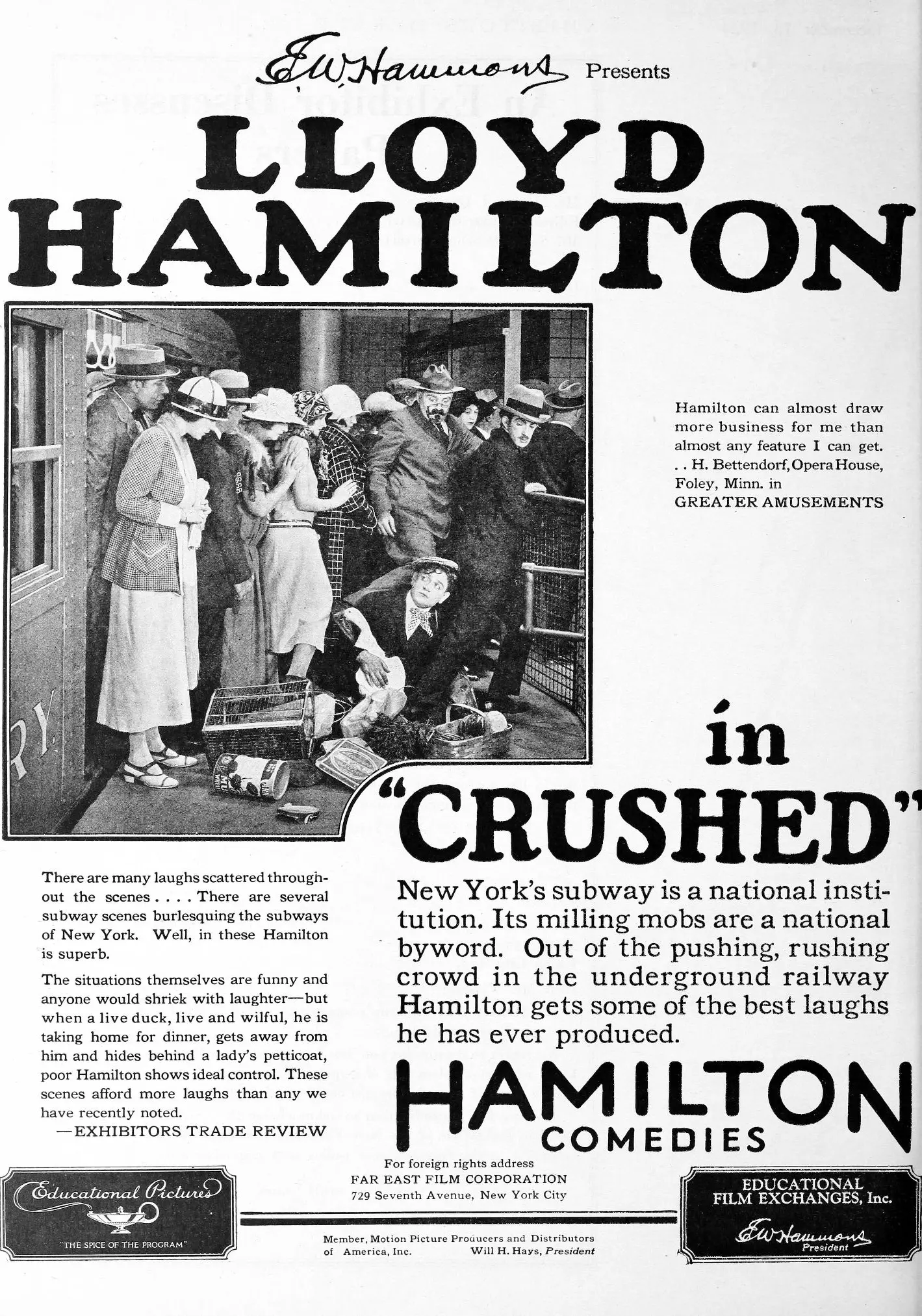
A definitive 8.8/10 rating for a film that redefined the boundaries of cult cinema. Crushed remains a cornerstone of transgressive art.
The silent era was frequently preoccupied with the collision between rural innocence and urban decadence, but few films capture the sheer, frantic anxiety of this transition quite like Crushed. Directed by the often-underappreciated Fred Hibbard, this 1924 gem serves as a vehicle for Lloyd Hamilton, a comedian whose 'lonesome' persona provided a stark, pathetic contrast to the more buoyant slapstick of his contemporaries. In this narrative, the inheritance trope—a staple of early cinema—is stripped of its whimsy and replaced with a palpable sense of dread. Mr. Jones is not a man seeking adventure; he is a man coerced into a performance of domesticity by the looming shadow of a bank account.
The film’s brilliance lies in its pacing. Unlike the more leisurely explorations found in The City of Masks, which treats the urban environment as a stage for deception, Crushed treats the city as a predatory organism. From the moment Jones arrives, the frame is crowded, the movements are jagged, and the social requirements are suffocating. The necessity of marriage is presented not as a romantic milestone, but as a bureaucratic hurdle, much like the social gymnastics seen in Be a Little Sport. However, Hibbard pushes the absurdity further, ensuring that Jones’s attempts to find a wife are met with increasingly grotesque failures until he finally settles into a union that feels more like a sentencing than a celebration.
One cannot discuss Crushed without acknowledging the towering performance of Blanche Payson. As the 'nightmare' wife, Payson utilizes her imposing physical stature to create a dynamic of dominance that was radically subversive for 1924. She does not merely share the screen with Lloyd Hamilton; she colonizes it. Their chemistry is built on a foundation of mutual incompatibility, a comedic friction that mirrors the larger thematic conflict of the film. While Hamilton’s Jones is a creature of soft edges and bewildered glances, Payson is all sharp angles and authoritative gestures.
This domestic power struggle serves as a microcosm for Jones’s relationship with the city itself. He is constantly being resized, pushed, and molded by forces beyond his control. In many ways, the marital 'nightmare' is an extension of the financial 'nightmare' that brought him to the city in the first place. The film cleverly avoids the easy path of making Payson a simple villain; she is, instead, a force of nature, an inevitable consequence of Jones’s mercenary pursuit of wealth. It’s a far cry from the more traditional gender roles explored in The Honor of His House, where duty and domesticity are handled with a heavier, more melodramatic hand.
Hibbard’s direction is remarkably sophisticated for a short-form comedy. He utilizes the camera to amplify the sense of entrapment. Close-ups of Hamilton’s expressive, doughy face are juxtaposed with wide shots of the bustling, indifferent city, emphasizing his isolation. There is a sequence involving a chaotic dinner party that rivals the best work of the era, where the physical comedy becomes almost hallucinatory. The choreography of the actors—including stalwarts like Robert McKenzie and Louise Carver—creates a sense of orchestrated chaos that reflects the crumbling sanity of the protagonist.
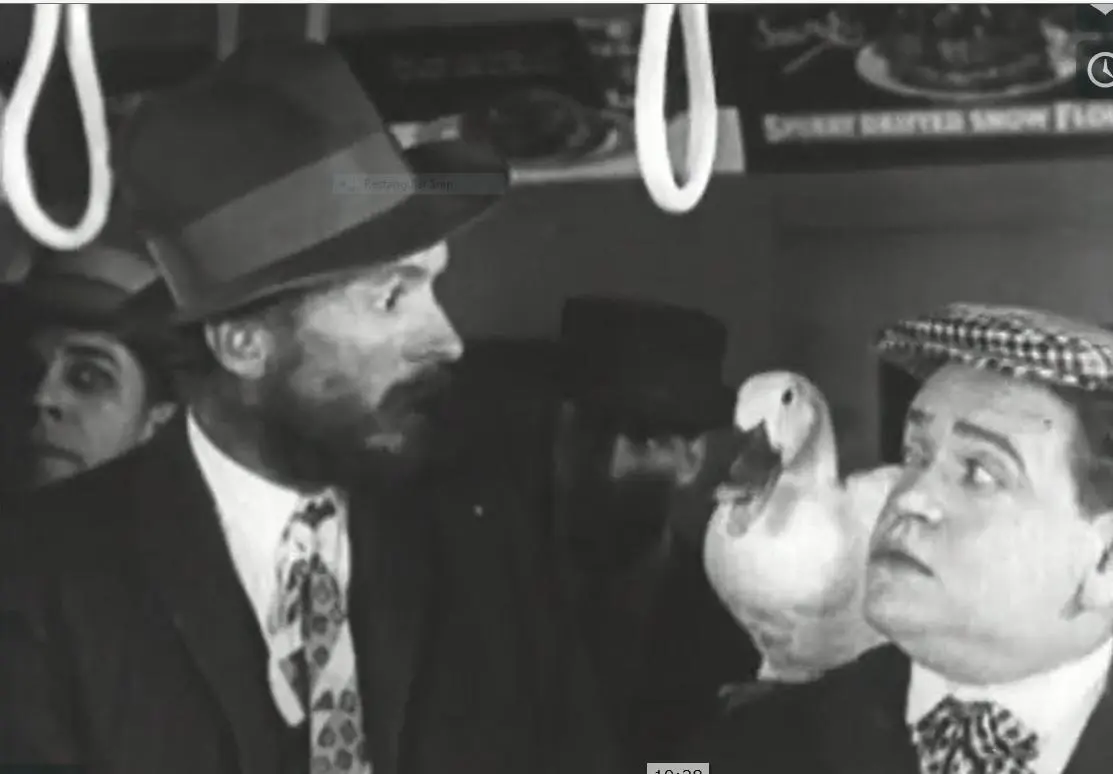
When comparing this to Queens Are Trumps, one notices a distinct difference in how the 'game' of social climbing is portrayed. While other films might find a certain charm in the hustle, Crushed finds only exhaustion. The slapstick here isn't just for laughs; it’s a physical manifestation of the protagonist’s struggle to remain upright in a world that wants to flatten him. This visceral quality is something Hibbard excelled at, a trait also visible in his other collaborations with the cast, yet it feels most potent here because the stakes are so fundamentally existential.
The supporting cast of Crushed reads like a who’s who of silent comedy character actors. Dorothy Seastrom provides a brief, luminous counterpoint to the surrounding madness, representing perhaps the 'ideal' that Jones can never truly attain because his motives are tainted by greed. Meanwhile, William Dyer and Mark Hamilton ground the more outlandish sequences with a gritty realism that was a hallmark of Fred Hibbard’s casting choices. Even Tommy Hicks, in his limited capacity, contributes to the sense of a world populated by people who are all, in some way, trying to extract something from one another.
Particularly noteworthy is the appearance of Lloyd Hamilton’s frequent collaborators. The shorthand between these performers allows for a level of timing that is breathtaking. In the silent era, where dialogue couldn't carry the narrative weight, these physical interactions were the lifeblood of the film. The way Robert McKenzie reacts to Hamilton’s ineptitude is a masterclass in reactionary comedy. This ensemble approach reminds me of the tight-knit feel of Somebody Lied, though Crushed possesses a much darker undercurrent of cynicism regarding human relationships.
At its core, Crushed is a cautionary tale about the cost of inheritance. In the early 20th century, the promise of 'old money' was often the only way out of the burgeoning industrial grind, yet the film suggests that the price of this exit is the surrender of one's autonomy. Jones is a man who sells his soul for a check, only to find that the devil is a very tall woman in a very small apartment. This theme of 'the price of admission' is a recurring motif in films like Der Mann ohne Namen - 1. Der Millionendieb, where the pursuit of wealth leads to a loss of identity.
The 'nightmare' marriage is not just a comedic trope; it is a metaphor for the binding contracts of modern life. Jones enters into the agreement willingly, driven by avarice, and spends the rest of the film trying to survive the consequences. The film’s title, Crushed, refers not just to a physical sensation, but to the psychological state of being overwhelmed by the very things one thought would bring freedom. It’s a surprisingly modern sentiment, echoing the anxieties of the post-war generation who found themselves trapped in the machinery of progress.
When we look at Crushed alongside La luz, tríptico de la vida moderna, we see two different cultures grappling with the same modernization. While 'La luz' takes a more panoramic, triptych approach to the modern condition, Crushed focuses its gaze on the individual, using comedy to make the tragedy of the 'everyman' palatable. It lacks the overt moralizing of The Torch Bearer, opting instead for a more nihilistic, 'laugh-to-keep-from-crying' energy.
Even compared to the lighter fare of Once a Mason or the identity-swapping antics of Alias Mary Brown, Crushed feels uniquely grounded in a specific kind of American misery. It isn't interested in the glamorous deceptions of the upper class; it’s interested in the awkward, painful deceptions of the middle class trying to ascend. The film shares a certain spiritual DNA with Boman på utställningen in its depiction of the 'little man' out of his depth, but Hibbard’s vision is sharper, less forgiving, and ultimately more memorable.
The technical execution of Crushed is a testament to the efficiency of the silent studio system. The editing is crisp, using rhythmic cuts to build tension during the more frantic chase and domestic sequences. The set design of the city apartment is particularly effective; it feels cluttered and oppressive, a physical manifestation of the protagonist’s 'crushed' spirit. This attention to environmental storytelling is what elevates the film above standard slapstick. It creates a world that feels lived-in and threatening, similar to the atmospheric dread found in The White Masks.
Furthermore, the film’s use of light and shadow—while not quite expressionistic—suggests an awareness of the darker currents flowing through European cinema at the time. There are moments where Jones is silhouetted against the city skyline, looking small and insignificant, a visual echo of the themes found in During the Plague. It’s this blend of American slapstick and a more somber, visual sophistication that makes Crushed such a fascinating artifact. It captures a moment in time when the comedy was becoming more complex, reflecting a world that was becoming increasingly difficult to navigate.
In the final analysis, Crushed is more than just a comedy of errors; it is a profound, if accidental, meditation on the human condition. It asks what we are willing to sacrifice for security and explores the inevitable disillusionment that follows when we realize we’ve made a bad bargain. The 'nightmare' is not just the wife, or the city, or the lost inheritance—it is the realization that Jones has become a spectator in his own life. This sense of fading relevance is beautifully explored in The Faded Flower, though Hibbard chooses to wrap his melancholy in a layer of frantic energy that keeps the audience engaged even as the protagonist’s world falls apart.
Lloyd Hamilton’s performance remains the anchor of the film. His ability to convey a deep, abiding sadness through the medium of physical comedy is a rare gift. He doesn't ask for the audience’s pity; he simply exists as a mirror to our own anxieties. When we laugh at Mr. Jones, we are laughing at the part of ourselves that has ever felt small, overwhelmed, or trapped by our own choices. Crushed is a masterpiece of the 'lonesome' comedy genre, a film that resonates just as strongly today as it did in 1924, reminding us that the 'big city' dreams we chase often come with a heavy, and sometimes hilarious, price tag. It is an essential watch for anyone interested in the evolution of cinematic comedy and the enduring power of the silent image.
Note: For those seeking a different tone of silent era exploration, consider the wintery desolation of Winter Has Came, which offers a stark contrast to the urban claustrophobia of Hibbard's work.
IMDb —
1921
Community
Log in to comment.