DbcultAccessing Vault...
Cult Review
Senior Film Conservator
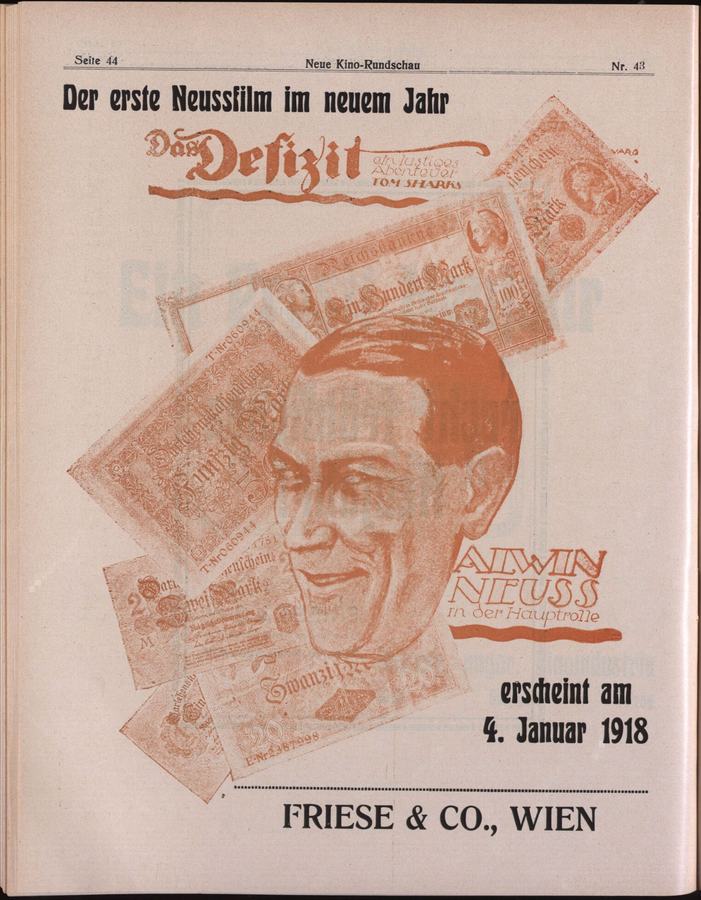
There are films that merely tell a story, and then there are cinematic experiences that excavate the very foundations of human nature, laying bare its frailties and its formidable resilience. 'Das Defizit,' a compelling, albeit largely unsung, masterpiece from the pen of Paul Rosenhayn, unequivocally belongs to the latter category. This isn't just a tale of financial collapse; it's a meticulously crafted psychological drama, a stark societal commentary, and an incandescent showcase of early 20th-century acting prowess. From its opening frames, one is drawn into a world of opulent facades and festering secrets, where the titular 'deficit' extends far beyond ledger books, permeating the souls of its protagonists.
At the heart of this intricate web lies Leo Connard's portrayal of Herr Conrad, a man whose public persona exudes an impenetrable aura of success and respectability. Connard masterfully conveys the simmering anxiety beneath the polished exterior, a silent scream of desperation that gradually intensifies with each passing scene. His performance is a clinic in understated agony, utilizing subtle shifts in posture, the flicker of an eye, or the clenching of a jaw to communicate a man on the precipice. We witness his descent from a position of unassailable authority to one of abject fear, as the financial 'deficit' within his banking empire metastasizes, threatening to consume everything he holds dear. This isn't a sudden fall; it's a gradual, agonizing erosion of integrity, a testament to Rosenhayn's nuanced character development.
The film's genius lies in its refusal to paint Conrad as a one-dimensional villain. Instead, we are invited to empathize with his plight, to understand the crushing pressures that lead him down a path of increasing moral compromise. It's a journey into the dark corners of the human psyche, where the pursuit of solvency justifies increasingly dubious actions. The narrative doesn't shy away from the ugliness, but it also provides glimpses into the initial, perhaps noble, intentions that were twisted by circumstance. This complexity makes 'Das Defizit' resonate deeply, prompting introspection on how easily one might succumb to similar pressures.
Opposite Connard, Else Roscher delivers an equally compelling performance as Frau Conrad, a character initially presented as the epitome of refined society, a woman whose life is seemingly insulated from the harsh realities of the financial world. Roscher's portrayal is a poignant study in gradual disillusionment. Her initial ignorance gives way to a dawning awareness, then to fear, and finally, to a profound sense of betrayal and despair. The silent film format, far from limiting her, amplifies her expressive power; her eyes, her gestures, her very posture convey volumes of unspoken emotion. We see her navigate the treacherous social landscape, maintaining a façade of composure even as her personal world disintegrates around her. Her suffering is palpable, a stark counterpoint to her husband's internal torment, highlighting the collateral damage of his choices.
Roscher's performance is particularly striking in scenes where she subtly challenges her husband's evasiveness, or when she confronts the societal whispers and judgmental glances that inevitably accompany public scandal. Her character's arc is a powerful commentary on the precarious position of women in that era, often dependent on their husbands' financial standing and reputation, yet simultaneously expected to embody the family's honor. Her journey from blissful ignorance to tragic understanding is one of the film's most emotionally resonant threads, making her a figure of immense pathos.
No tale of financial intrigue would be complete without its shadowy figures, and 'Das Defizit' introduces us to two particularly memorable ones. Alwin Neuß, as the enigmatic consortium leader, embodies a cold, calculating ruthlessness that sends shivers down the spine. Neuß eschews overt villainy for a more insidious menace, his gaze a predatory assessment of opportunity and vulnerability. He represents the impersonal, unforgiving forces of the market, a stark contrast to Conrad's more human, albeit flawed, struggles. His presence is a constant, looming threat, a reminder that the world of finance is as much about power as it is about profit.
Harry Lamberts-Paulsen, on the other hand, provides a different kind of pressure as the relentless investigator. Lamberts-Paulsen crafts a character who is neither purely good nor purely evil, but rather a man driven by a singular, almost obsessive, pursuit of the truth. His methods are uncompromising, his inquiries probing, and he serves as the catalyst for much of the film's dramatic revelations. His interactions with Conrad are tense, a cat-and-mouse game where the stakes are reputation, freedom, and ultimately, life itself. The dynamic between them is reminiscent of the moral quandaries explored in films like The Seekers, where the pursuit of justice often blurs the lines of personal ethics.
Perhaps the most tragic figure in this ensemble is Henry Wasa's junior partner. Wasa imbues his character with a youthful idealism that slowly corrodes under the weight of his superior's transgressions. He is the audience's moral compass, a character who grapples with the agonizing choice between loyalty to his mentor and adherence to his own principles. His internal conflict is exquisitely rendered, a silent battle fought in his expressive face and hesitant movements. Wasa's performance elevates a potentially secondary role to one of profound significance, embodying the corruption of innocence that so often accompanies unchecked greed. His eventual decision, born of a desperate need for truth, serves as a pivotal turning point in the narrative, propelling the film towards its inevitable, devastating climax. This arc, while less overt, carries a powerful emotional punch, echoing the themes of disillusionment found in works like The Tongues of Men.
Paul Rosenhayn's screenplay for 'Das Defizit' is a marvel of intricate plotting and psychological depth. He constructs a narrative that is both expansive in its societal scope and intensely personal in its focus on individual characters. The pacing is deliberate, allowing the tension to build organically, each revelation carefully placed to maximize its impact. Rosenhayn avoids cheap theatrics, instead opting for a slow burn that culminates in a truly cathartic explosion of truth. His dialogue, conveyed through intertitles, is sharp and economical, yet rich in subtext, allowing the actors ample room for non-verbal expression.
The brilliance of Rosenhayn's writing lies in its ability to explore universal themes—greed, loyalty, betrayal, societal expectations—within a very specific historical and economic context. He understands that the 'deficit' is not just a financial term but a metaphor for the moral and emotional bankruptcy that can plague individuals and institutions alike. The film's structure, moving from initial prosperity to impending doom and eventual reckoning, is a classic dramatic trajectory, yet Rosenhayn injects it with such vivid characterization and psychological insight that it feels entirely fresh and compelling. One could even draw parallels to the complex moral landscapes often found in films like Cora, where personal choices have far-reaching, often devastating, consequences.
Beyond the stellar performances and narrative depth, 'Das Defizit' is also a triumph of visual storytelling. The cinematography, while reflective of its era, is remarkably sophisticated, utilizing chiaroscuro lighting to great effect, particularly in scenes depicting Conrad's internal struggles or the shadowy dealings of Neuß's consortium. The sets, from the opulent banking halls to the lavish Conrad residence, are meticulously designed, creating a palpable sense of the world these characters inhabit and the grandeur that is slowly slipping away. The stark contrast between the bright, bustling city streets and the increasingly dark, claustrophobic interiors of Conrad's office effectively mirrors his psychological state.
The film's visual language is a character in itself, enhancing the themes of hidden truths and looming threats. The use of close-ups on the actors' faces, particularly Connard and Roscher, allows for an intimate connection with their emotions, transcending the limitations of the silent medium. This visual poetry elevates the drama, making every glance, every shadow, every meticulously framed shot contribute to the overarching sense of impending crisis. It's a masterclass in how to convey complex emotions and narrative beats without a single spoken word, much like the evocative visual narratives seen in The Eye of Envy, where visual cues are paramount to understanding underlying tensions.
'Das Defizit' stands as a powerful testament to the artistic heights achieved during the silent film era. Its exploration of financial corruption, moral decay, and the devastating impact of personal choices remains as relevant today as it was upon its release. In an age where economic instability and corporate malfeasance continue to make headlines, the film's central themes resonate with a chilling familiarity. It serves as a potent reminder that while the specific mechanisms of finance may change, the human elements of greed, fear, and the struggle for integrity are timeless.
The film's influence, though perhaps not as widely recognized as some of its contemporaries, can be seen in later dramas that delve into the psychological toll of financial ruin. It prefigures the nuanced character studies that would become a hallmark of subsequent cinematic movements, demonstrating an early sophistication in portraying complex human motivations. For those interested in the evolution of dramatic storytelling on screen, 'Das Defizit' is an indispensable viewing experience, offering a window into a bygone era while speaking directly to contemporary concerns. Its intricate plot, compelling performances, and profound thematic depth secure its place as a significant, albeit often overlooked, piece of cinematic history. It’s a work that demands re-evaluation and greater recognition, a true gem that shines brightly even amidst the vast catalog of silent era productions. One might even argue its thematic courage aligns with the bold narratives found in films like The Rogues of London, albeit with a focus on internal, rather than external, transgressions.
Ultimately, 'Das Defizit' is a film about the crushing weight of unseen burdens. The financial deficit is merely the tangible manifestation of a deeper, more pervasive deficit of truth, honesty, and moral courage. It's a somber, yet profoundly moving, exploration of the human cost of maintaining appearances and the inevitable reckoning that follows when the facade finally crumbles. The performances from Else Roscher, Leo Connard, Harry Lamberts-Paulsen, Henry Wasa, and Alwin Neuß are uniformly excellent, each contributing a vital thread to the film's rich tapestry. Paul Rosenhayn's narrative vision is brought to life with a directorial finesse that ensures every moment, every silent gesture, every intertitle, serves a purpose. This is not just a film to be watched; it is a film to be experienced, to be felt, and to be pondered long after the final frame fades to black. It reminds us that some deficits can never truly be repaid, only faced. And in facing them, we often discover the true measure of a soul. Its examination of societal pressures and personal downfall makes it a fascinating companion piece to other films exploring the darker side of human ambition, such as The Kiss of Hate, where internal conflicts lead to external ruin, or even the subtle psychological tension found within The Gentle Intruder, albeit with a far grander scope of societal collapse.
IMDb 6.3
1932
Community
Log in to comment.