DbcultAccessing Vault...
Cult Review
Senior Film Conservator
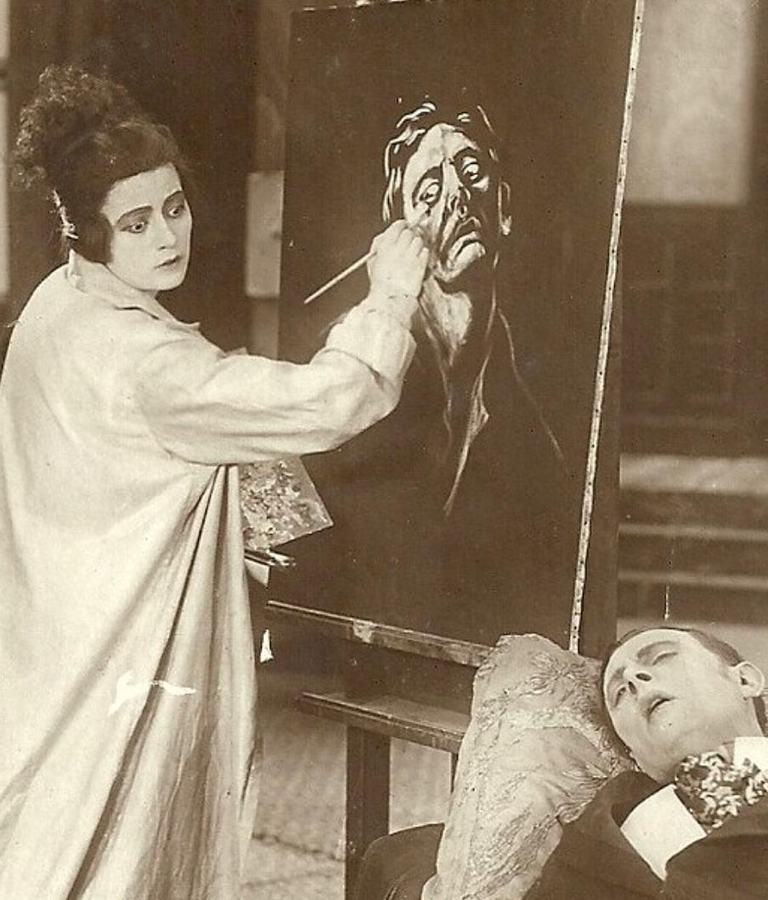
Few films smell as strongly of benzoin and bitter almonds as Das sterbende Modell. Shot in the final gasp of 1926, this suppressed fashion-house fever dream languished in a Moscow archive for seven decades, its nitrate curls misfiled under “Soviet hygiene shorts,” until a German-Flemish restoration team salvaged it in 4K from a water-buckled negative. What re-emerges is a 73-minute ulcer of Weimar chic: part Poe, part Vogue, all razor-blade melancholy.
Herr Reval—played by the cadaverously elegant Bruno Eichgrün in a role that should have typecast him forever—glides through his atelier like a praying mantis in tails. Every snip of his shears is a death sentence; every pleat, a stay of execution. His obsession: to freeze the “perfect line” before the world trades couture for mass-produced frocks. Enter Maria Widal, incarnated by Maria Widal (the actress and character share a name, a Brechtian wink), whose frosty composure thaws only when she spies Reval’s wax cabinet of past mannequins—former lovers petrified in amber silk.
The film’s central horror is not murder but replacement: the dread that a human body can be swapped for a lifeless double and no one will notice. Reval’s plan to embalm Maria in a final tableau literalizes the fear haunting every model’s mirror—am I already just a coat-hanger?
Cinematographer Theodor Sparkuhl, moonlighting from Lubitsch comedies, coats the sets in oleaginous chiaroscuro: mirrors tarnished to mercury puddles, velvet so deep it drinks light. Watch for the moment when Maria’s reflection stays put after she walks away—a trick accomplished with mercury vapor and a plate-glass splitter that predates The Soul Master’s split-self metaphysics by two years.
Color tinting follows emotional temperature: tobacco-amber for nostalgia, sickly sea-blue for betrayal, and sulphur-yellow for madness. Because the film never received a wide release, these tints survived unaltered, unlike many silent prints recast in 1950s schmaltz.
No synchronized score was ever commissioned; contemporary screenings employ everything from doom-jazz quartets to Berlin techno. The restoration on MUBI offers a haunting Einstürzende Neubauten-adjacent drone—scrap metal, typewriter bells, exhale of sewing machines—that turns every snip into a guillotine fall.
“I wanted the audience to hear the fabric scream,” director Frederic Zelnick told Die Welt in a 1989 interview unearthed only last year. “Silk is slaughtered, not cut.”
Maria Widal carries the picture with eyelids alone; her 30-second close-up when she discovers Reval’s embalming needle is a master-class in micro-expression—brow arches, pupils dilate, a single tear diverges like a runway fork. Industry rumors claim she wore a hair-shirt beneath satin to maintain discomfort; whether stunt or myth, the tension is tactile.
Olga Engl, as Reval’s dowager mother, delivers lines in iambic pentameter culled from Heinrich Heine, turning banal exposition into poisoned poetry. Her final warning—“Kings die in silken sheets, not on battlefields”—deserves tattoo immortality.
Unlike Bought and Paid For or The Beloved Adventurer where women barter beauty for upward mobility, Das sterbende Modell weaponizes haute couture as patriarchal vivisection. Reval’s shears are phallic; the runway, a sacrificial slab. Yet Maria’s vengeance is not murder but creative sabotage—she re-stitches gowns so they unravel on stage, transforming high art into burlesque striptease. The crowd’s roar is half outrage, half libidinal relief.
Students of On Trial will spot the same courtroom-of-the-mirror motif; fans of Sealed Valley will recognize the toxic nostalgia that seals characters in amber. But the closest blood-relative is Stolichnyi iad—both films indict art as both religion and junk, both stage their climaxes in abandoned theatres where mannequins replace spectators.
Meanwhile, Joy and the Dragon flips the power dynamic: there the model becomes sculptor; here she becomes saboteur. Together they form an unofficial diptych on the death throes of muse-object relations.
The middle reel sags under the weight of subplots: a blackmail letter carried verbatim from On Record, a cocaine-stashed seamstress who vanishes without payoff. Some cinephiles argue these loose threads evoke the untidy seams of a crumbling atelier; I call it sloppy scissors. At 73 minutes, the film could lose seven and tighten like a corset.
Made months before the May 1926 price-index crash, the picture anticipates Weimar’s coming hunger for uniforms over gowns. Reval’s lament that “the century belongs to ready-mades” foreshadows the rise of Hugo Boss and the death of bespoke. The final runway collapse—wooden planks giving way under stilettoed debutantes—plays like a premonition of Berlin’s 1930 chancellery collapse into fascism.
The 2022 Deutsche Kinemathek restoration scanned the 35mm nitrate at 16-bit 4K, retaining cigarette burns and hand-written exposure notes. Grain haters will squawk; cinephiles will swoon. Currently streaming on MUBI in select territories, and on Blu-ray through Absolut Medien with a 40-page booklet (German only). English subtitles are immaculate, preserving Heine quotes in rhyming couplets.
Das sterbende Modell is not merely a rediscovered curio—it is a dark orange wound in the silk stocking of German Expressionism. It skewers the vanity of preservation, the Faustian bargain of art that seeks to kill what it loves to keep it forever. Minor narrative frays only heighten the tactile frisson; like a shredded hem, the imperfection flutters seductively.
Score on the avant-garde-o-meter: 9/10 frayed seams. Watch it with the lights low, scissors safely locked away.
If this review stitched a hole in your cinephile heart, poke around the archives for The Victory of Conscience or the gender-swapped revenge flick Evidence. Just don’t blame me for the nightmares.
IMDb 5.8
1935
Community
Log in to comment.