DbcultAccessing Vault...
Cult Review
Senior Film Conservator
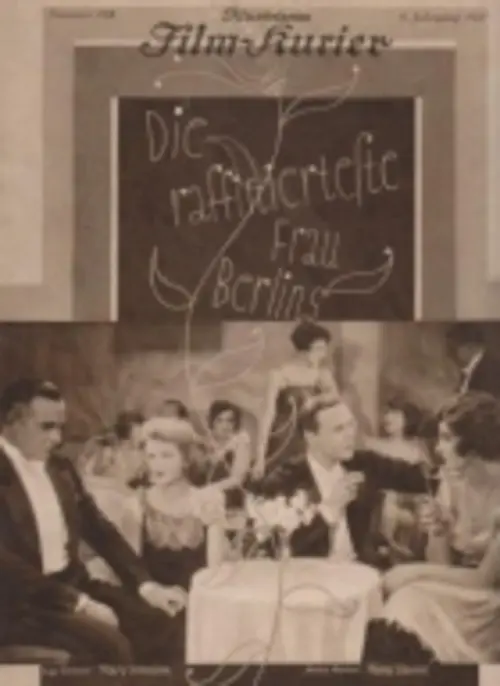
Is Die raffinierteste Frau Berlins a hidden gem or a forgotten relic? Short answer: It is a fascinating, if occasionally sluggish, window into the high-society artifice of 1920s Germany that rewards patient viewers with its sharp social observations.
This film is for the dedicated cinephile who finds beauty in the architecture of silent-era storytelling and the specific cultural anxieties of the Weimar Republic. It is absolutely not for those who demand high-octane action or the rapid-fire pacing of modern digital cinema.
1) This film works because of its impeccable costume design and the magnetic, understated performance of Mary Johnson, who carries the weight of the narrative with a single glance.
2) This film fails because the middle act loses momentum, leaning too heavily on title cards to explain complex social maneuvers that the camera should have captured.
3) You should watch it if you are a fan of Weimar-era aesthetics or want to see Rudolf Klein-Rogge in a role that highlights his versatility beyond the iconic villains of Fritz Lang.
To understand Die raffinierteste Frau Berlins, one must understand the year 1927. Berlin was the pulsing heart of European culture, a city vibrating with the tension between extreme poverty and grotesque wealth. The film captures this dichotomy not through gritty realism, but through the lens of 'refinement.' The sets are cavernous, the lighting is often harsh, and the characters move with a practiced rigidity that suggests they are always being watched. It reminds me of the psychological tension in The House of Fear, where the environment itself feels like an antagonist.
The directing by Franz Seitz is deliberate. He doesn't rush the scenes. Instead, he allows the camera to linger on the textures of the silk dresses and the smoke rising from expensive cigars. This isn't just vanity; it’s a thematic choice. In this world, the surface is everything. If you lose your 'refinement,' you lose your soul. This focus on the external mask is a common thread in films like Vampyrdanserinden, where the performance of femininity is central to the plot.
Mary Johnson, as Dolly, is the anchor. In an era where silent acting often leaned into theatrical pantomime, Johnson is remarkably modern. There is a scene early in the film where she enters a crowded ballroom. Most actresses of the time would have played to the rafters, but Johnson remains still. Her power comes from her composure. She is the 'refined woman' not because she is the loudest, but because she is the most controlled. It is a performance that anticipates the cool detachment of later noir icons.
Contrast this with the supporting cast. Rudolf Klein-Rogge, a titan of German cinema, provides a necessary gravity. While he is often associated with the bombast of *Metropolis*, here he shows a quieter, more calculating side. The chemistry—or lack thereof—between the characters is the engine of the film. It’s a game of social chess where every move is calculated to avoid the kind of emotional exposure seen in Mother, I Need You.
Yes, but with caveats. If you are looking for a masterpiece that redefined the medium, this isn't it. It doesn't have the experimental fervor of the Soviet montage movement or the expressionist shadows of Murnau. However, it is a superior example of the 'society film.' It captures the specific social anxieties of the German middle class—the fear of falling behind, the obsession with status, and the fragility of wealth. It deals with these themes far more effectively than The Poor Rich Man, which often felt too didactic.
The film is a time capsule. It shows us what Berlin thought of itself at the height of its power. The humor, provided by actors like Paul Morgan and Siegfried Berisch, is surprisingly sharp. It mocks the very society it depicts, offering a cynical edge that prevents the film from becoming a mere vanity project. It’s a film that knows its world is built on sand. It works. But it’s flawed.
The pacing is where the film struggles most. The first act is a brilliant setup, establishing the stakes and the characters with the efficiency of A Wild Goose Chase. However, the second act gets bogged down in secondary plotlines that don't always pay off. There is a subplot involving a stolen document that feels like it belongs in a different movie, perhaps something closer to The Mysterious Mrs. Musslewhite. It distracts from the central character study of Dolly.
Visually, the film is a feast for those who appreciate the 'New Objectivity' style. The cinematography is crisp, favoring sharp lines and deep focus. This clarity emphasizes the coldness of the characters' lives. Even in the comedic moments, such as the social blunders reminiscent of Bride and Gloomy or Please Excuse Me, the camera remains objective and detached. It refuses to let the audience off the hook with easy sentimentality.
The screenplay by Richard Arvay and Robert Liebmann is a fascinating artifact. Liebmann, in particular, would go on to write for major sound films, and you can see his interest in dialogue-driven conflict even here in the silent era. The title cards are not just functional; they are witty. They capture the linguistic gymnastics of a society that prides itself on saying one thing and meaning another. This narrative trickery is something we see expanded in films like Tricked.
The film’s exploration of class is subtle but biting. Unlike The Plumber's Daughter, which treats class as a barrier to be overcome by love, Die raffinierteste Frau Berlins treats class as a prison that the characters have decorated with gold. There is a sense of 'uneasy money' throughout, much like the themes explored in Uneasy Money. No one is ever quite safe, and the 'refinement' is the only thing keeping the wolves at the door.
When compared to other melodramas like Kathleen Mavourneen or the more innocent Dust Flower, Die raffinierteste Frau Berlins feels remarkably cynical. It doesn't believe in the inherent goodness of people. It believes in the power of the image. Even the comedic elements, which might remind some of the slapstick pacing in Alice's Egg Plant, are grounded in a darker social reality. It is a film that demands to be taken seriously, even when it is being funny.
The film’s exploration of romantic recklessness, similar to Reckless Romance, is handled with a much cooler hand. It’s not about the heat of passion; it’s about the cold calculation of a social merger. This lack of warmth is its greatest strength. It makes the film feel honest in a way that many of its contemporaries were not.
Die raffinierteste Frau Berlins is a sophisticated, if imperfect, slice of 1920s cinema. It captures a world on the brink of collapse, obsessed with its own reflection. While it may not be a 'masterpiece' in the traditional sense, it is an essential watch for anyone interested in the social history of Berlin or the evolution of the modern female protagonist. It is a film that understands that in the game of life, the one who wears the best mask wins.
IMDb —
1923
Community
Log in to comment.