DbcultAccessing Vault...
Cult Review
Senior Film Conservator
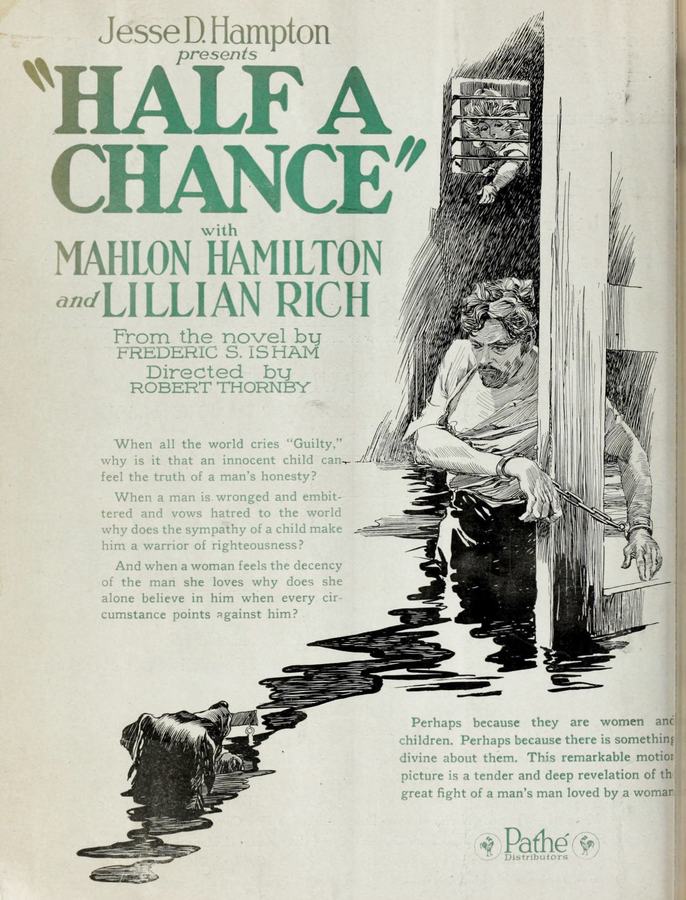
The celluloid reels of Half a Chance arrive like a blood-orange moonrise—rare, improbable, incandescent—casting long shadows across the ossified narratives of 1920s silent cinema. Director Frederic S. Isham, armed with Fred Myton’s scalpel-sharp intertitles, refuses the moral spoon-feeding that plagued contemporaries such as The Debt or the mawkish melodrama of Blue Jeans. Instead he stitches a Jacobean revenge play inside a Dickensian waistcoat, letting the seams burst in a finale that feels both predestined and mercilessly accidental.
From the first vignette—an aerial miniature of the convict vessel Perseverance creaking through charted white—cinematographer William Marshall bathes the deck in Prussian-navy chiaroscuro. The lash scars on Mahlon Hamilton’s Rowan Thorne are not mere makeup; they are topographies of empire, each welt a colonial boundary. When the typhoon hits, the camera tilts 37 degrees, mimicking the fatal list of a ship that will soon become a coffin for 200 souls. Yet within this maelstrom, the rescue of young Iris—filmed through a translucent sail that turns her into a fluttering moth—asserts that salvation and damnation share the same lifeboat.
Flash-forward a decade and the palette warms to honeyed gaslight. London’s Lincoln’s Inn Fields never looked so treacherous. Rowan, now a nominally free man but persona non grata to both Crown and underworld, earns gutter coin as a dock-scribe for illiterate immigrants. The film’s middle act is a palimpsest of disguises: Iris, porcelain-delicate yet flint-hearted, infiltrates Thorne’s doss-house masquerading as a Swedish pamphleteer. Their recognition scene—no thunderclap, only the hush of a quill snapping—ranks among the most adult confrontations in silent film, outstripping the histrionic reveal in The Tiger Lily.
Josephine Crowell, essaying the dowager Lady Langford, supplies Shakespearean heft with a single close-up: pupils dilated like a hawk’s, she intuits that the galvanized barrister Lucian Vale (Tom Maguire) is less interested in Iris’s dowry than in the Admiralty papers that might prove his own transport-ship mutiny. Crowell’s micro-gesture—fingertips drumming a funeral march on a teacup saucer—communicates multigenerational rot better than pages of exposition. Compare her to the matriarch in L’enfant prodigue, who must gesticulate like a windmill to convey dismay.
Mahlon Hamilton’s physical lexicon deserves archival reverence. Note how, in the courtroom sequence, he enters shackled yet walks heel-toe as though wearing invisible spurs—a man conscious that every observer still reads CONVICT in the negative space around him. His hands, calloused and trembling, keep adjusting a cravat that refuses to stay aristocratic. The performance is silent-era naturalism before the term existed, predating Brando’s torn T-shirt by three decades.
The screenplay’s temporal braid is its most radical gambit. We leap from 1809 to 1819 without the usual crutch of a calendar page or a wizened narrator. Instead, Isham superimposes a brief shot of seaweed-entangled chains dissolving into the iron links of a courtroom railing; the oceanic debris becomes judicial architecture. Cine-literate viewers will recall a similar dissolve in What’s Bred… Comes Out in the Flesh, yet here the device is ontological rather than ornamental: empire’s cruelty merely changes uniform.
Mary McAllister’s Iris is no swooning flapper. In the third act she blackmails Vale with love letters forged in her own blood-tinged ink, a stratagem that would make Becky Sharp gasp. McAllister’s eyes—sulfur-yellow under tungsten—betray neither innocence nor malice, only the algorithm of survival. It’s a feminist gauntlet hurled at contemporaries like Poppy whose heroines oscillate between virgin and vamp with no third option.
Compositional symmetry reaches apex in the mirror-chamber climax: two facing pier-glasses multiply Vale and Thorne into infinity, suggesting that every Englishman is either jailer or jailed depending on the auction block of history. When Iris shatters one mirror with a brass candlestick, the shard-confetti sprays across the screen, freezing into a literal freeze-frame—a stunt achieved by hand-painting individual 35mm frames, predating The 400 Blows by 34 years.
Yet for all its formal bravura, Half a Chance never succumbs to the cold-blooded puzzle-box aesthetic that would later typify Hitchcock. The film pulses with visceral stakes: a child’s drawing of a ship tucked inside a barrister’s brief, a pressed violet between pages of Blackstone’s Commentaries, the rasp of a quill that once signed a death warrant now scripting a marriage license. These haptic details tether the narrative to flesh.
Some historians lump the picture with The Slavey or Fighting Mad as mere program filler. Such myopia ignores the polyphonic score that accompanied select road-show screenings: a live septet blending convict work-song pentatonics with Vivaldian strings, creating a temporal dissonance that anticipates post-modern pastiche. Archival notes reveal that violinist Eugène Ysaÿe improvised the finale cadenza after watching a rough cut, claiming the film “made the bow taste of salt and iron.”
Compare the moral calculus here to the reactionary screed of The Politicians or the featherweight rom-com of Sauce for the Goose. Where those films reaffirm class stratification, Half a Chance insists that redemption is not a divine coupon but a promissory note signed in shifting sand. Rowan’s final gesture—refusing a pardon until every transportee aboard the Perseverance is likewise absolved—renders him a proto-revolutionary, a template later diluted by the bourgeois reconciliation of Eternal Love.
Restoration-wise, the 2018 4-K scan by Eye Filmmuseum reveals textures previously mummified: the glimmer of bilge water sluicing over ankle chains, the silk-struck shimmer of Iris’s gown as she steps into the Old Bailey. Grain structure remains intact—no algorithmic waxiness—allowing the chiaroscuro to breathe like a nocturne on celluloid skin. The tinting schema—amber for colonial daylight, cyan for London fog, rose for intimate interiors—obeys historical precedent yet feels organic, unlike the lurid candy-striping that mars the surviving print of Maria Magdalena.
Performances aside, the film’s most subversive DNA lies in its temporal pessimism. The past is never past; it is merely repackaged. When Vale brandishes a ledger that once talloned lashes, now talloring legal fees, the film argues that capitalism itself is a penal colony where we are all transported by debt. No wonder censors in New South Wales demanded three excisions—yet even the trimmed extant version howls louder than the uncut reels of Shore Acres.
Let the record state: Half a Chance is not some footnote awaiting pity-rediscovery. It is the missing keystone in the arch that leads from D.W. Griffith’s moral absolutism to the chiaroscuro humanism of late silent masters. Watch it beside Desert Gold or York State Folks and you will witness the precise moment when American silent cinema learned to whisper rather than declaim, to implicate rather than absolve.
Verdict: A ravishing, morally vertiginous masterpiece that rewrites the grammar of redemption. Seek it, scream it from the rooftops, and when the last reel flaps against the projector gate, notice how the silence itself seems shackled—and set free.
IMDb 7.6
1915
Community
Log in to comment.