DbcultAccessing Vault...
Cult Review
Senior Film Conservator
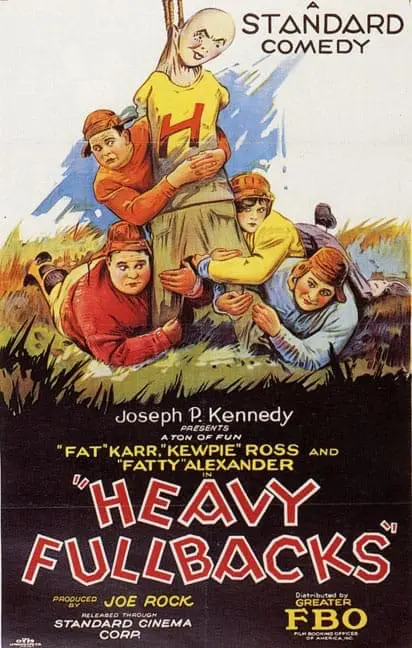
Should you spend your time on this silent-era relic? Short answer: yes, but only if you appreciate the raw, unrefined energy of 1920s slapstick.
This film is specifically for historians of physical comedy and fans of the 'Ton of Fun' trio. It is definitely NOT for viewers who require a tight narrative or modern sensitivity regarding body image.
Heavy Fullbacks is a fascinating example of the 'Ton of Fun' shorts that prioritized physical scale over narrative depth. While it lacks the sophisticated timing of a Buster Keaton feature, it offers a visceral, high-energy experience that captures the absurdity of the era’s burlesque tradition. It is a loud, silent movie.
1) This film works because the physical commitment of the lead trio creates a unique visual rhythm that smaller actors simply couldn't replicate.
2) This film fails because the plot is essentially a clothesline for gags, with almost no character development beyond the surface level.
3) You should watch it if you want to see how early cinema utilized the 'sports parody' genre before it became a Hollywood staple.
The setting of Heavy Fullbacks is its most inspired creative choice. The idea of a town centered around a college for barbers and chiropractors is inherently ridiculous, yet the film treats it with a straight-faced commitment to the bit. This allows for a series of opening gags that bridge the gap between grooming and bone-setting. In one specific scene, a 'chiropractic adjustment' is performed with such violent enthusiasm that it resembles a professional wrestling match more than medical care.
This satire of vocational education provides a much-needed layer of texture. Without it, the film would just be another chase sequence. By grounding the rivalry in this specific, weird world, the director gives the slapstick a sense of place. It’s a world where a razor is as dangerous as a tackle, and the film leans into that crossover with glee.
The trio consisting of 'Kewpie' Ross, Hilliard Karr, and Frank Alexander was a staple of the era. They weren't just actors; they were a spectacle. In Heavy Fullbacks, their chemistry is the engine that drives the film. Unlike many comedy teams where one person is the 'straight man,' here the three act as a collective force of nature. Their movements are surprisingly coordinated, like a heavy-set ballet of errors.
Bud Jamison serves as the perfect foil. Jamison, who frequently appeared in Chaplin shorts, understands how to react to the trio's mass. When he is on screen, the film gains a sense of kinetic stakes. He isn't just trying to win the girl; he's trying to survive the sheer physical volume of his opponents. It’s a classic David vs. Goliath setup, but with three Goliaths and a very confused David.
The cinematography in Heavy Fullbacks is functional rather than artistic, but it handles the challenge of framing three large men simultaneously with surprising efficiency. The director uses wide shots to emphasize the scale of the trio, often positioning them in a triangle formation to dominate the frame. This creates a visual claustrophobia for Bud Jamison, which works perfectly for the comedy.
The pacing is relentless. Once the football game begins, the editing speeds up, mimicking the frantic nature of the sport. However, unlike the more polished Two Tough Tenderfeet, the transitions here can feel a bit jarring. There are moments where the logic of the game is completely abandoned for a quick gag, such as a player disappearing into the mud only to reappear on the other side of the field. It’s nonsensical, but it fits the burlesque tone.
The football game is the centerpiece of the film, and it is where the slapstick reaches its peak. It’s a messy, muddy affair. The ball is often secondary to the collisions. What is most striking about this sequence is how little the film cares about the rules of the game. It’s a parody of athleticism. The 'heavy fullbacks' use their weight as a literal weapon, turning the field into a demolition derby.
The ending is the film's most debatable creative decision. Usually, in these comedies, the hero wins the game and the girl. Here, the game ends in a draw. No one wins. The trophy is given to Lois Boyd. This is a brutally simple subversion. On one hand, it feels like a lazy way to resolve the plot. On the other, it’s a refreshing rejection of the idea that the woman is a prize to be won through a sports match. It’s an accidental moment of progressivism in a film otherwise built on broad stereotypes.
When compared to other films of the period like Honeymoon Hardships, Heavy Fullbacks feels much more grounded in physical spectacle. While other shorts tried to incorporate more complex situational irony, this film knows exactly what it is: a vehicle for three men to fall over in amusing ways. It shares some DNA with Flip's Circus in its reliance on the 'spectacle of the body,' but it lacks the whimsical charm of the latter.
It also lacks the emotional resonance of a film like Humoresque. But that’s not the point. You don't go to a barber-chiropractor college comedy for emotional resonance. You go for the sight of a 300-pound man being tackled into a pile of shaving cream.
If you are a student of film history, yes. It provides a clear window into the transition of comedy from the stage to the screen. If you are looking for a masterpiece of cinema, look elsewhere. It is a minor work, but a loud one. It’s a mess, but a deliberate one. The physics are wrong, the plot is thin, but the energy is infectious.
Pros:
- High-energy performances from the 'Ton of Fun' trio.
- Genuinely creative use of the college setting for gags.
- Short runtime ensures the joke doesn't overstay its welcome.
- Bud Jamison is a fantastic physical antagonist.
Cons:
- The humor is very one-note.
- Minimal narrative stakes.
- Some of the physical gags feel recycled from earlier shorts.
Heavy Fullbacks is a punchy, aggressive piece of silent comedy that doesn't ask for your respect, only your laughter. It succeeds in its narrow goal of providing physical spectacle. Gravity is the only real villain here, and the 'Ton of Fun' trio fights it to a glorious, muddy draw. It’s not a masterpiece, but it’s a heavy-hitting slice of history. It works. But it’s flawed.
IMDb —
1926
Community
Log in to comment.