DbcultAccessing Vault...
Cult Review
Senior Film Conservator
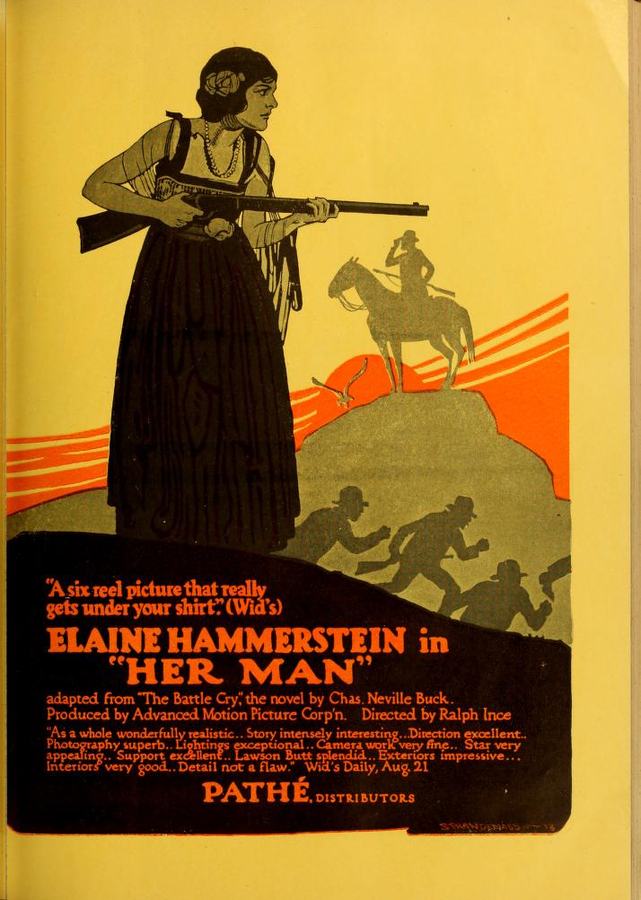
Juanita’s first glimpse of the Cumberlands is a dissolve that feels like a bruise blooming—mist drapes the ridgelines like a confession no one asked for.
By the time the intertitle card fades, we understand that Her Man is not merely another backwoods tableau strung together with moonshine and muskets; it is a celluloid battle between enlightenment and entropy, pitched at a tempo that anticipates the feverish sagas Ford would later mythologize. The film’s 1924 release places it in that restless interstice when silent cinema was flexing every muscle before the microphone shackled it to dialogue, and director John Ince—aided by scenarist Augustus Thomas—treats the feud like a living organism: it exhales through barren orchards, it pulses under floorboards, it leaks into hymnals.
Violet Palmer’s Juanita arrives with a wardrobe calibrated for Newport garden parties, yet the screenplay refuses to sand down her privilege into easy noblesse oblige. Instead, her silk scarf becomes both banner and noose: she knots it around a child’s neck to demonstrate vowels, then yanks it taut as a tourniquet when lead rips flesh. Palmer—primarily known for light comedies—lets her eyes do the heavy lifting; they widen not in ingenue shock but in voracious curiosity, as though violence were merely another dialect she must master. The moment she trades her kid gloves for the rifle, the cut is so abrupt that the splice itself feels like a slap, a visual oath that she will no longer subcontract her survival.
Carleton Macy’s performance belongs in the pantheon of mountain masculinity that later echoes through The World, the Flesh and the Devil and even, in a crooked lineage, through Trapped by the Camera. Macy never merely plays a clan chief; he inhabits the very barometric shift that precedes his entrance—dogs stop barking, pine needles hold their breath. His courtship of Juanita is staged in negative space: the film keeps them at opposite edges of the frame until a thunderstorm strands them under a rotting corn-crib roof. In close-up, rainwater dilutes the blood on his knuckles; she marks the letters L-A-W into the mud between them, and he smears the A into an O—a primal correction that whispers, here, lexicon is seduction.
Rather than choreographing skirmishes like square dances, Ince stages the feud as thermodynamic law: heat rises, grudges sink, and every action metastasizes. When the McBriars ambush a Havey cousin, the camera pivots from the victim’s boots still twitching in foreground to a distant ridge where a child releases a red kite—an image at once lyrical and obscene, reminding us that atrocity always has spectators. This ricochet logic anticipates the chain-revenge structure of The Shadow of a Doubt, though Her Man predates it by several years and lacks that film’s noir fatalism, substituting instead a frontier positism that believes even bullets can be tutored.
One reel lingers inside a one-room school lit by kerosene; shadows jitter across hand-chalked alphabet cards. A McBriar boy sounds out M-U-R-D-E-R, then glances at the Havey girl across the bench—suddenly the word is no longer abstraction but itinerary. Juanita’s lesson plan unravels into blood-oath, and the film indicts the very act of naming: to spell is to conjure. This thematic spine allies Her Man with The Perfect Thirty-Six, where suffrage campaigns weaponize pamphlets, yet here print culture is both salvation and accelerant.
The film’s most subversive stroke arrives when Juanita, long-dress torn to the knee, racks a Winchester she barely shoulders. The reverse-shot reveals her POV: cross-hairs trembling over the heart of Old Milt. In 1924, to witness a society woman squeeze off rounds at a patriarch was incendiary—comparable only to Leatrice Joy’s pistol-packing flapper in Cecil B. DeMille’s The Road to Yesterday. Yet Her Man refuses to fetishize; the recoil slams her against a split-rail fence, busting her lip. Blood beads on chin, she licks it, and in that copper taste recalibrates the entire narrative: marriage will not domesticate her; it will arm her.
Because the Hays Office had not yet clamped the industry’s moral calipers, the hanging sequence is startlingly clinical. The camera tracks beneath the gallows, revealing boots testing air, then dollies backward through a crowd whose faces mutate from vengeance to nausea. The cutaway to a fiddler—frozen mid-bow—works as both macabre humor and moral freeze-frame: art itself stunned into silence. Compare this to the lynch-mob hysteria of The Celebrated Stielow Case; here the state’s victory tastes of rust rather than triumph, foreshadowing that legal justice can be merely another bloodline.
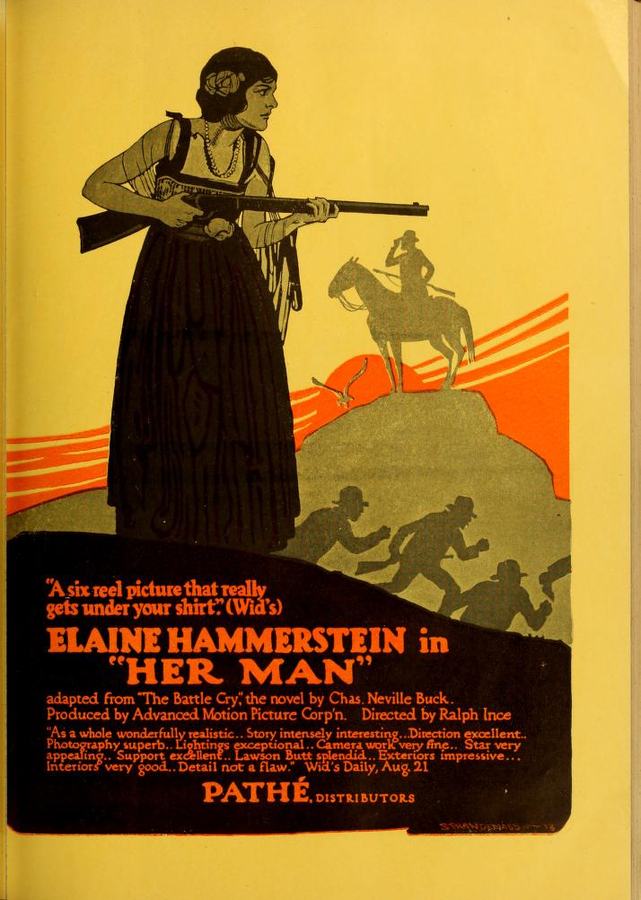
The bedside wedding—candle nubs, bible, and a midwife pressed into officiant—flips the bourgeois fantasy on its head. No organ, no veil, only the percussion of Anse’s ragged breath. Juanita’s vows are whispered into an ear caked with powder residue, yet the close-up on her pupils reveals a cosmic reconfiguration: she is not renouncing civilization but smuggling it into the wild, encoded within a sacrament older than statutes. When dawn backlights the cabin and we realize Anse will survive, the film withholds easy catharsis; instead, the couple simply grips hands atop the bible, their interlaced fingers forming a new sigil—part cross, part trigger-guard.
Cinematographer Devereaux Jennings treats fog like a character. It slithers along creek beds, pools inside doorways, swallows hoofbeats. Such atmospherics presage the expressionist swamps of Vampyrdanserinden, yet here the murk is historical, not supernatural. Jennings contrasts that opacity with tactile details: a page from McGuffey’s Reader, greasy with possum fat; a hymnal swollen by humidity; a bullet mold glowing orange beside the hearth. Each object is encoded with narrative voltage; you sense that if you scratched any surface, story would bleed.
Surviving prints are mute; no authentic cue sheets surface. Contemporary exhibitors likely mashed Appalachian reels with parlour ballads, producing an aural whiplash that mirrored the film’s culture clash. Modern festivals often commission new scores—fiddles, dulcimers, the obligatory washboard—yet such choices sand the edges off the narrative’s urban intrusion. A bolder restorer might juxtapose atonal strings with field hollers, letting dissonance stand in for the heroine’s fractured identity. Until then, the vacuum amplifies every visual throb; you hear the strike of a match that never occurs onscreen, testimony to cinema’s synesthetic voodoo.
Elaine Hammerstein, as Jeb’s widow, delivers a single-tear tableau worthy of Lillian Gish without the histrionics. Leatrice Joy cameos as a traveling photographer, her lens becoming the film’s meta-conscience—she snaps the hanging, then retreats under her hooded cape, a witness who refuses to forget. Cecil Chichester’s Old Milt is less villain than entropy’s agent; his final glare through a broken windowpane condenses generations of grievance into a look sharp enough to cut tin.
The last known 35 mm nitrate print resides in an Italian archive, vinegar-wrinkled and missing the hanging reel. A 4K scan was attempted in 2017, but emulsion bubbled under the scanner’s lamp like hot caramel. Enthusiasts circulate a 1.2 GB digital file—watermarked, interlaced, riddled with comet tails—yet even that battered ghost seethes with potency. A crowdfunding campaign spearheaded by Women in Film Heritage Committee aims to reconstruct the missing reel via an original continuity script discovered in a West Virginia attic; donors receive a limited-edition reed diffuser scented with pine-knot and black-powder (marketing genius or olfactory colonialism? You decide).
Pair Her Man with A Woman’s Power and you witness two poles of feminist intervention: urban reformist versus rural insurrectionist. Contrast it with The Traitress and you map how seduction can weaponize empire. Finally, set it beside The Love Hermit to see how solitude heals in one film while solidarity arms in another.
Great art does not resolve; it irradiates. Her Man leaves the feud smoldering, the marriage unconsummated on any ledger, and the mountains glowering at the audacity of one woman who dared replace bullets with bylaws. Yet the film’s fiercest legacy lies in its proposition that love itself can be a loaded chamber, that to teach is to trespass, that to wed is to wager your life on a syllable. Until a pristine print surfaces, we chase its afterimage—the way you stare at a hillside after lightning, waiting for fire to announce itself in the dark.
IMDb —
1922
Community
Log in to comment.