DbcultAccessing Vault...
Cult Review
Senior Film Conservator
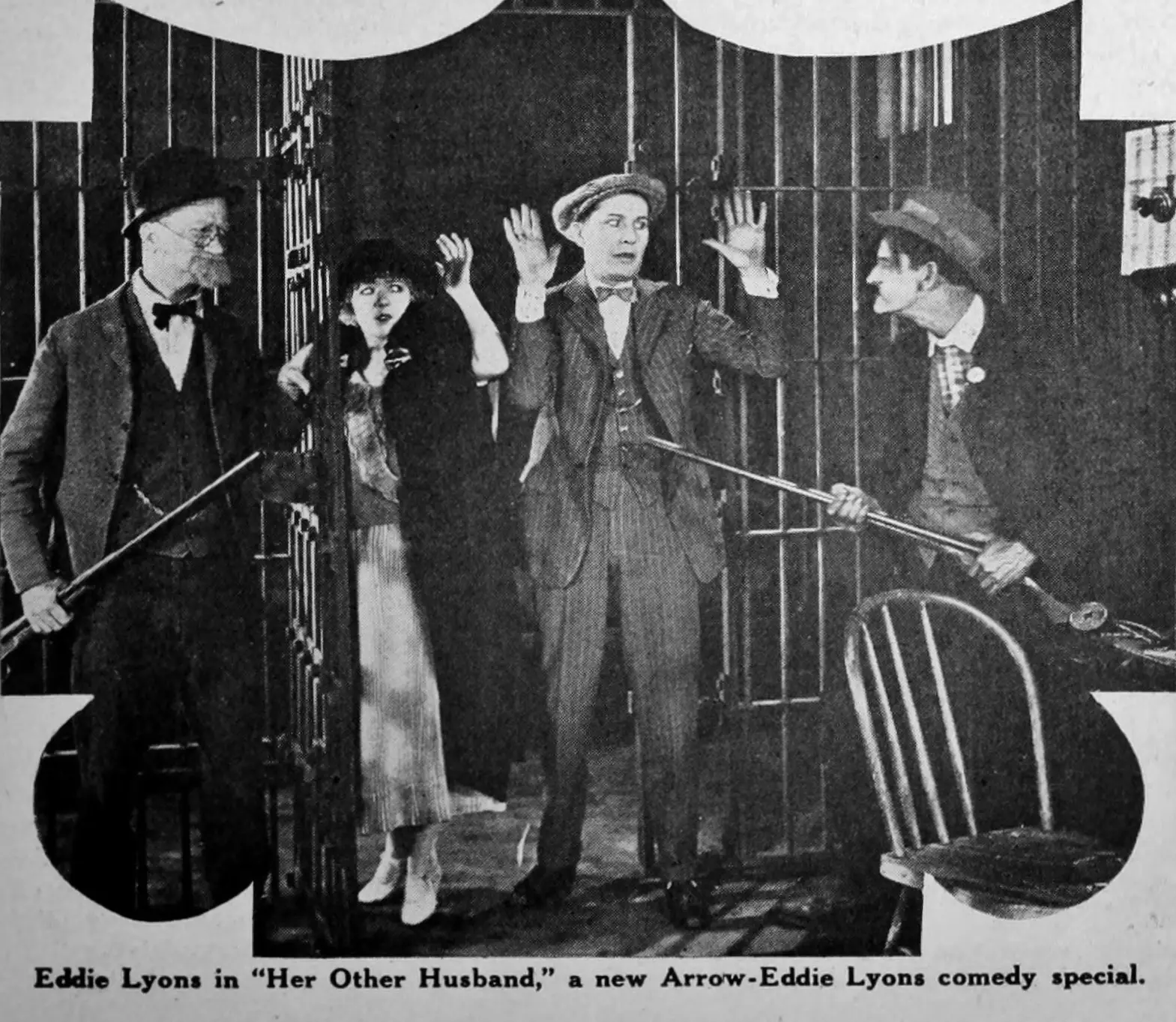
To witness Her Other Husband in its native temporal habitat is to encounter the 1920s at a fascinating crossroads of cinematic evolution. At this juncture, the language of film was transitioning from the primitive gags of the nickelodeon era into a more structured, albeit still chaotic, form of narrative storytelling. This film, featuring the formidable pairing of Lillian Hackett and Eddie Lyons, represents a sophisticated iteration of the domestic farce, a genre that thrived on the tension between public propriety and private pandemonium.
The film’s brilliance lies not in the novelty of its premise—which involves the classic 'wrong person in the wrong room' trope—but in the sheer velocity of its execution. Lyons, who had spent much of the previous decade refining his comedic timing in partnership with Lee Moran, brings a solo (or rather, newly partnered) energy here that feels both liberated and desperate. He inhabits the frame with a nervous vitality, his every gesture a calculated attempt to stave off the social ruin that domestic scandal promised in 1920. In contrast, Hackett offers a performance of nuanced mischief; she is the fulcrum upon which the entire plot rotates, managing to appear both the victim of circumstance and the architect of its resolution.
In the silent era, comedy was a visual language of geometry. Her Other Husband utilizes the space of the household as a stage for complex blocking. Doors are not merely exits; they are rhythmic devices. When Lyons enters a room, the audience is already anticipating the exit of a rival, a ghost of a husband, or a prying neighbor. This spatial choreography is reminiscent of the structural integrity found in The City of Masks, where the environment itself dictates the moral boundaries of the characters.
Unlike the more somber explorations of duty seen in The Honor of His House, this film treats the concept of 'honor' as a punchline. The 'other husband' of the title is a phantom of social expectation, a specter that haunts the protagonist’s attempts at a quiet life. The film’s writers (though often uncredited in the modern sense, their influence is felt in every beat) understood that for a farce to work, the stakes must feel existential to the characters while remaining absurd to the audience. This dichotomy is handled with a deftness that suggests a deep understanding of the human condition's inherent silliness.
"The film operates as a visual symphony of panic, where the crescendo is always a slammed door and the resolution is a sheepish grin."
When we place Her Other Husband alongside its contemporaries, its unique flavor becomes even more apparent. It lacks the existential dread of During the Plague, opting instead for a sunny, albeit frantic, disposition. While other films of the period were experimenting with the darker corners of the human psyche—such as the thematic weight found in The White Masks—Lyons and Hackett were content to play in the sandbox of human vanity. There is a lightness here that mirrors the ebullience of Be a Little Sport, yet it carries a sharper satirical edge.
The film also predates the more polished, high-society comedies of the mid-1920s, such as Queens Are Trumps. In Her Other Husband, the settings are more grounded, the stakes more relatable. We are not in the palaces of Europe but in the parlors of an aspiring middle class. This relatability is what likely fueled its success; audiences saw their own fears of social embarrassment reflected back at them, albeit distorted through the lens of slapstick hyperbole.
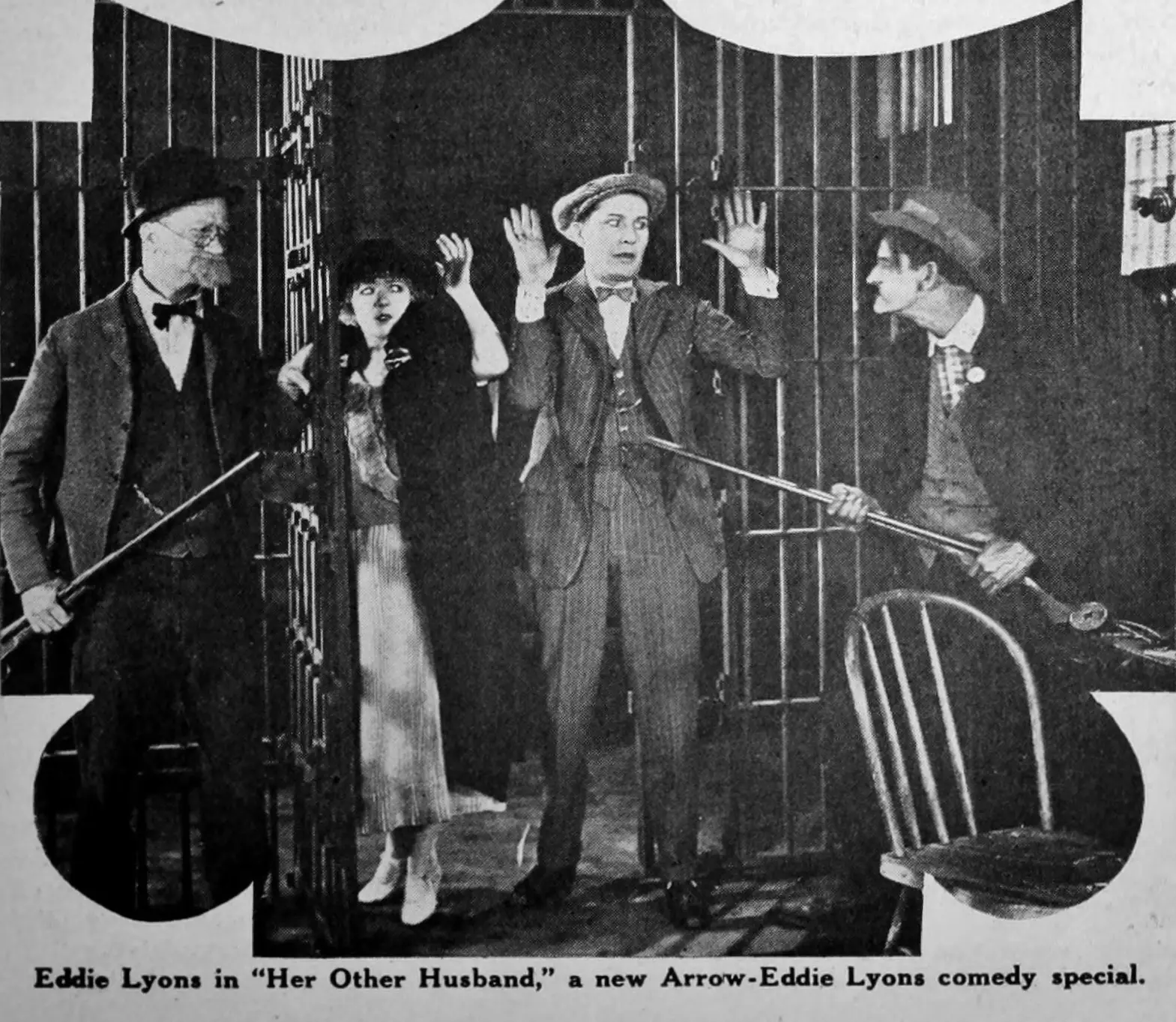
From a technical standpoint, the cinematography is remarkably clean for a production of this vintage. The lighting avoids the harsh, flat look of earlier silents, instead using shadows to emphasize the 'hiding' aspect of the plot. The intertitles are more than mere exposition; they are punctuations of wit, often providing a cynical commentary on the action that the actors’ faces alone cannot convey. This synergy between text and image is a hallmark of the era’s best work, comparable to the narrative complexity found in La luz, tríptico de la vida moderna, though far less experimental in its editing.
One cannot ignore the costume design, which, while seemingly standard, plays a vital role in the film's semiotics. Lyons’ suits are always slightly too tight or too loose, emphasizing his discomfort in his own social skin. Hackett’s attire, on the other hand, is impeccably chosen to project a sense of control that her character frequently loses. This visual storytelling is a subtle art that often goes unremarked in silent film critique, yet it is essential for the characterization that drives the narrative forward.
Why does the 'other husband' trope persist? In films like Somebody Lied or Once a Mason, the secret identity or the hidden spouse is a catalyst for the breakdown of the patriarchal order. Her Other Husband follows this tradition by suggesting that the 'husband' is not a person, but a role—one that can be filled, vacated, or duplicated as the situation demands. This fluid view of identity was quite radical for 1920, even if presented in the guise of a harmless comedy.
Furthermore, the film’s pacing is a masterclass in tension. It avoids the lethargy that sometimes plagues early features. By the time we reach the third act, the misunderstandings have piled up like a house of cards in a windstorm. The resolution, while expected, is satisfying because it rewards the audience’s investment in the chaos. It lacks the tragic overtones of The Faded Flower, choosing instead to end on a note of harmonious, if exhausted, reconciliation.
In the grand tapestry of silent cinema, Her Other Husband may not have the monumental status of a Griffith or a Murnau epic, but it is an essential piece of the puzzle. It captures a specific moment of American humor—one that was moving away from the rural and toward the urban, from the physical to the situational. It is a film that rewards multiple viewings, as the subtle interplay between Lyons and Hackett reveals new layers of comedic timing with each pass.
As we look back from the vantage point of the 21st century, we can see the seeds of the modern sitcom being sown in these twenty-four frames per second. The film is a testament to the enduring power of a well-told joke and the timelessness of human folly. It stands alongside works like Alias Mary Brown and Boman på utställningen as a vital document of a world trying to find its laughter in the wake of global upheaval. To watch it today is not merely an act of archival curiosity, but a genuine pleasure, proving that while technology changes, the mechanics of a good laugh remain remarkably consistent.
Ultimately, Her Other Husband is a triumph of the spirit over the mundane. It invites us to laugh at the structures we build for ourselves—the marriages, the houses, the reputations—and reminds us that beneath the veneer of 1920s respectability, there is always a bit of a 'sport' waiting to break free, much like the characters in Be a Little Sport. It is a sparkling, albeit brief, moment in film history that deserves its place in the spotlight once more.
IMDb —
1915
Community
Log in to comment.