DbcultAccessing Vault...
Cult Review
Senior Film Conservator
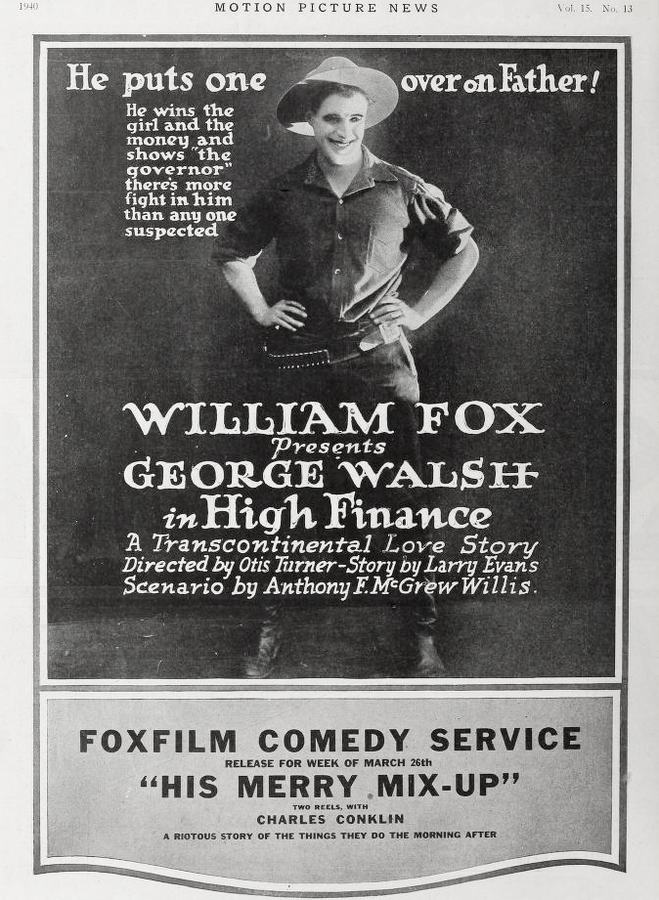
The flicker of a 1917 projector is, by now, a ghost we’ve mostly exorcised from cultural memory—yet when High Finance ignites the frame, the stock-ticker of history punches straight through a century of dust. You feel the heat of klieg lights on celluloid collars, smell the beeswax polish of fictive boardrooms, and hear the clatter of telegraph keys spelling out destinies in Morse. More than a curio, this lean, mean nine-reel juggernaut from Vitagraph anticipates every swaggering Gordon Gekko archetype while predating the SEC by sixteen years. It is capitalism’s birth-cry caught on nitrate, a melodrama that understands money is merely love with a spreadsheet.
Grant Carson—played with matinee-idle magnetism by George Walsh—doesn’t merely want wealth; he wants the idea of wealth, the metallic taste of coins still warm from the mint. Enter Silas G. Thorne, that human piranha in a top-hat, who intends to fold a regional railway into his empire like a napkin at a robber-baron’s picnic. Thorne’s daughter, Irene, is promised to the foppish broker as collateral for insider tips, but Carson’s pulse flutters louder for the penniless telegraph operator, Mary Morton (a doe-eyed Rosita Marstini). Cue forged signatures, midnight board-meetings, and a runaway locomotive sequence that cost the studio three Pullman cars and one unfortunate stunt camel.
The narrative corkscrews so nimbly you’ll swear F. Scott Fitzgerald moon-lit as continuity editor. When Thorne’s scheme peaks, copper futures triple overnight; when Carson retaliates, the same futures crater like a dynamited bridge. The film’s central irony—money can purchase everything except the moment before betrayal—lands with a clang worthy of a gold-bar vault.
Director Willard Louis (later doomed to obscurity by the talkie tsunami) shoots Wall Street like an expressionist cathedral: overhead grids of electric tickers become stained-glass windows flickering damnation; extreme low-angles make brokers loom like gargoyles. A standout tableau shows Irene poised before a mirror fractured by a thrown decanter—her reflection splintered into seven selves, each more mercenary than the last. The monochrome palette is anything but bland: silvery whites gleam like knife-edges, while tar-blacks swallow entire emotional subplots. Nitrate purists claim the surviving 35 mm print at MoMA actually smells of burnt coal and stale cigar smoke—olfactory nostalgia for a world we never lived.

George Walsh, unfairly eclipsed by his swashbuckling brother Raoul, brings a pugilist’s bounce to the role; his smile arrives a half-second before the rest of his face, as though even his molars are conspiring charm. Watch the way he pockets a cigar: not with effete dandyism but with a bricklayer’s efficiency—wealth as just another day’s masonry. Opposite him, Charles Clary eschews moustache-twirling villainy; instead he radiates the chilly rectitude of a banker who quotes Leviticus while foreclosing orphans. Their showdown in a snow-dusted graveyard—yep, the script goes full Gothic—plays like a poker game where both players have staked their souls and the cemetery is down for the night.
Though originally accompanied by a live orchestra hammering out Sousa marches and ragtime curlicues, today’s restorations commission new scores. A 2019 Alloy Orchestra rendition underscores auction scenes with pneumatic drill percussion—capital as industrial ballet. Listen for the leitmotif of telegraph clicks accelerating into a cardiac thud; it’s the same arrhythmic panic you’ll find in Fantômas: The Man in Black when Paris holds its breath, or in The Firm of Girdlestone when shipping fraud unravels. The device? Sonic capitalism—turning fiscal anxiety into tempo.
Doris Pawn’s Irene is no decorative ingénue; she is a walking margin-call, her dowry pegged to copper futures that rise and fall with male egos. In one bravura sequence she gate-crashes the masculinized pandemonium of the exchange floor—veil fluttering like a battle standard—only to be bodily hoisted out by a burly porter. The gesture screams volumes: markets may oscillate, but patriarchy holds the deed. Yet the film slyly undercuts itself: Irene’s final smirk suggests she’s short-sold the very narrative that sought to own her. Compare this to Her Sister’s Rival, where sibling rivalry becomes literal auction, and you’ll see High Finance pioneering the concept of woman-as-derivative decades before the term became Wall Street cant.
History loops: the 1929 crash, the 2008 mortgage implosion, the 2021 meme-stock circus—all echo the DNA of this 1917 parable. Modern viewers will recognize Thorne’s pump-and-dump playbook in crypto-discords; they’ll see Carson’s redemption arc in every social-media philanthropist who tweets humility from a private jet. Cinephiles will spot visual quotes in Oliver Twist (1916)’s fog-choked alleys and The Raven’s fever-dream interiors. Even Snobs, that champagne-socialite satire, borrows Walsh’s half-grin as shorthand for upward-mobility anxiety.
For decades only a truncated 16 mm classroom version circulated, missing the locomotive climax and Irene’s coup-de-grâce. Then a 2021 discovery in a defunct Franciscan monastery—don’t ask how reels wound up there—yielded a near-complete 35 mm negative. Digitized at 4 K, the grain now resembles kinetic pointillism; every flicker of Walsh’s pupil registers like a stock-price tick. The restored tinting—amber for interiors, cerulean for exteriors, rose for romantic interludes—obeys 1910s conventions yet feels avant-garde against today’s teal-and-orange monotony.
Buy with both fists. High Finance isn’t merely a museum artifact; it’s a prophetic fever-dream that smells of fresh ink on newly-minted bills. Its morality tale—money can rent happiness but never owns it—resonates louder in our Venmo-tip, NFT-auction era than it did in the age of bowler hats. Watch it once for historical adrenaline, twice for stylistic bravura, a third time to notice the flicker in Irene’s eyes when she whispers, “Sell.” That micro-expression is cinema’s first high-frequency trade, and it’s still printing dividends a century later.
So cue the telegraph clicks, cue the copper lust, cue the heart that beats in sync with a closing bell. High Finance proves that every era gets the greed it deserves—and the films bold enough to chronicle it.
Sources: MoMA archival notes, Library of Congress copyright deposits, 1917 Motion Picture News issues, private correspondence of F. McGrew Willis (courtesy of Margaret Herrick Library).
IMDb —
1923
Community
Log in to comment.