DbcultAccessing Vault...
Cult Review
Senior Film Conservator
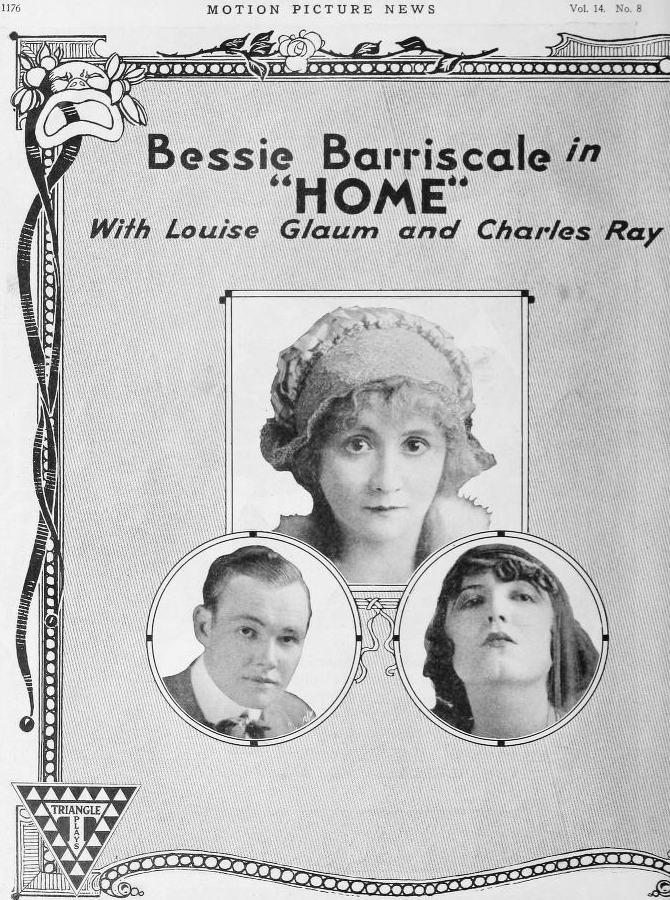
The year 1916 represented a pivotal junction in the evolution of American cinema, a period where the primitive flickers of the nickelodeon era were being supplanted by sophisticated narratives of social observation. At the heart of this transition stands Home, a film that serves as a lacerating critique of the Gilded Age’s lingering ghosts. Directed with a keen eye for domestic topography, this film doesn't merely tell a story; it dissects the very architecture of class identity. Written by the prolific C. Gardner Sullivan, the screenplay functions as a surgical instrument, peeling back the layers of affectation that define the Wheaton family.
In the cinematic landscape of the 1910s, we often saw tales of struggle or high-society romance, but rarely did we witness such a meta-textual deconstruction of behavior. Bessie Wheaton, portrayed with a nuanced volatility by Bessie Barriscale, is the audience’s surrogate—a woman of intellect returning to a home that has become a stage for bad acting. The family she finds is not the one she left; they have become caricatures of wealth. This shift in the Wheaton household is reminiscent of the stylistic shifts found in Drama v kabare futuristov No. 13, where art and life blur into a performative mess, though here the stakes are grounded in the crushing reality of social stratification.
Bessie’s decision to adopt their flaws is a stroke of narrative genius. It is a psychological stratagem that predates modern therapeutic interventions. By becoming the worst version of her father’s laziness and her mother’s vanity, she creates a hyper-realized version of their own sins. This 'mirroring' is a common trope in silent melodrama, yet Sullivan elevates it beyond the simple morality play. It becomes a commentary on the plasticity of the American identity. If one can 'put on' the airs of an aristocrat, one can just as easily 'put on' the parody of that aristocrat to expose the fraudulence of the original.
The Wheaton family members are not merely villains; they are victims of a specific brand of cultural myopia. The father, played with a weary sense of entitlement by Joseph J. Dowling, represents the stagnant end of the American Dream—wealth without purpose. Contrast this with the kinetic energy found in Leben heisst kämpfen, and one sees the moral vacuum Sullivan is attempting to highlight. The mother’s snobbery is not innate; it is a cultivated defense mechanism against her own middle-class origins, a theme also explored in the episodic grandeur of Gloria's Romance.
Then we have the sister, whose obsession with royalty leads her to the arms of Count d'Orr. The Count himself is a fascinating figure—a hollow vessel of European prestige that serves as a litmus test for the family’s vacuity. When Bessie lures him away, she isn't acting out of malice toward her sister, but out of a desperate need to demonstrate that their 'prizes' are as superficial as their manners. This romantic entanglement, while bordering on the soap-operatic, is handled with a restraint that keeps the focus on the thematic core: the erosion of authentic human connection in the face of status-seeking.
The cinematography of Home utilizes the confined spaces of the Wheaton estate to create a sense of claustrophobia. The opulent sets, designed to scream 'new money,' act as a gilded cage. Much like the frozen landscapes in Dr. Mawson in the Antarctic, the Wheaton home is an environment that is hostile to natural life—only here, the frost is emotional rather than physical. The camera lingers on the stiff collars and the elaborate gowns, emphasizing the physical discomfort of these social masks.
Sullivan’s writing avoids the pitfalls of the era's often-saccharine intertitles. Instead, we get a sharp, almost cynical dialogue that cuts through the sentimentality. When Bessie finally confronts her family, the words are not a plea for love, but a indictment of their performance. She tells them she was 'mirroring' them—a term that suggests a cold, scientific observation. This intellectual approach to melodrama is what separates this film from contemporaries like Rose of the South or the more traditional tragedies like Manon Lescaut.
Amidst this sea of artifice, Allan Shelby (Charles Ray) serves as the narrative’s moral compass. His confusion at Bessie’s behavioral shift provides the necessary tension to keep the audience engaged. If Bessie is the actor, Allan is the audience who believes the play is real. His eventual reconciliation with her, after she flees the 'theater' of her home, provides the emotional catharsis required by 1916 audiences, yet it feels earned. Unlike the tragic finality of The Last Chapter, Home offers a chance for reconstruction.
Charles Ray’s performance is understated, a hallmark of his early work before he became synonymous with 'country boy' roles. Here, he is the modern man, bewildered by the archaic social games of the Wheatons. His presence reminds us that there is a world outside the Wheaton mansion—a world of genuine labor and sincere affection, far removed from the 'waxen' existence of the social elite, a theme subtly echoed in The Waxen Doll.
When we look at Home in the context of its peers, its sophistication becomes even more apparent. While Captain Courtesy dealt with external conflicts and historical heroism, Home turned the camera inward, focusing on the domestic battlefield. It shares a certain DNA with The Catspaw in its exploration of manipulation, but where The Catspaw uses manipulation for gain, Bessie uses it for enlightenment.
The film’s pacing is deliberate, lacking the frenetic energy of The Adventures of a Madcap, but this allows for a deeper immersion into the family’s dysfunction. We see the slow-motion car wreck of their social climbing. Even the inclusion of the Count feels like a nod to the international intrigue found in The Vampires: Satanas, though stripped of its pulp trappings and recast as a satirical element. The Count is not a villainous mastermind; he is a bored opportunist, much like the figures in The Lipton Cup: Introducing Sir Thomas Lipton, though without the commercial ambition.
The resolution of Home, where the family acknowledges their 'burlesque of the upper crust,' is surprisingly modern. It suggests that identity is a choice and that the masks we wear can eventually be removed if we are confronted with their ugliness. This is not the grand historical sweep of Richelieu, nor is it a courtroom drama like Evidence. It is a intimate, psychological chamber piece that manages to speak to the macro-economic anxieties of its time.
Bessie Barriscale’s performance remains a high-water mark for the era. She manages to convey a character who is playing a character, a feat of 'acting-within-acting' that requires immense control. Her transition from the 'lazy' daughter back to the 'real' Bessie is handled with a grace that avoids the jerky histrionics common in lesser silent films. She is the soul of the film, the one who burns the house down (metaphorically) so that a real home can be built on the ashes of pretension.
In conclusion, Home is a vital piece of cinematic history that deserves more than a footnote in the archives. It is a sharp, witty, and ultimately hopeful look at the fragility of the social ego. It reminds us that while we may seek to elevate ourselves through titles and clubs, our true 'home' is found in the authenticity of our character and the sincerity of our relationships. For any student of early 20th-century film, it is an essential viewing, offering a masterclass in social satire that remains relevant even in our own age of curated digital identities.
IMDb —
1918
Community
Log in to comment.