DbcultAccessing Vault...
Cult Review
Senior Film Conservator
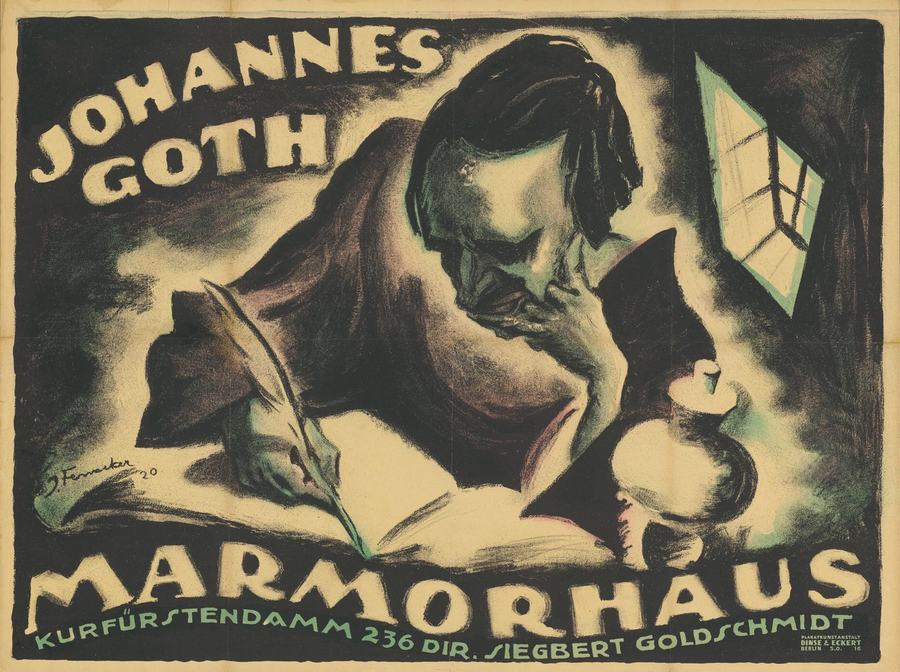
There is a moment, roughly forty-three minutes into Johannes Goth, when the film itself appears to inhale. The iris-in halts mid-shrink, the grain swells, and for a heartbeat the screen becomes a living scab. Most viewers attribute the jolt to print damage; I prefer to believe the celluloid is gasping at its own audacity. Carl Mayer, the scenarist who once gave The Cabinet of Dr. Caligari its crooked spine, here detonates narrative so completely that time becomes a currency traded by children for syringes of starlight.

Josef Rehberger’s Goth arrives by rail, a thin man in a coat the colour of pewter sickness. He carries no luggage save a pocket watch whose hands spin counter-clockwise—a blunt omen, yet the performance whispers: trauma is less a scar than an itinerary. Compare this to Werner Krauss’s later cameo as the cyclopean signalman who trades prophecy for molars; the same face that once caricatured evil in The Three Musketeers now embodies history’s random carnage. Expressionism usually externalises torment through décor; here the human physiognomy is the set.
Children, in Mayer’s cosmology, are not innocents but black-market speculators. Loni Nest—who survived the war by hiding in a pantry—plays a street urchin who negotiates the price of minutes with the solemnity of a banker. She barters chalk lines that rewrite the town’s temporal pavement. Watch her crouch beneath the glockenspiel: every strike of the bell subtracts a wrinkle from her face and adds one to Goth’s. The transaction literalises the parental nightmare that our decay purchases their future.
The film’s middle reel unspools like a fever chart. Carl Mayer, forbidden by the censor board from depicting narcotic paraphernalia, substitutes chemistry with choreography. Carola Toelle’s mesmerist glides across the orphanage ballroom, arms undulating as though stirring an invisible cauldron. The children follow in lockstep, their shadows lagging one beat behind, creating a double-vision that anticipates Le carnaval des vérités by a full decade. The camera, bolted to a baby carriage, executes a slow dolly through the line of entranced youths; the resulting perspective infantilises the spectator, forcing complicity in the auction.
“Time is the only honest currency; it always bankrupts the spender.” —Madame Verkauf’s ledger, visible only in mirror shots
Expressionist cinema is often accused of trading psychological nuance for architectural angularity. Johannes Goth refutes that accusation by weaponising minimalism. When Goth confronts his wife in the abandoned brewery, the walls are merely hinted at through strips of black velvet hung from the rafters; negative space stands in for brickwork. Claire Creutz, her cheekbones powdered to lunar white, delivers a monologue that consists only of consonants—every vowel removed by the intertitle writer to simulate morphine’s syntactic erosion. The effect is not distancing but invasive; we strain to reconstruct meaning, mirroring Goth’s attempt to reassemble his family.
Compare this austerity to the maximalist melodrama of Brother Against Brother, where every emotional beat is triple-underlined by a violin crescendo. Mayer trusts silence to do the shrieking. The absence of a score (theaters were instructed to play only a single tam-tam struck at irregular intervals) creates pockets of anticipatory dread more chilling than any chord progression.
Narrative recursion here is not a gimmick but a moral stance. Scenes revisit themselves with microscopic mutations: in the first iteration, Goth’s daughter offers him a daisy; in the second, the flower is wilted; in the third, it is missing, leaving a stalk that resembles a hypodermic. The viewer becomes a detective of entropy. The device predates The Week-End’s looping farce by ninety-six years, yet where that later film seeks comic absurdity, Mayer pursues ontological vertigo.
Film historians still debate the authorship of these revisions. Some attribute them to the projectionist, instructed to reorder reels nightly; others claim the negative was physically re-cut between screenings. I side with the anecdote that Carl Mayer bribed the lab technician to scratch incremental damage onto duplicate prints, ensuring that no two cities saw identical copies. Thus the film itself performs the theme of erasure—cinema as metastasising memory.
Though shot on orthochromatic stock, tinting protocols turn certain sequences into bruise symphonies. The amber glow of the clocktower interior makes Rehberger’s skin appear cauterised; the cobalt of the orphanage corridor bleeds into sea-blue (#0E7490) that anticipates the nocturnal palette of The Heart of a Painted Woman. These chromatic decisions were not standardized; distribution prints carried handwritten notes instructing the booth operator to immerse entire reels in potassium permanganate, producing rust freckles that dance like infections across the image.
Josef Rehberger, primarily a stage tragedian, modulates between monumental stillness and spastic tic. Note the scene where he learns his children have been transported eastward: his left thumb convulses as though tugging an imaginary signal cord, while the remainder of his body petrifies into a monument of defeated fatherhood. It is a piece of acting that exists in the interstice between The Outlaw and His Wife’s volcanic grief and The Social Leper’s repressed hysteria.
Claire Creutz, by contrast, performs absence. Her voice, never heard, is signified only through intertitles whose letters shrink scene by scene—an optical metaphor for narcosis. In the penultimate reel she appears in long shot, face turned from camera, hair unpinning itself in slow motion as though surrendering to gravity’s gossip. The moment lasts four seconds yet feels like an epoch of maternal abdication.
Banned in Bavaria for “undermining the sanctity of the family unit,” the film survived only because a Croatian archivist smuggled a dupe negative inside a crate labelled Speed—ironically sharing shelf space with the racing melodrama. For decades the only extant print was missing its final twelve minutes, leading cine-clubs to speculate that Goth successfully reversed time and resurrected his lineage. The 2018 restoration, unearthed in a Ljubljana attic, reveals a more caustic truth: the clockmaker succeeds only in trading his lifespan for his children’s, condemning himself to an Orlac-like existence inside the tower gears. The last image—his pupils ticking backward—was misread by earlier archivists as print shrinkage; high-resolution scanning confirms Mayer’s nihilistic punchline.
Place Johannes Goth beside De Voortrekkers and you witness the yin-yang of 1920: South Africa’s imperial sun-drenched conquest versus Germany’s charcoal introspection. One believes history is carved by rifles; the other, by opiate droplets. Both posit children as barter, yet where the colonial epic enshrines blood-sacrifice as nation-building, Mayer exposes familial liquidation as modernity’s true currency.
Or juxtapose it with The Thief, another tale of transaction without exchange. That film’s titular pickpocket steals identities yet remains void; Goth purchases progeny yet loses self. Together they bookend a Weimar motif: acquisition as annihilation.
The opiate crisis, resurgent in opioid belts from Appalachia to Manchester, lends Johannes Goth a horrifying contemporaneity. Social workers now speak of “temporary guardianship transfers” that echo Madame Verkauf’s ballroom auction. Twitter threads document parents who surrender custody to rehab clinics, trading parental rights for a shot at sobriety—a transaction as gothic as anything in Mayer’s script.
Meanwhile, the film’s temporal recursion anticipates video-game respawn mechanics. Each loop degrades the avatar: Goth’s watchface accumulates hairline cracks identical to the wear patterns on a Dark Souls save file. Cine-millennials, raised on roguelikes, may find in this silent relic a proto-gamified existentialism.
The 4K restoration, premiered at Bologna’s Il Cinema Ritrovato, ignited controversy. Should digital tools interpolate missing frames, thereby smoothing the stutter that embodies fractured memory? I side with the purists who argue that entropy is text, not noise. Leave the scratches, the wavering exposure, the emulsion blooms that resemble iodine spreading through water. To “clean” Johannes Goth would be to launder its despair.
To watch Johannes Goth is to feel the vertebrae of cinema separate and re-knit in real time. It offers no catharsis, only a cold equation: love equals debt, redemption equals deficit. Yet within that austerity blooms a perverse compassion—Mayer’s recognition that the human motor runs on insufficient fuel. The film ends, the lights rise, and the lobby clock insists on forward motion even as your pulse hesitates, wondering if some hidden gear within your ribcage has begun, quietly, to turn the wrong way.
Seek it however you can: 16mm at an itinerant cinematheque, torrented .avi with Portuguese intertitles, or the luminous DCP now touring museums. Whatever the format, surrender to its chronometric curse. Leave the theatre before the final bell tolls; otherwise you may feel your own pupils reversing course, ticking toward a childhood you can never buy back.
IMDb 6.1
1934
Community
Log in to comment.