DbcultAccessing Vault...
Cult Review
Senior Film Conservator
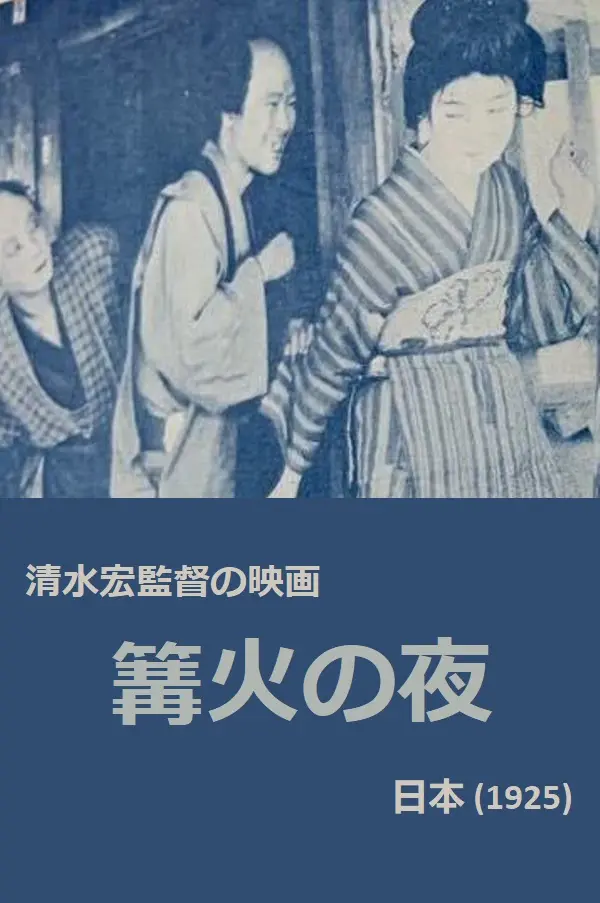
Is Kagaribi no yoru a film that warrants your time in the modern age? Short answer: Yes, but only if you treat it as a historical excavation rather than a casual Friday night watch.
This film is specifically for the dedicated cinephile interested in the evolution of the Shochiku Kamata style and the early DNA of Japanese realism. It is absolutely not for anyone who requires a fast-paced narrative or the polished continuity of modern digital filmmaking.
1) This film works because it masters the use of naturalistic lighting through the central bonfire motif, creating a psychological depth that predates more famous uses of chiaroscuro in global cinema.
2) This film fails because its reliance on the 'Shinpa' theatrical tradition occasionally results in over-gesticulated performances that clash with Shimizu’s emerging naturalism.
3) You should watch it if you want to witness the exact moment the Japanese silent film began to pivot away from stage-bound traditions toward a uniquely cinematic language.
To understand Kagaribi no yoru, one must understand the environment of 1925 Japan. The film industry was in a state of flux, caught between the old-world theatricality and the 'Pure Film Movement' that sought to strip away the influence of the stage. Hiroshi Shimizu, even at this early stage, was a disruptor. While his contemporaries might have been looking at films like The Legion of Death for inspiration in scale, Shimizu was looking at the dirt, the fire, and the faces of the common people.
The film’s structure is deceptively simple. It doesn't rely on the complex plotting found in something like Number 17. Instead, it builds tension through atmosphere. The bonfire isn't just a prop; it is a primal force that strips away the masks of the characters. When Kikuko Tachibana’s character stands before the flames, the flickering light reveals a vulnerability that no amount of dialogue could convey. It is raw. It is uncomfortable. It works.
Why should a modern viewer care about a silent film from the mid-20s? The answer lies in the 'Shimizu Touch.' Even here, we see his fascination with the wandering protagonist and the ephemeral nature of human connections. If you have seen The Innocence of Lizette, you might expect a certain level of sentimentalism, but Shimizu cuts through that with a sharp, almost architectural sense of space.
The film demands patience. It is a slow burn. But for those who can tune their internal clock to the 1920s, the rewards are significant. You are watching the birth of a style that would eventually influence the likes of Ozu and Mizoguchi. It is historical homework, yes, but it is homework that feels like a discovery.
The cinematography in Kagaribi no yoru is surprisingly sophisticated. While many silent films of the era, such as Rumpelstiltskin, relied on flat, stage-like lighting, Shimizu and his camera team experimented with the erratic light of the fire. There is a specific scene where Soichi Kunijima’s character watches the sparks fly into the night sky. The camera lingers on the sparks longer than a Western director of the time might have allowed.
This focus on the 'ma'—the space between actions—is what sets Shimizu apart. The firelight creates deep shadows on the actors' faces, forcing the audience to read their intentions through subtle shifts in posture rather than broad facial expressions. It’s a brave choice for a director in 1925. It’s also a choice that makes the film feel surprisingly modern in its ambiguity.
However, we must address the pacing. The middle act drags. It lacks the punchy rhythm of a film like Frenzied Film. There are moments where the narrative loops back on itself, perhaps a symptom of the script's origin or the need to fill a specific runtime. It’s flawed. But the flaws are as interesting as the successes.
Kikuko Tachibana is the soul of this film. In an era where actresses were often relegated to being either the 'maiden' or the 'temptress,' as seen in films like The Girl Who Came Back, Tachibana offers something more layered. Her performance is grounded in a physical stillness that contrasts beautifully with the chaotic movement of the fire.
Soichi Kunijima, on the other hand, struggles slightly more with the transition from stage to screen. There are moments where his reactions feel telegraphed to the back row of a theater that isn't there. Yet, in his quiet moments with Yasuro Shiga, there is a genuine chemistry that hints at the ensemble-driven masterworks Shimizu would produce later in the 1930s. It’s a performance of transitions.
The supporting cast, including Noboru Iwai and Atsushi Watanabe, provide the necessary social context. They represent the weight of the community, the 'eyes' that the protagonists are constantly trying to escape. This dynamic of the individual versus the group is a recurring theme in Japanese cinema, and Kagaribi no yoru handles it with more nuance than the morality plays of the time, such as Unsühnbar.
Pros:
The film offers a rare glimpse into the early Shochiku Kamata studio aesthetic. The cinematography is genuinely innovative for 1925, using shadows to tell a story that the intertitles cannot. It has a haunting atmosphere that lingers long after the credits—or the silence—ends.
Cons:
The narrative resolution feels somewhat dated, adhering to social norms that may frustrate modern viewers. Some of the physical acting is distractingly theatrical. The print quality (depending on the archive) can be a barrier to entry for casual viewers.
Most critics focus on the 'humanism' of Shimizu, but they miss the nihilism in Kagaribi no yoru. The bonfire isn't a symbol of warmth or community; it’s a symbol of consumption. It consumes the characters' secrets and leaves them with nothing. It’s a surprisingly dark worldview for a director often categorized as 'gentle.' This film is more cynical than it appears on the surface. It’s a cold film about a hot fire.
Kagaribi no yoru is not a masterpiece in the traditional sense. It is a sketch of a masterpiece. It is the rough draft of a genius finding his voice. When compared to the polished entertainment of A Gentleman of Leisure, it feels raw and unrefined. But that rawness is exactly why it is valuable. It doesn't have the commercial sheen of Mountain Dew or the generic appeal of Love's Boomerang.
Instead, it offers a window into a specific moment in time when cinema was still figuring out what it could be. It is a difficult, sometimes frustrating, but ultimately rewarding experience for those willing to look into the flames. It works. But it’s flawed. And in its flaws, we find the humanity that would define Hiroshi Shimizu’s career.
IMDb —
1924
Community
Log in to comment.