DbcultAccessing Vault...
Cult Review
Senior Film Conservator
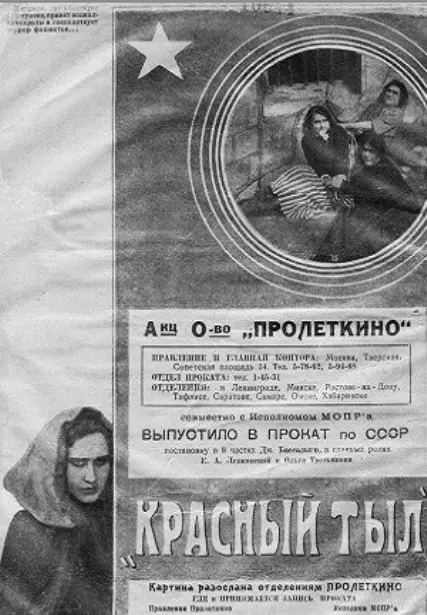
In the pantheon of early Soviet cinema, few works capture the raw, unvarnished anxiety of the post-revolutionary period with as much surgical precision as Krasnyy tyl (1924). While the international spotlight often lingers on the montage-heavy experiments of Eisenstein or the rhythmic symphonies of Vertov, Boris Bulatov’s work offers a more grounded, yet no less provocative, exploration of the societal psyche. This film is a stark reminder that the revolution was not merely won in the muddy trenches of the Civil War, but in the sweat-soaked factories and the paranoid corridors of the 'Red Rear.' It is a film that breathes with the heavy, rhythmic pulse of industrialization, yet its heart is perpetually skipping beats due to the pervasive threat of sabotage.
The narrative efficacy of Krasnyy tyl lies in its refusal to romanticize the struggle. Unlike the melodramatic flourishes found in The Other Man's Wife, Bulatov’s script is lean, almost skeletal, focusing on the mechanics of survival and the ethics of vigilance. The film operates as both a call to arms and a cautionary tale, reflecting the precarious nature of the Soviet experiment in its infancy. It shares a certain thematic DNA with In the Python's Den, particularly in its depiction of the clandestine forces working to dismantle the new order from within the shadows of the old world.
The ensemble cast, led by the formidable Nikolay Bravko, delivers performances that transcend the typical gesticulatory excess of the silent era. Bravko possesses a stoic magnetism; his eyes reflect a weariness that is not merely physical but spiritual, embodying the weight of a generation tasked with building a utopia on the ruins of an empire. Contrast this with the work of Elena Juzhnaja, whose portrayal of resilience provides a necessary emotional anchor amidst the film’s more rigid ideological segments. Her presence on screen offers a nuance that reminds us of the human cost of political upheaval, a sentiment often explored in the more intimate dramas like Drama na okhote.
Supporting turns from Olga Tretyakova and Ivan Pelttser add layers of texture to the social landscape. Pelttser, in particular, brings a grounded verisimilitude to his role, representing the older generation caught in the gears of change. The interaction between these characters creates a microcosm of Soviet society—a volatile mixture of fervent believers, reluctant participants, and hidden antagonists. This dynamic is reminiscent of the character-driven tension in Trigger Fingers, though Krasnyy tyl replaces the frontier lawlessness with the cold, calculated logic of the Cheka.
Visually, the film is a masterclass in chiaroscuro. The cinematography utilizes high-contrast lighting to delineate the moral boundaries of the world—the bright, open spaces of the collective effort versus the murky, jagged shadows where the counter-revolutionaries lurk. There is a palpable sense of space; the factory floors are rendered as cathedral-like structures of steel and steam, while the private dwellings feel cramped and infested with secrets. This visual dichotomy serves to emphasize the film's central thesis: that the private sphere is a liability, and only in the public, collective eye can safety be found.
One cannot help but draw comparisons to the gritty realism of Erich von Stroheim’s Greed (1924). While Greed focuses on the corrosive power of capital on the individual, Krasnyy tyl examines the corrosive power of ideological betrayal on the collective. Both films share an obsession with the material reality of their environments, using the physical world to mirror the internal decay of their characters. The atmospheric dread present here also echoes the environmental hostility found in The Storm (1922), where the elements themselves seem to conspire against human endeavor.
To understand Krasnyy tyl, one must understand the era of its birth. 1924 was a year of profound transition; the death of Lenin and the complexities of the NEP created a landscape of uncertainty. Bulatov’s film acts as a stabilizing force, a cinematic manifesto that seeks to define the virtues of the new Soviet citizen. It deals with themes of sacrifice and vigilance that are similarly parsed in Whom the Gods Would Destroy, yet it does so without the mythological distancing. Here, the gods are replaced by the State, and the destruction is not a matter of fate, but of political failure.
The film’s portrayal of the 'Red Rear' as a site of active combat is a brilliant subversion of war film tropes. By moving the conflict away from the trenches and into the grain elevators and telegraph offices, Bulatov democratizes the concept of the soldier. Every citizen is a combatant; every choice is a tactical maneuver. This pervasive sense of duty and the looming threat of the 'unconquerable' spirit of the old guard makes it a fascinating companion piece to The Man Unconquerable, though the ideological poles are reversed.
When we look at the broader landscape of the 1920s, Krasnyy tyl stands out for its lack of artifice. While German expressionism was exploring the fractured psyche through distorted sets in films like Der Leibeigene, Soviet cinema was finding its voice through the lens of dialectical materialism. Krasnyy tyl is not interested in the dreamscape; it is interested in the waking world, however harsh that world may be. It shares the narrative density of The Deemster or the moral complexity of His Convict Bride, but it filters these elements through a uniquely Marxist-Leninist prism.
Even in its moments of lighter character interaction, there is a subtextual weight. A scene involving Mikhail Garkavi or Evgeniy Lepkovskiy might seem incidental, but in the context of the 'Red Rear,' every interaction is a test of loyalty. This is far removed from the breezy levity of Hello, Judge or the youthful exuberance of Flickering Youth. In Bulatov’s world, youth does not flicker; it burns with the cold fire of necessity. The stakes are always absolute, a quality it shares with the high-stakes survivalism of Skinning Skinners.
As we view Krasnyy tyl through the lens of a century’s distance, its power remains remarkably undiminished. It is a document of a time when cinema was being forged as the most important of all arts, a tool for social engineering and national identity. The film’s focus on the domestic front—the 'rear'—anticipates the total mobilization themes of later World War II cinema, yet it retains a specific, early-Soviet flavor of experimentalism mixed with dogmatic fervor. It serves as a stark reminder of the principle that 'as a man sows, so shall he reap,' a theme explored through a different cultural lens in As a Man Sows.
The film’s conclusion is not one of easy catharsis but of continued vigilance. It acknowledges that the 'Red Rear' is a permanent state of being for the revolutionary subject. Boris Bulatov, along with his talented cast and crew, created a work that is as much a psychological thriller as it is a political drama. The haunting imagery of Nikolay Bravko staring into the future—a future both bright with promise and dark with the potential for betrayal—remains one of the most potent images of the 1920s. Krasnyy tyl is not just a film to be watched; it is a film to be interrogated, a celluloid artifact that continues to yield new insights into the complex machinery of human belief and societal transformation.
Ultimately, Krasnyy tyl stands as a monumental achievement in early narrative cinema. It successfully bridges the gap between the avant-garde and the accessible, providing a blueprint for the political thriller that would be refined for decades to come. Its exploration of paranoia, industry, and the collective soul ensures its place as an essential chapter in the history of the silver screen, a flickering beacon from a world that was being born in fire and iron.
IMDb 5.7
1933
Community
Log in to comment.