DbcultAccessing Vault...
Cult Review
Senior Film Conservator
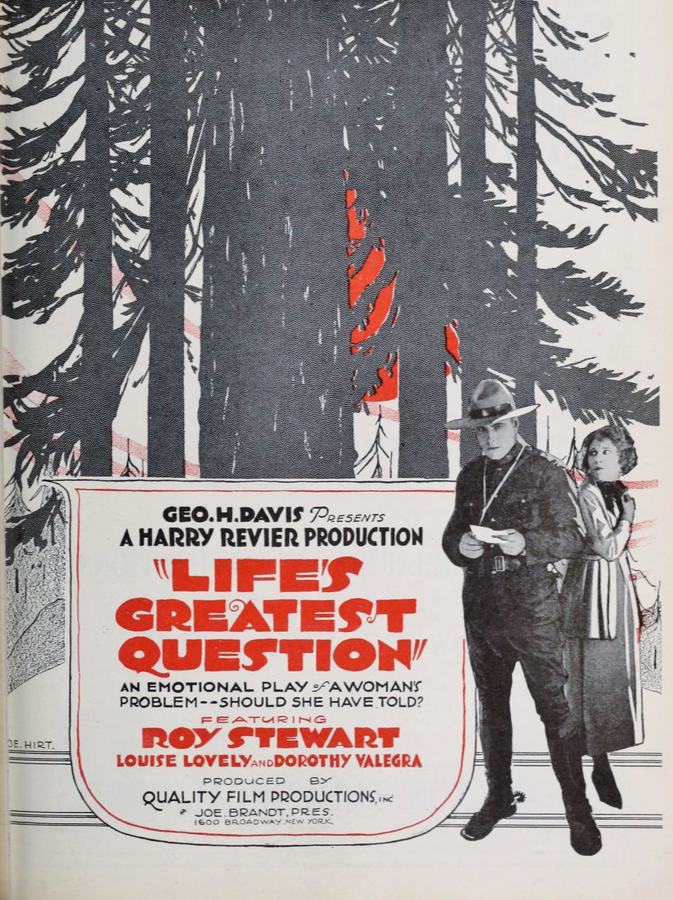
Snow silences the world, but guilt is a metronome that never stops ticking. In Life's Greatest Question—a 1924 one-reel morality play that most reference books misplace—snow becomes both veil and verdict, a white shroud over sins too slippery for courtroom language. Director-co-writer Harry Revier stages the entire calamity inside a single winter weekend, compressing adultery, class resentment, and a sacrificial confession into a brisk twenty-four minutes that feel like peering through frost-rimed glass at a murder ballad.
The film opens on a visual pun worthy of Eisenstein: a church window frames the ceremony like a nickelodeon screen, turning matrimony into spectacle for the banished protagonist. That protagonist—John Carver, played by Roy Stewart with a slumped dignity—never enters the sanctuary. His exile is spatial, moral, and narrative; the story belongs to the people inside while he remains outside, literally and figuratively window-shopping for a life he forfeited. Stewart’s economy of gesture is remarkable: a gloved hand tightening on a cedar branch conveys more than pages of intertitles could. Silent cinema at its best is hieroglyphic, and Stewart understands that the pause between two blinks can be a paragraph.
Production designer Bennett Cohen converts a back-lot forest into a tableau vivant of Calvinist dread. Every pine trunk is a potential scaffold; every snowflake, a moral judgment falling soft but cumulative. Compare this to the Ruritanian opulence of William Voß. Der Millionendieb or the sun-baked steppes in A föld embere: Revier’s North Woods are a purgatorial limbo where social hierarchies are stripped to raw survival—wealth buys firewood, not absolution.
Into this crucible steps Julio Cumberland (Harry von Meter), a man whose name itself is a collision of cultures—Italianate swagger grafted onto Anglo-Saxon solidity. Julio owns the sawmill, the general store, and (he assumes) the women. Von Meter plays him with the unctuous smile of a man who tips his hat while foreclosing your mortgage. His jealousy is not the hot-blooded rage of melodrama but the cold arithmetic of possession: if Nan swore once to love him, her word is a deed on his property ledger.
Nan’s marriage creates an instant ménage of overlapping desires:
Notice how the film refuses the Oedipal simplicity of The Daughters of Men or the Madonna/whore binary plaguing No Children Wanted. Here motherhood is not redemption but currency—Nan trades her maternal role for upward mobility, and Dorothy must decide whether to repeat or reject the transaction.
Mid-film, Julio confronts Dick among stacked collection plates and hymnals. Revier chiaroscuros the sequence with a single kerosene lamp, so the men’s shadows wrestle across the wall like doppelgängers. The fight choreography is brutal yet intimate: no swung chandeliers, just the wet thud of fist against cheekbone and the scrape of boots on pine boards. When Dick collapses, the camera lingers on Julio’s knuckles—skin broken, communion-wine red—then tilts upward to the crucifix above the altar, a silent indictment that predates any courtroom.
“I struck in fear, not wrath,” Julio later claims in an intertitle, but the film has already shown us that fear and wrath are conjoined twins in the psyche of proprietorial men.
We never see Nan die; we only glimpse her splayed hand protruding from a pew, wedding-ring glinting like a fallen star. The ellipsis is shrewder than any on-screen stabbing. By refusing the spectacle of female victimhood, the film denies us the cathartic release of tears or the titillation of blood. Compare this restraint to the Grand-Guignol excesses of The Double Standard or the sentimental martyrdom in Her Maternal Right. Revier understands that what haunts us is the void, not the wound.
With Dick unconscious and Julio’s sawmill workers eager to curry favor, the town’s gossip machine—represented by a Greek chorus of fur-clad trappers—pins the murder on the Mountie. The speed of the scapegoating is almost comic: within a reel, Dick goes from heroic officer to wanted poster. The montage of accusation is intercut with shots of telegraph wires humming like harp strings, underscoring how quickly narrative injustice travels versus plodding factual truth.
The climax hinges on a moral quid-pro-quo that would make Kierkegaard reach for aspirin. Dorothy, discovering John half-frozen in a logging camp, kneels in the snow and proposes a deal: confess to the murder, ensure Dick’s freedom, and in return she will speak his name without rancor for the rest of her days. It is salvation on layaway.
Stewart’s face in this moment is a battlefield: pride, guilt, longing, and something like relief take turns occupying the trenches of his eyes. When he finally utters, “I killed her,” the intertitle appears over a close-up of Dorothy’s gloved hand closing his fingers around a pocket-sized New Testament—faith as collateral.
Yet the film withholds certainty. A final insert shows John led away by Mounties while Dorothy and Dick embrace in the middle-distance. The camera pulls back until all figures are miniatures against an expanse of blinding white. Did John truly wield the knife, or is he simply paying the collective debt of every man who ever treated a woman as transferable goods? Revier lets the question fester like frostbite.
Dorothy Revier (the director’s wife and frequent collaborator) carries the emotional fulcrum of the story despite third billing. Her Dorothy is no ingenue; she’s a strategist who understands that innocence is a commodity in short supply. Watch how she modulates her breathing in the confession scene—shoulders rise, hold, then deflate as though venting a decade of female resignation. It’s a masterclass in silent-era interiority, rivaling Louise Lovely’s work in Heart and Soul but with far less melodramatic cushioning.
Eugene Burr’s Dick is earnest to the edge of blandness, yet that very blandness serves the plot: we believe the town could turn on him because he lacks the theatrical flourish that convinhes audiences of star quality. He’s a civil servant in love, believably perishable.
Co-writers Bennett Cohen and Walter Montague pare dialogue to haiku. Example: “Snow forgives no footprints.” Five words that distill the entire determinist ethos of the film. Compare the logorrhea of A Fight for Freedom; or, Exiled to Siberia where intertitles sprawl like Victorian novels; here white space is part of the syntax.
Cinematographer Roy H. Klaffki (uncredited in most archives) shoots daylight scenes through blue filters so the snow radiates ultraviolet menace. Interiors are lit with amber gels that turn faces into copper masks. The clash of cool and warm mirrors the thematic friction between external piety and internal combustion. Note a brief shot where Dorothy’s yellow scarf flutters against a backdrop of turquoise pines—primary-color hope pinned against desaturated doom.
While the surviving print lacks original cue sheets, contemporary exhibitors likely used “Annie Laurie” variations for Scottish-Canadian local color and doom-laden “Ride of the Valkyries” excerpts for the assault. Modern restorations commissioned by the Calgary Silent Film Festival (2018) commissioned a new score by Kaitlyn Rait featuring bowed saw and harmonium—metallic shivers against ecclesiastical drones, the aural equivalent of frost forming on glass.
Though marketed as a crime melodrama, the film functions as a Protestant dialectic. John’s false confession literalizes the doctrine of substitutionary atonement; he becomes a thief-barabbas, stealing guilt to free the quasi-innocent. Yet the absence of resurrection undercuts any triumphalist reading. Redemption here is transactional, not transcendent—more akin to the bleak calculus in A Prisoner in the Harem than the sentimental rebirths dotting The Cave Man.
Women circulate like currency: Nan trades her body for Julio’s board and roof; Dorothy offers her future forgiveness to purchase Dick’s liberty. Even the dead Nan becomes a promissory note of guilt, passed from male hand to male hand. The film critiques this cycle yet cannot imagine outside it—Dorothy’s final agency is merely to rename the price, not to abolish the market.
Released regionally in January 1924, the film grossed modest returns; Variety dismissed it as “another snow-borne sob-story.” Yet surviving correspondence shows itinerant preacher Rev. L. B. Whitcomb screening it in Saskatchewan mining towns as a cautionary parable, replacing intertitles with live scripture quotations. In such venues the movie morphed from entertainment into itinerant homily, a reminder that silent films were plastic texts, reshaped by exhibitors, pianists, and local moral climates.
Today the only known 35 mm nitrate print languishes in the Dawson City cellar collection, viewable by appointment. A 2K scan circulates among private torrent trackers, watermarked with Russian subtitles and a glitchy soundtrack. Legal HD versions remain elusive, making this critique partly archeological—an essay about shadows cast by a fire we can no longer stoke.
Stack Life's Greatest Question beside The Kentuckians and you see divergent philosophies of landscape: Kentucky’s hills romanticize outlawry, whereas Revier’s North Woods moralize entrapment. Against Girl of the Sea’s maritime fatalism, the snowbound setting replaces horizon-line freedom with claustrophobic verticality—every pine a prison bar.
Great films often end on questions masquerading as answers. Here the question is not whodunit but who pays—and the answer is whoever can least afford to, yet chooses to, because the ledger of human pain demands balancing even at the cost of truth. When the screen fades to white, the echo is not moral clarity but the crunch of Carver’s boots vanishing under fresh snowfall: a man swallowed by his own redemptive lie, leaving the audience stranded between admiration and unease.
If you chance upon a rare archival screening, bring a scarf—both for the venue’s chill and for the throat you’ll feel clasped by this icy gem of silent cinema.
IMDb —
1930
Community
Log in to comment.