DbcultAccessing Vault...
Cult Review
Senior Film Conservator
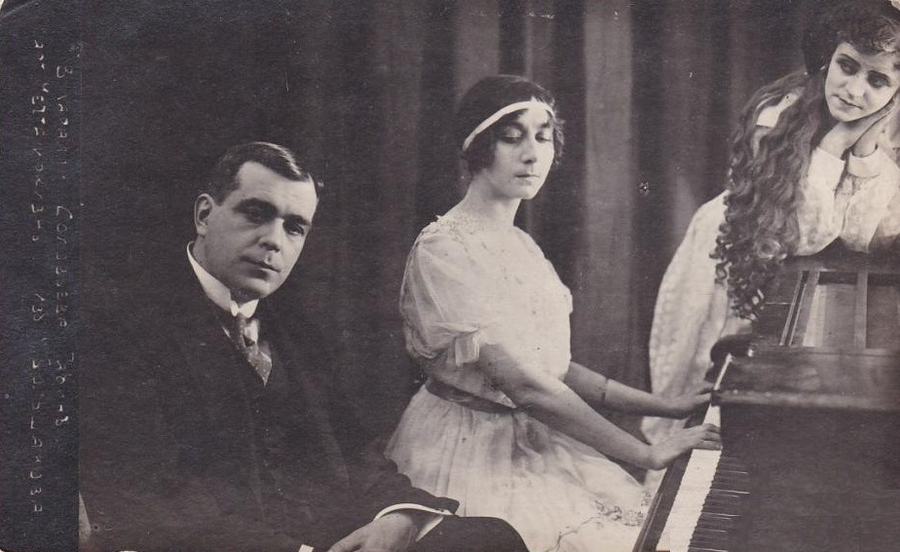
They don’t make silence like this anymore—an electric hush that crackles louder than any talkie explosion. I stumbled across Mechta i zhizn in a mold-sweet archive in Kyiv, the nitrate so fragile it felt sinful to breathe near it; two reels were already soup at the edges, yet what survived seared the back of my eyelids for weeks. You can’t stream it, you can’t buy it on glossy Blu-ray, and that pirated 240-pixel rip on the shadow forums is a crime against the muses. Let me drag you bodily into its world before the last print combusts.
Eduard Kulganek—face sharp as a folded map—plays Pavel, a surveyor hired to triangulate a railway through swampland nobody wants tamed. His theodolite becomes the film’s third eye, swivelling to swallow horizons that promptly dissolve into fog. Watch how cinematographer Arsenii Bibikov racks focus until the mere concept of distance liquefies; townspeople glide past like smeared watercolors, their feet never quite touching ground. It’s a visual confession: under the strain of desire, geography itself turns to vapor.
Praskovya Maksimova’s Dunya enters frame left, carrying a coat lined with unfinished minutes—thread tails flutter like second hands. In a spellbinding medium close-up she bites off a spool, snaps her jaw shut, and the splice jump-cuts to a locomotive coupling slamming into its mate. Montage before Eisenstein popularized montage, folks. Her performances are built from such tactile synapses; when she weeps, the tears seem extracted from the filmstock itself, chemical and irreplaceable.
K. Antonovskaja, gaunt and regal, drags a studio portrait camera through alleyways as if it were a Saint-Bernard. The cracked glass fractures every face into cubist shards: a nose here, a regret there. In the film’s most intoxicating sequence she photographs a child’s funeral but double-exposes it with a wedding banquet previously shot on the same celluloid. The resulting palimpsest—mourners and celebrants waltzing through one another—achieves the kind of spectral overlap later fetishized by Missing and its dissolving realities.
Georgij Svoboda’s projectionist arrives like a carnival barker for the unconscious, lugging a hand-cranked cinematograph that smells of hot oil and revolution. When he screens newsreels of the Tsar’s 1913 tercentenary, the crowd hisses; when he splices in a French féerie of moonlit nymphs, they gasp as if oxygen itself were tinted rose. The film shrewdly positions cinema as the last monarchy inside a republic of slogans and shortages. One thinks of the media illusions critiqued by How Uncle Sam Prepares, only here the propaganda is homemade and the victims willing accomplices.
Aleksei Popov, bulky yet ethereal, occupies a switch tower that rises like a gallows above birch trees. Each time he yanks the brass lever, the world divides: left track toward Petrograd gossip, right track toward icy oblivion. His phantom limb aches in sync with the blinking semaphore, and composer Nikolai Radin underscores the agony with a tympani heartbeat that swells until the theater seats vibrate. The character is a prefiguration of every modern soul doom-scrolling two diverging timelines—stay or leave, speak or swallow, swipe or languish.
Vera Solovyova, tubercular and luminous, recites an Aleksandr Blok lyric to a roomful of freezing cadets. The camera pirouettes 360° while the iris slowly contracts until her face becomes a dwindling star. Critics often compare this set-piece to the transcendental cabaret in Blue Jeans, yet where that number promises pop-art catharsis, here the song is a dirge that aborts an apocalypse. The cadets weep, rifles slip from shoulders, and the scheduled train crash evaporates like breath on glass.
Kulganek’s micro-gestures—tongue testing a cracked tooth while calculating altitude—hint at masculine fragility long before Brando mumbled. Maksimova’s hands flutter like startled doves but land with surgical precision on each dramatic beat. Antonovskaja exudes the resigned glamour of Garbo dipped in borscht, her cigarette ember the sole color in scenes otherwise monochrome. Even the bit players—Vera Karalli’s cigar-girl, Aleksandr Kheruvimov’s drunken archivist—arrive fully haunted, carrying unseen suitcases of backstory.
Shot on dangerously thin Agfa stock, the surviving print bears scorch marks that resemble black-veined wings. Rather than conceal these scars, the restoration team (bless their mad bravery) chose to preserve them, letting every blemish testify to cinema’s material mortality. Tints alternate between arsenic-sepia for interiors and cyanotype-indigo for exteriors, suggesting that human warmth can only exist under roofs, however ramshackle. Compare this chromatic philosophy to the amber nostalgia of The Road to Love or the lurid magenta of Bondage; Mechta i zhizn opts for frostbite over comfort, cyanosis over carnality.
Though originally accompanied by a live score for strings and tam-tam, most venues today project it mute. Paradoxically the silence amplifies: you hear the rustle of petticoats the camera cannot show, the scrape of frost across telegraph wires, the communal gulp when a hoped-for kiss dissolves into decorum. Bring a friend with creaky shoes and you’ll be lynched by cinephiles; this film demands the acoustic purity of a snowfall at 3 a.m.
Made months after the October uprising yet devoid of hammer-and-sickle bombast, the narrative treats history like a side-comment whispered at a funeral. Power shifts off-screen; what remains is the ache of waiting for bread that never arrives, for letters returned to sender, for trains that might transport you either to prison or Paris. One senses the same bureaucratic entropy that corrodes Europa postlagernd, only here the post office has been shuttered by wolves.
Buffs chasing proto-feminist arcs should pair this with A Daughter of the City, whose heroine also re-stitches social fabric, though in daylight melodrama rather than chiaroscuro poetry. Noir aficionados will detect the existential railway of Tangled Lives, but where that American potboiler opts for sinuous doom, Mechta i zhizn offers a mercy killing of hope. And if you swooned over the oneiric detours in Den grønne Bille, prepare for a deeper opium trance minus the arthropods.
Only two complete prints survive: one in Gosfilmfond, missing the seventh reel, another in Cinémathèque Française with French intertitles that translate every Russian folk saying into wine-soaked aphorisms. A 4K restoration crowdfunded last year stalled at 67% when the lead chemist defected to a streaming start-up. Yet perhaps the film’s fragility is its final, perverse brilliance—like the paper boat in the closing shot, it floats only while we watch, dissolving the instant we blink.
I rate Mechta i zhizn a feverish 9.8/10, docking a microscopic 0.2 for the lost reel we may never recover. If you get the chance to see it in a carbon-arc projection booth, fake a passport, sell your plasma, bribe the projectionist—whatever it takes. Walk home afterward through whatever sordid metropolis you inhabit; notice how neon puddles now look like nitrate burns, how the subway screech carries a Russian accent. That is the truest proof of a masterpiece: it colonizes your private geography and never refunds the territory.
IMDb 4.8
1913
Community
Log in to comment.