DbcultAccessing Vault...
Cult Review
Senior Film Conservator
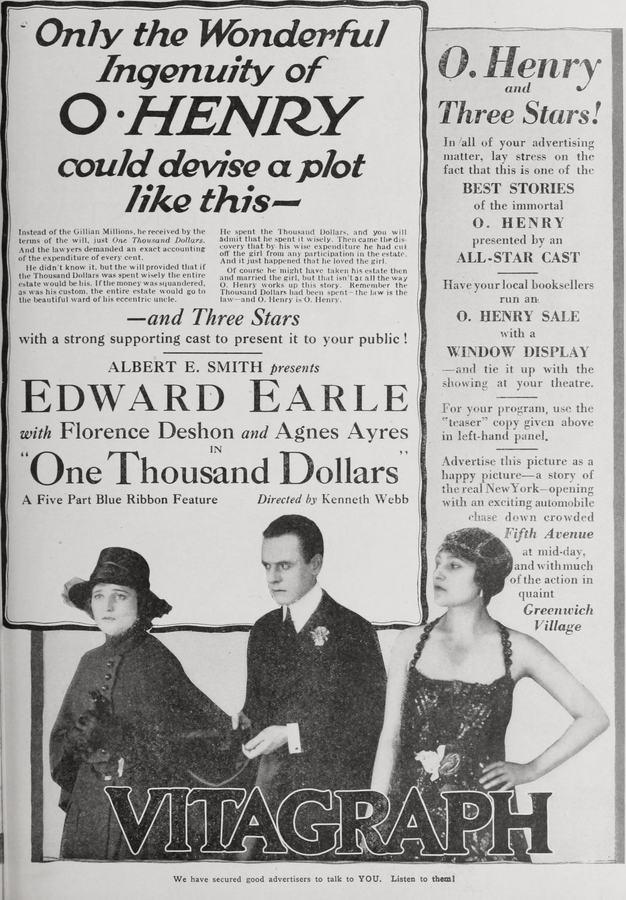
In the annals of early cinema, certain films, despite their age and the technical limitations of their era, continue to captivate with their timeless narratives and profound moral insights. Among these, the silent adaptation of O. Henry’s poignant short story, One Thousand Dollars, stands as a remarkable testament to the enduring power of storytelling. Released in a period when the moving picture was still finding its voice, this film transcends its lack of spoken dialogue through a masterful blend of visual storytelling, nuanced performances, and a narrative deeply rooted in human nature’s capacity for transformation. It's a cinematic journey that invites us to ponder the true value of wealth, the nature of generosity, and the often-surprising paths to self-discovery.
The film introduces us to Eddie Gillian, portrayed with a charming, if initially feckless, abandon by Edward Earle. Eddie is the quintessential young man of means, his existence cushioned by a seemingly endless allowance from his crusty, yet ultimately benevolent, Uncle Bryson. His days are a whirl of social engagements, extravagant expenditures, and the fleeting affections of Lotta Lauriere (Ann Brody), a burlesque queen whose allure is as ephemeral as the bubbles in a champagne glass. This portrayal of Eddie's early life is crucial; it establishes a baseline of unexamined privilege against which his later trials and triumphs will be measured. It’s a world where superficiality reigns, where genuine connection often takes a backseat to immediate gratification. Earle captures this initial naiveté with a subtle grace, allowing the audience to see not a villain, but a young man simply adrift in a sea of unearned comfort.
The dramatic fulcrum of the narrative arrives with Uncle Bryson's death. The reading of the will, a scene imbued with palpable tension even without dialogue, reveals a shocking twist: Eddie, the presumed heir to a vast fortune, is bequeathed a mere one thousand dollars. The will's accompanying directive—to spend this modest sum "prudently and unselfishly"—is a masterstroke of narrative irony, a challenge designed to awaken a dormant conscience. This moment acts as a stark demarcation, severing Eddie from his past self and propelling him onto a path of unexpected introspection. The immediate consequence is Lotta Lauriere's swift departure, her affections proving as conditional as Eddie's financial standing. Ann Brody, in her portrayal of Lotta, perfectly embodies the transactional nature of such relationships, her abrupt abandonment serving as a stark mirror to Eddie's previous superficiality. This scene resonates with the harsh realities of societal expectations and the often-brutal honesty that accompanies financial reversals. One might draw parallels to films like The Raggedy Queen, where characters are stripped of their societal facades, forced to confront their true selves when material comforts vanish.
In contrast to Lotta's mercenary spirit, we have Margaret Hayden, Uncle Bryson's ward, portrayed with quiet dignity and profound depth by Agnes Ayres. Margaret, too, receives a meager inheritance—a mere ten dollars—highlighting her own precarious financial situation and underscoring the vast disparity between her circumstances and Eddie’s former opulence. It is to Margaret that Eddie, in a moment of genuine selflessness, offers his entire thousand dollars, convinced it is rightfully hers. This act is not born of a calculated ploy or an expectation of reward, but from a burgeoning sense of justice and empathy. It is the first true manifestation of his transformation, a quiet rebellion against his former self. Ayres's portrayal of Margaret is subtle yet powerful, her expressions conveying a depth of character that belies her seemingly secondary role. She is the moral compass, the quiet strength that guides Eddie towards his awakening. Her reaction to Eddie's gift is particularly telling; a blend of surprise, gratitude, and an inherent understanding of his evolving character.
The genius of O. Henry’s original story, faithfully adapted by Stanley Olmstead, lies in its signature twist. Bryson's lawyer reveals that the initial thousand dollars was merely a test. Eddie is to inherit half a million dollars, provided he spent the initial sum generously. This revelation is not a simple reward for good behavior, but a confirmation of character. It validates Eddie's transformation, proving that his generosity was not a calculated move but a genuine shift in his moral landscape. The moment Eddie attempts to turn this larger fortune over to Margaret, too, further solidifies his newfound integrity. His desire to share, rather than hoard, speaks volumes. Margaret's refusal to accept it outright, instead agreeing to share it as his wife, completes the narrative arc, cementing their bond not through financial necessity, but through mutual respect and shared values. This echoes themes found in films like The Warfare of the Flesh or Sonad skuld (Atonement of Guilt), where protagonists undergo profound ethical journeys, often culminating in redemption or a new understanding of love and commitment.
As a silent film, One Thousand Dollars relies heavily on visual cues, expressive acting, and intertitles to convey its narrative and emotional depth. The director, though uncredited in many records, orchestrates a remarkably clear and engaging story. The cinematography, typical of the era, uses close-ups to emphasize emotional reactions and wider shots to establish the social milieu. The sets and costumes effectively distinguish between Eddie’s initial luxurious lifestyle and the more modest surroundings that follow his 'disinheritance.' The visual contrast between Lotta's flamboyant attire and Margaret's understated elegance is particularly effective in highlighting their differing characters.
The performances are a masterclass in silent film acting. Edward Earle navigates Eddie's journey from carefree playboy to conscientious man with impressive subtlety. His facial expressions and body language convey his initial ennui, his shock at the will's contents, his disillusionment with Lotta, and finally, his profound realization and genuine affection for Margaret. Agnes Ayres, as Margaret, projects an inner strength and moral purity that is both captivating and believable. Her quiet resolve and unwavering integrity serve as a powerful counterpoint to Eddie’s initial frivolity. Even supporting roles, such as Ann Brody's Lotta and Templar Saxe's portrayal of the lawyer, contribute significantly to the film's overall texture, each actor deftly communicating their character's motivations and emotional states through gesture and expression. This reliance on non-verbal communication elevates the narrative, forcing the audience to engage more deeply with the visual language of cinema, much like the evocative visual storytelling in films such as The Pursuit of the Phantom, where atmosphere and character expression are paramount.
Stanley Olmstead's adaptation of O. Henry's short story is particularly effective because it captures the essence of the original author's style: a blend of wit, social observation, and, most famously, the surprise ending. O. Henry's stories often delight in exposing the ironies of life and the unexpected turns of fate, and One Thousand Dollars is a prime example. The film masterfully builds towards the revelation of Bryson's true intentions, making the audience, much like Eddie, re-evaluate their understanding of generosity and worth. This thematic core—that true value lies not in accumulated wealth but in the spirit with which it is used—remains profoundly relevant.
The film explores several enduring themes: the corrupting influence of unearned wealth, the redemptive power of selflessness, and the distinction between superficial attraction and genuine love. Eddie's journey is a classic hero's arc, albeit one driven by moral awakening rather than physical prowess. He sheds his skin of indolence and emerges as a man capable of profound thought and action. The contrasting figures of Lotta and Margaret serve as powerful allegories for different paths in life: one of transient pleasure, the other of enduring virtue. This moral clarity, presented without heavy-handed sermonizing, is one of the film's greatest strengths. It subtly guides the viewer to consider their own values, much like the introspective narratives of A Child of the Wild, which often delve into the formation of character amidst challenging circumstances.
Released during a burgeoning era of cinema, One Thousand Dollars would have resonated strongly with audiences grappling with the rapid social and economic changes of the early 20th century. The story's commentary on wealth, class, and personal responsibility would have been particularly pertinent. It offered a form of escapism, yet also provoked thought, a delicate balance that good cinema always strives to achieve. The film's enduring appeal lies in its universal message. Even today, the questions it poses about money, morality, and the true measure of a person remain as relevant as ever. It reminds us that character is often forged in adversity, and that the greatest riches are not always monetary.
The simplicity of the silent film format, far from being a limitation, enhances the narrative's focus on character and theme. Without the distraction of dialogue, viewers are compelled to observe the nuances of performance and the subtleties of visual storytelling. This makes films like One Thousand Dollars not just historical artifacts, but living examples of how powerful a story can be when stripped down to its essential elements. It's a journey from superficiality to substance, from self-indulgence to selflessness, and ultimately, to a love founded on mutual respect and shared values. The film, like its protagonist, undergoes its own transformation, evolving from a simple adaptation into a timeless classic. It stands as a compelling argument for the silent era's artistic merits, proving that profound human stories do not require spoken words to resonate deeply within the audience's heart and mind. Its narrative simplicity, combined with its moral complexity, ensures its place as a significant piece of cinematic history, inviting new generations to discover the beauty and wisdom embedded in its frames. Much like Liberty or Unprotected, which explored personal freedom and vulnerability, 'One Thousand Dollars' delves into the liberation that comes from moral integrity. The film doesn't just tell a story; it performs a subtle, yet effective, psychological examination of its characters, making it a profound and memorable viewing experience.
IMDb 5.3
1931
Community
Log in to comment.