DbcultAccessing Vault...
Cult Review
Senior Film Conservator
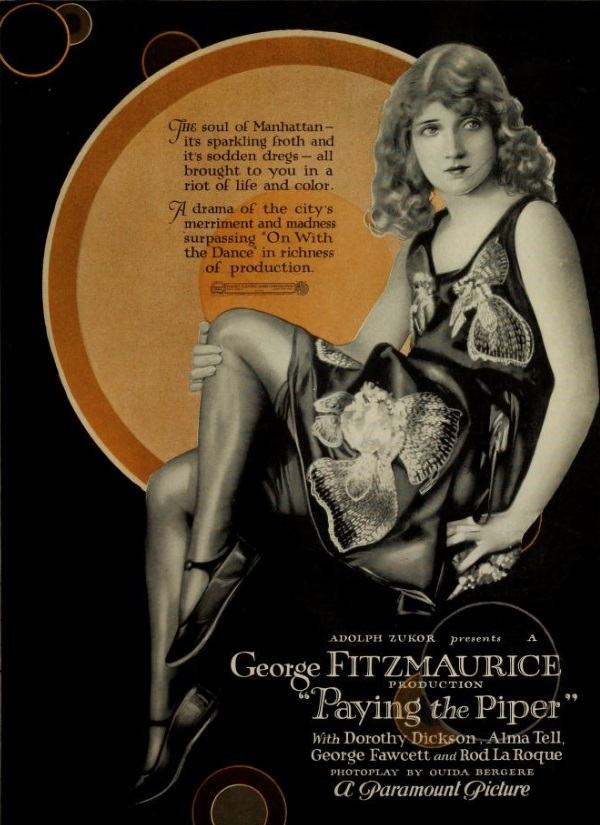
The 1921 cinematic tapestry Paying the Piper, directed with a discerning eye for the grotesque excesses of the American aristocracy, stands as a formidable monument to the era of silent melodrama. Written by the prolific Ouida Bergère, the film navigates the treacherous waters of social obligation and the corrosive nature of inherited wealth. Unlike the operatic intensity of Passion, which seeks to externalize internal turmoil through historical grandeur, Paying the Piper is an intimate, almost claustrophobic examination of the domestic sphere as a battlefield. The narrative centers on Larry and Barbara, two individuals who have been forged in the crucible of 'broken homes'—a term that, in the context of this film, implies a lack of moral grounding rather than mere financial instability.
The central conceit—a marriage of convenience—is treated not merely as a plot device, but as an ontological crisis. Larry (Reginald Denny) and Barbara (Alma Tell) are characters defined by their absences. They represent a generation adrift, seeking to anchor themselves through a union that is inherently hollow. Their pact is a rejection of the romantic idealism found in contemporary works like Singing River, opting instead for a cold, clinical pragmatism that reflects the disillusionment of the post-war elite.
The introduction of Marcia, the dancer, injects a necessary vitality into the film’s otherwise somber aesthetic. Marcia represents the 'other'—the world of art, labor, and authentic expression that the protagonists have long since abandoned. Her movements on screen are framed with a kinetic energy that contrasts sharply with the static, posed existence of the wealthy. In many ways, her character recalls the hypnotic allure found in Trilby, though Marcia possesses a self-agency that Trilby lacked. Larry’s love for Marcia is his only tether to humanity, a flickering candle in the cavernous halls of his family’s estate.
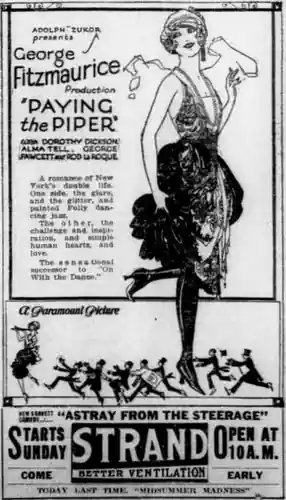
Conversely, Keith, the architect, played with a steady, grounded gravitas by Rod La Rocque, serves as the film’s moral compass. Architecture, as a profession, is not chosen at random here; it symbolizes the act of building something enduring, a stark contrast to the ephemeral and destructive whims of the socialites. When Barbara attempts to 'vamp' Keith—a performance of seduction that Alma Tell executes with chilling precision—she is not merely seeking a lover, but attempting to corrupt the very concept of structural integrity. The film’s exploration of the 'vamp' archetype is far more nuanced than the caricatures seen in Love, Honor and Behave!. Here, the vamping is a defense mechanism, a way for Barbara to exert power in a world where she feels fundamentally powerless.
The second act of Paying the Piper shifts focus to Barbara’s ill-fated foray into the world of acting. This sequence is perhaps the film’s most scathing critique of the vanity of the upper class. Barbara views the stage not as a craft to be mastered, but as a mirror in which to admire her own reflection. Her failure is inevitable, yet Bergère’s script treats her with a surprising amount of empathy. The descent from the heights of social privilege to the gutters of professional rejection is handled with a visual flair that rivals the atmospheric dread of Le ravin sans fond. The lighting becomes harsher, the shadows longer, as Barbara realizes that her status cannot buy talent or respect.
During her absence, the film focuses on the transformative power of Keith’s influence on Larry. The process of 'making a man' out of Larry is depicted through a series of vignettes that emphasize discipline and labor. This thematic preoccupation with masculine redemption is a recurring motif in early 20th-century cinema, echoing the sentiments found in A Man of Sorrow. Reginald Denny delivers a performance of remarkable range, transitioning from a dissipated wastrel to a man of substance with a subtlety that was rare for the period. His chemistry with Fredric March—appearing here in an early, formative role—provides a glimpse into the future of Hollywood acting, where psychological depth began to supersede theatrical gesturing.
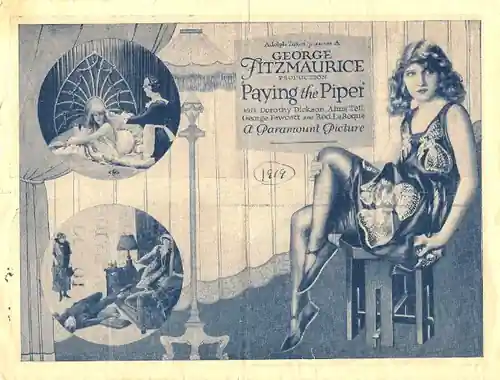
Visually, Paying the Piper is a masterclass in the use of space. The director utilizes the deep focus of the era to place characters in environments that dwarf them, emphasizing their insignificance against the weight of their heritage. The opulent sets are not merely backgrounds; they are active participants in the drama, much like the haunting environments in Wahnsinn. Every velvet curtain and marble column feels laden with the ghosts of the 'broken homes' that produced Larry and Barbara. The film’s pacing is deliberate, allowing the emotional beats to resonate with the audience, a technique that stands in contrast to the frenetic energy of The Extraordinary Adventures of Saturnino Farandola.
The use of intertitles in this production is particularly noteworthy. Rather than simply relaying dialogue, they often provide philosophical commentary on the action, elevating the film from a mere melodrama to a social treatise. This literary quality is a hallmark of Ouida Bergère’s writing, which always sought to find the universal truth within the specific tragedy. The film’s climax, involving Barbara’s return and plea for forgiveness, is handled with a restraint that avoids the saccharine pitfalls of many of its contemporaries, such as His Only Father.
As the final frames of Paying the Piper flicker and fade, the audience is left with a profound sense of the cyclical nature of human folly. The film does not offer easy answers; while Larry finds redemption, Barbara’s path remains uncertain, a shadow of the woman she once was. This ambiguity is what gives the film its lasting power. It is a precursor to the modern character study, a film that understands that the 'piper' must always be paid, but the currency of that payment is often the soul itself. In its exploration of the intersection between wealth and morality, it shares a spiritual kinship with Tepeyac and Golfo, films that likewise grapple with the weight of tradition and the struggle for individual identity.
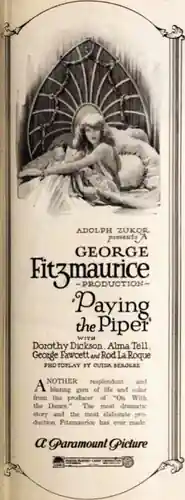
The supporting cast, including George Fawcett and Dorothy Dickson, provide a rich texture to the social milieu, each representing a different facet of the crumbling aristocracy. The film’s ability to balance these multiple narratives without losing its central focus is a testament to the tight construction of the screenplay. It avoids the disjointed feel of Dockan eller Glödande kärlek, maintaining a singular, driving momentum toward its inevitable conclusion. Even in its quieter moments, such as the scenes between Keith and Marcia, there is an underlying tension that keeps the viewer engaged, reminiscent of the atmospheric stillness in As the Sun Went Down.
Ultimately, Paying the Piper is a film about the necessity of loss in the pursuit of growth. Larry must lose his illusions of comfort, Barbara must lose her pride, and Keith must lose his solitude to find a greater connection. It is a sophisticated, intellectually stimulating piece of cinema that deserves a prominent place in the canon of silent film. It captures a specific moment in time—the transition from the Victorian moral landscape to the liberated, yet often lost, world of the 1920s—with a clarity and honesty that remains startling even a century later. Whether one views it as a cautionary tale or a study in human resilience, its impact is undeniable. It stands tall alongside The Captivating Captive and Girls Don't Gamble as a vital document of a society in flux, forever paying the price for its own evolution.
IMDb —
1928
Community
Log in to comment.