DbcultAccessing Vault...
Cult Review
Senior Film Conservator
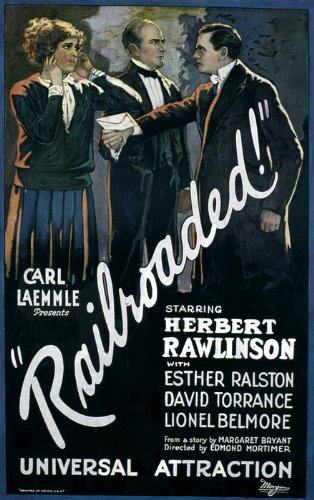
In the pantheon of silent cinema, few narratives tackle the fragility of the legal apparatus with as much grit and psychological density as Railroaded. Directed with a keen eye for the shadows of the human soul, this 1923 production moves beyond the standard 'wronged man' trope, delving instead into the terrifying possibility that the very architects of justice—the judges—can unknowingly become the executioners of their own kin. The film presents Richard Garbin, played with a simmering, volatile energy by David Torrence, as a man whose willfulness is both his greatest asset and his most profound liability. Unlike the existential suffering found in Lon Chaney’s performance in He Who Gets Slapped, Torrence’s Garbin is not a victim of fate, but a victim of human chicanery.
The initial sequences of the film establish a stark contrast between the gilded life of the Garbin family and the subterranean world of Corton’s treachery. The framing of Richard is not merely a plot point; it is a visceral indictment of how easily a reputation can be dismantled. When Richard is 'railroaded' into prison, the term itself carries a heavy, industrial weight—a mechanical, unstoppable force that crushes individuality. This cinematic depiction of the legal system as a blind machine shares certain thematic DNA with the allegorical struggles found in Experience, though Railroaded maintains a grounded, almost noir-like realism that was ahead of its time.
The narrative pivot occurs when Richard escapes and assumes the identity of 'Ragland.' This transition is more than a name change; it is a shedding of the self. The scene where Ragland meets his father, Judge Garbin (Alfred Fisher), at a dinner party is a masterclass in suspense. The irony is thick enough to be suffocating. Here is a man who has spent his life interpreting the law, yet he fails to recognize the living proof of the law’s failure sitting across from him. This sequence evokes the high-stakes social tension of The Firing Line, where social standing and secret histories collide with devastating potential.
"Justice is blind, but the heart has its own vision—a vision that Richard Garbin must regain through the crucible of exile."
Judge Garbin’s proposal—that Richard finish his sentence on the estate of Hugh Dunster—is a fascinating legal anomaly. It reflects a period in storytelling where the 'gentleman’s agreement' could supersede the cold bars of a cell. This shift to the Dunster estate moves the film from the claustrophobia of the city and the prison into a pastoral liminal space. It is here that the film’s visual palette expands, moving away from the dark, urban shadows into a more luminescent, hopeful aesthetic, reminiscent of the atmospheric shifts in Mutter Erde.
The introduction of Joan Dunster, portrayed by the luminous Esther Ralston, provides the film with its moral and emotional anchor. Ralston, who would later be celebrated in The WAMPAS Baby Stars of 1922, brings a sophisticated intelligence to the role of Joan. She is not merely a prize to be won; she is the catalyst for Richard’s transformation from a man of vengeance to a man of peace. Her discovery of Richard’s true identity and his plan to kill Corton serves as the film’s ethical climax.
The chemistry between Torrence and Ralston is palpable, bridging the gap between the film’s darker impulses and its romantic aspirations. Unlike the tragic, doomed romances seen in Samson and Delilah, the relationship in Railroaded is built on a foundation of mutual redemption. Joan’s intervention—preventing Richard from carrying out his bloody vendetta—is a crucial subversion of the revenge genre. It suggests that the only way to truly defeat a man like Corton is to refuse to descend to his level of savagery.
The writing by Charles Kenyon and Marguerite Bryant deserves significant praise. They avoid the mawkish sentimentality that often plagued silent melodramas. Instead, they focus on the internecine conflict within Richard. The dialogue—translated through intertitles—is sharp and purposefully sparse, allowing the visual storytelling to carry the weight of the subtext. The pacing is deliberate, mirroring the slow-burning fuse of Richard’s anger. One can see echoes of this tight narrative structure in other contemporary works like An Unwilling Hero, yet Railroaded feels more personal, more urgent.
The character of Corton acts as a dark mirror to Richard. While Richard is willful and impulsive, Corton is cold and calculating. Their rivalry is not just a battle of men, but a battle of philosophies: the chaos of the framed versus the order of the framer. This dynamic is handled with a sophistication that rivals the character studies found in La malchanceuse, where the protagonist is similarly haunted by a past they cannot escape.
The film’s conclusion, with Richard and Joan sailing for Africa with the Judge’s blessing, is a powerful image of the 'tabula rasa.' In the early 20th century, Africa was often depicted in cinema as a place of adventure or colonial expansion, but here it serves as a spiritual sanctuary. It is a land beyond the reach of the 'railroading' systems of the West. This ending provides a sense of closure that is both satisfying and intellectually stimulating. It asks the audience to consider if a man can ever truly be free within the system that once condemned him, or if he must seek a new world entirely to find his soul.
Comparing this to the lighthearted escapism of Captain Kidd, Jr. or the whimsical nature of Newman Laugh-O-Grams, Railroaded stands out as a somber, reflective work. It shares more with the gravity of As a Woman Sows in its exploration of the consequences of our actions and the possibility of forgiveness.
From a technical standpoint, the cinematography captures the duality of Richard’s journey. The use of low-key lighting during the prison and escape sequences creates a sense of entrapment, while the Dunster estate is filmed with a soft, diffused light that suggests a healing environment. This visual storytelling is as effective as any modern color grading, proving that the masters of the silent era understood the emotional language of light and shadow. The film’s ability to weave together a complex plot involving judicial corruption, personal vendettas, and romantic redemption is a testament to the era’s creative peak.
While films like A Day and Night at Coney Island offered audiences a glimpse into the frenetic energy of modern life, Railroaded offered a mirror to its darker undercurrents. It remains a vital piece of cinema history, a reminder that the quest for justice is often a lonely, treacherous path that requires the intervention of love and the courage to abandon the past. Whether viewed as a legal thriller or a romantic drama, it succeeds on every level, leaving the viewer with a profound sense of the resilience of the human spirit.
In the wider context of 1920s cinema, including works like San-Zurka-San or the intimate character work of Jack, Railroaded holds its own as a narrative powerhouse. It is a film that demands to be remembered, not just for its plot, but for its nuanced understanding of the human condition. It is a story of a man who was lost in the gears of the law and found himself in the heart of a woman, eventually finding peace on a distant shore.
IMDb 6.1
1914
Community
Log in to comment.