DbcultAccessing Vault...
Cult Review
Senior Film Conservator
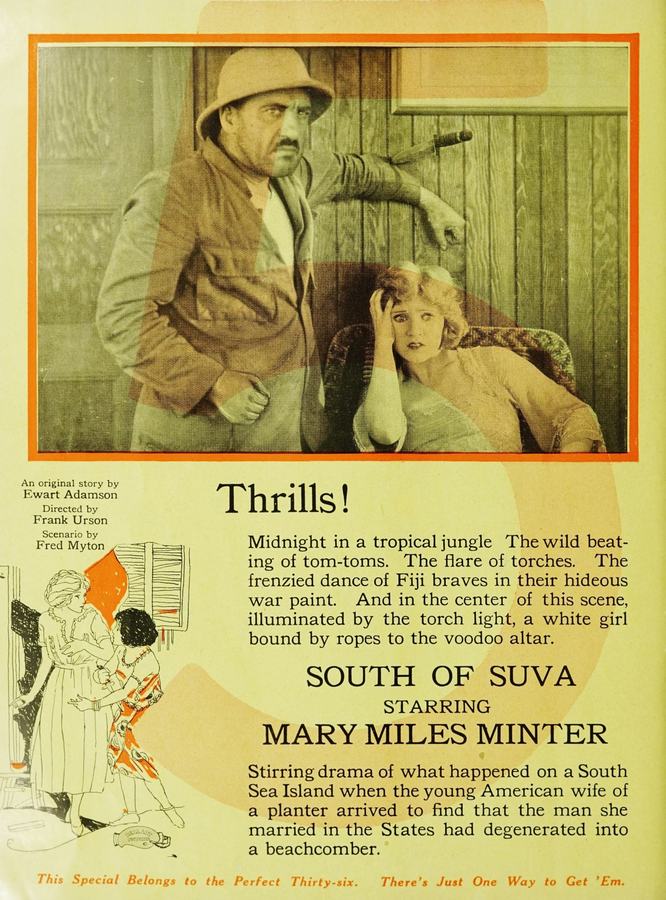
The very title South of Suva feels like inhaling frangipani tinged with kerosene: intoxicating yet primed to ignite. Directed by Franklyn Barrett and released at the tail end of 1922, this Paramount melodrama has slipped through the cracks of canonical conversation, but once you glimpse its feverish DNA—colonial guilt, racial tension, female self-reinvention—you recognize a proto-noir beating beneath its sun-scorched skin.
Barrett, an Australian import, understood that silence amplifies texture. He floods the frame with magnesium-white beaches that bruise into turquoise, then juxtaposes that Eden against the sweat-darkened cotton of plantation overseers. Cinematographer L. William O’Connell lenses Mary Miles Minter as though she were a porcelain cameo dropped into a smoldering terrarium—every bead of perspiration on her clavicle gleams like a tiny pearl of panic. The film’s intertitles, penned by Fred Myton and Ewart Adamson, favor curt declarations—“He sold his soul for rum; she bartered her name for breath”—that thud like drumbeats.
Minter, already haunted off-screen by the unsolved murder of William Desmond Taylor, channels a tremulous defiance here. Watch the micro-movements when Phyllis peels off her wedding ring: thumb rubbing gold as though testing its malleability, eyes flicking toward the door, lips parting on a breath that never becomes a scream. She performs identity the way a cornered animal tests the give in a snare—every pause is strategy.
John Webster, essayed by a granite-jawed John Bowers, embodies the brittle paternalism of white capital. He imports Hindi workers because their indenture is cheaper than Fijian wages, then feigns surprise when indigenous resentment metastasizes. In one lingering close-up, Webster studies a payroll ledger; Barrett superimposes silhouettes of cane cutters toiling in the background, the numbers literally written on their bodies. It’s a visual indictment that predates Soviet montage in its dialectical punch.
Larry Steers plays the husband with a rubber-limbed dissolution worthy of late-period Barrymore. Liquor isn’t mere escape; it’s the solvent corroding the myth of white competence. His linen suit yellows scene by scene, a living barometer of moral malaria. When he finally offers Phyllis to the “natives,” the gesture feels less like villainy than the logical endpoint of commodification—woman as commodity, labor as commodity, flesh as currency.
Human sacrifice in commercial silent cinema? You heard correctly. Barrett stages the ritual inside a torch-lit bure, shadows writhing like eels across the thatch. Phyllis, wrists bound with braided coconut fiber, becomes a tableau of porcelain terror. Yet the camera refuses to eroticize her peril; it lingers on the faces of the Fijian rebels, whose eyes reflect centuries of dispossession. The sequence anticipates the ethnographic dread later refined in Krzyk and La belle dame sans merci.
Surviving prints contain no original score, yet archival notes suggest Paramount encouraged exhibitors to interpolate “island melodies” between reels. Contemporary reviewers complained of ukuleles clashing with Hindu ragas—an aural metaphor for the cultural collision depicted onscreen. Modern festivals often commission new scores; I caught a 2019 MoMA restoration with a Fijian choir weaving iTaukei chants with tabla loops, and the effect was revelatory—the music stitched past and present into a single open wound.

Barrett shot interiors in L.A., but second-unit crews captured Suva’s harbors and the fire-dance of Beqa. The splice between back-lot sets and authentic Melanesian footage is seamless, predating the hybrid strategies later embraced by Milestones and A Daughter of the Wolf. The result is a geographic vertigo: you’re never sure if the next frame will exhale studio air or salt-laden monsoon.
Yes, the film traffics in the “noble savage” trope, but its sympathies scatter in multiple directions. The Hindi coolies are shown negotiating contracts in Urdu, their dignity intact. Indigenous Fijians, led by the charismatic Bhogwan Singh, articulate grievances via subtitle cards that bristle with legal precision. The true antagonist is capital itself, personified by Latimer’s slouching decadence and Webster’s paper-pushing rationalism. The riot climaxes not in racial bloodlust but in a class revolt the plantation owners misread as tribal savagery.
Phyllis’s adoption of “Pauline Leonard” is no throwaway gimmick. It interrogates the malleability of self under colonialism: a white woman can rename herself because the machinery of empire secures her privilege, while indentured laborers carry fixed appellations stamped on ledgers. When Webster calls her “Pauline” even after discovering the ruse, the film hints that affection transcends legal identity, though only for those cushioned by race.
Government police arrive with rifles and white pith helmets, but Barrett undercuts triumph. A lingering shot shows a Fijian child clutching a broken toy boat amid the rubble—an indelible emblem of collateral damage. Phyllis’s gratitude is tempered by the realization that her survival hinged on the same imperial apparatus that precipitated the crisis. The film’s final embrace between her and Webster occurs beside a cracked plantation bell, its clapper silent, its resonance spent.
The gendered peril nods to Camille and The Strange Woman, yet its post-colonial unease anticipates later post-war masterpieces. The human-sacrifice motif resurfaces in Unto the End, though none match the racial cross-talk Barrett squeezes into ten reels.
No complete 35 mm negative survives; the Library of Congress holds a 9-reel composite with two missing intertitles, while Gosfilmofond’s print includes a variant ending where Webster stays behind to face trial for breach of labor ordinances. Cinephiles trade bootlegs like samizdat, each generation re-translating the intertitles to expunge outdated epithets. The film’s instability becomes part of its text: a story about fractured identity that exists only in fractured form.
Watch South of Suva for its tropical noir dread, its collision of libido and empire, its rare admission that love can germinate even in soil salted by exploitation. But watch it also as a cautionary reel: identities forged on stolen land remain as fragile as nitrate; revolutions sparked by betrayal burn hotter than cane-fire; and sometimes the only thing south of Suva is the shadow we cast when we turn our backs on history.
VERDICT: A scorched orchid of a film—beauty laced with venom, still potent a century on.
IMDb 6.5
1928
Community
Log in to comment.