DbcultAccessing Vault...
4.4/10
Senior Film Conservator
A definitive 4.4/10 rating for a film that redefined the boundaries of cult cinema. Stomatol (Missionären i Afrika) remains a cornerstone of transgressive art.
Is Stomatol (Missionären i Afrika) worth your time in the modern era? Short answer: yes, but only as a historical curiosity for those interested in the evolution of marketing and animation.
This film is for students of early cinema and those who want to see how propaganda and advertising once shook hands. It is absolutely not for anyone looking for a sensitive or politically correct depiction of global cultures.
This film works because it utilizes a pioneering animation technique that predates the complexity of Disney, focusing on clear, high-contrast visuals that were perfect for the low-resolution projection systems of 1916.
This film fails because its narrative relies heavily on colonial stereotypes that are jarring and offensive to a contemporary audience, making the 'humor' feel stagnant and cruel.
You should watch it if you are researching the 'Kapten Grogg' era of Swedish animation or if you want to understand how early brands used the 'civilizing mission' trope to sell household goods.
Victor Bergdahl was not just an animator; he was a technician of the subconscious. In Stomatol (Missionären i Afrika), he manages to strip away the complexities found in contemporary works like The Burning Soil to create something purely transactional.
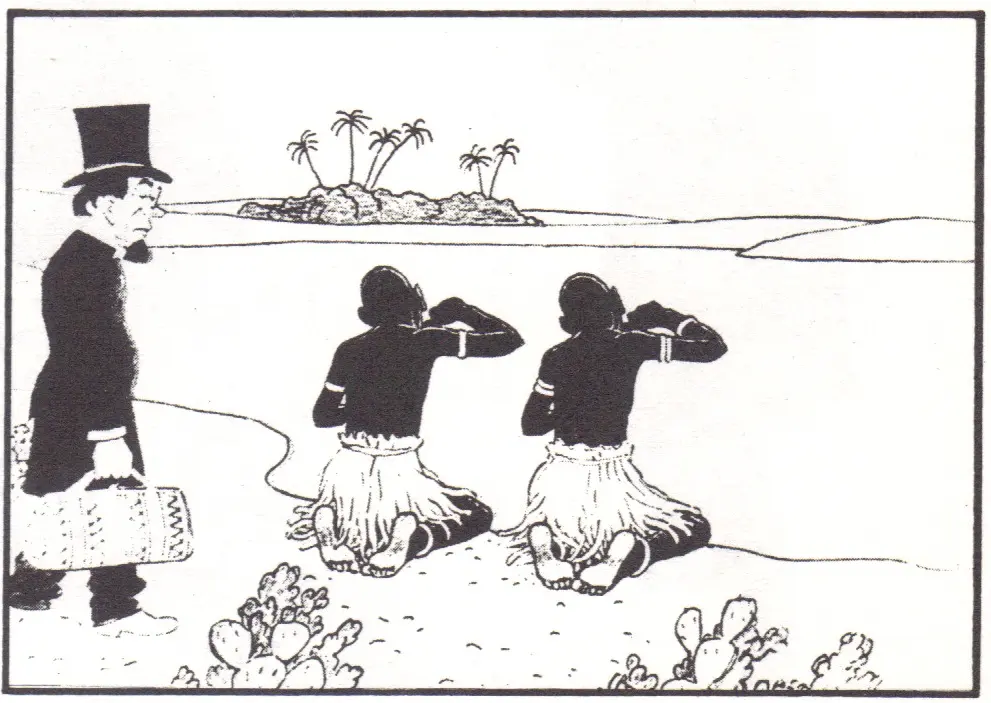
The plot is brutally simple. A missionary meets a lion. The missionary brushes the lion's teeth. The lion is satisfied. It is a primitive loop of action and reward.
Consider the way the lion’s jaw moves. It is a mechanical, repetitive motion that mirrors the industrial age. This isn't the fluid, expressive character work we see later in the century. It is a puppet made of ink.
The simplicity is the point. In 1916, audiences weren't looking for the emotional depth of The Passion of a Woman Teacher. They were looking for the novelty of movement itself.
We cannot ignore the elephant—or in this case, the lion—in the room. The film uses the 'Missionary in Africa' trope as a shorthand for 'superiority.' The missionary is the bringer of the brush, the bringer of the paste, and by extension, the bringer of order.
This is a far cry from the experimental, observational truth sought in Kino-pravda no. 4. Bergdahl isn't interested in truth. He is interested in the brand. Stomatol is the hero.
The missionary’s calm demeanor in the face of a predator is a visual lie. It suggests that Western hygiene is a shield against the wild. It’s an absurd claim, but in the context of 1910s advertising, it was gold.
The lion, once brushed, becomes a domestic object. It loses its threat. This transformation is the core of the film's 'success' as an ad. It promises that the product can tame even the most savage forces.
Bergdahl’s work here is inextricably linked to his most famous creation, Kapten Grogg. You can see the same DNA in the character designs. The lines are thick, the backgrounds are minimal, and the focus is entirely on the gag.
Unlike the atmospheric tension in Under the Greenwood Tree, there is no attempt at lighting or shadow here. It is a flat world. But that flatness allows for a specific kind of clarity.
The pacing is surprisingly brisk. At just a couple of minutes, it doesn't overstay its welcome. It delivers the punchline and exits. This is a lesson many modern directors could learn from.
One specific moment stands out: the missionary’s hand as he applies the paste. The detail in the tube of Stomatol is higher than the detail in the missionary’s face. The product is the star. The human is just a delivery system.
Does Stomatol (Missionären i Afrika) hold up as a piece of cinema?
If you are looking for entertainment, the answer is no. If you are looking for a window into the 1916 psyche, the answer is yes. It is a rare example of how early animation was used to monetize cultural biases. The film is a fossil. It is hard, cold, and tells us exactly what the world used to look like.
Compared to the narrative complexity of It Is the Law, this film feels like a nursery rhyme. But nursery rhymes are often where a culture's darkest assumptions are hidden.
There is a strange, unintentional surrealism at play here. The idea of a lion needing a toothbrush is inherently funny, but Bergdahl plays it with a straight face. This lack of irony is what makes it so fascinating.
It lacks the melodrama of Her Bargain Day or the moralizing of The Fable of the Traveling Salesman. It is a film about a thing. A tube of paste.
The animation of the lion’s mane is particularly interesting. It’s a series of jagged lines that vibrate with a life of their own. It’s almost expressionistic, though Bergdahl likely didn't intend it to be.
This vibration gives the film an energy that static illustrations lack. It feels alive, even if the life it portrays is a caricature. It is the energy of a new medium finding its legs.
Pros:
Cons:
When you watch Autour de la roue, you see a focus on the machine. In Stomatol, the product is the machine. It is a tool for modification.
Even in silent action films like Three Jumps Ahead, the hero is defined by physical prowess. Here, the missionary is defined by what he owns. His power comes from his bag of tricks.
This shift from 'doing' to 'owning' is the hallmark of modern advertising. Bergdahl was one of the first to realize that animation could make this ownership look magical. It could make a toothbrush seem like a scepter.
It’s a cynical realization, but a brilliant one from a business perspective. Stomatol is still a known brand in Sweden today. This film is part of the reason why.
We have to be honest. It’s uncomfortable. The film treats the African setting as a playground for Western products. It’s a theme that would persist for decades in films like Perils of the Coast Guard or The Courageous Coward.
But ignoring it doesn't help us understand it. By looking at Stomatol, we see the blueprint for how brands insert themselves into the global narrative. We see the beginning of the 'problem/solution' marketing loop.
The problem is the wild. The solution is the paste. It’s a lie, of course. But it’s a very effective one.
The film doesn't have the heart of The Hidden Spring. It doesn't have the grit of She Wolves. It has the cold, calculating eye of a salesman.
Stomatol (Missionären i Afrika) is a fascinating, if ugly, piece of history. It is a masterclass in early visual communication and a disaster of cultural sensitivity. It works. But it’s flawed. Watch it to learn, not to enjoy. It is a 100-year-old commercial that still manages to leave a bad taste in the mouth, despite being about toothpaste.

IMDb 6.6
1930
Community
Log in to comment.