DbcultAccessing Vault...
6.7/10
Senior Film Conservator
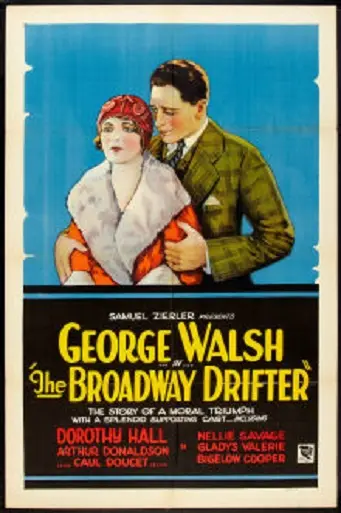
A definitive 6.7/10 rating for a film that redefined the boundaries of cult cinema. The Broadway Drifter remains a cornerstone of transgressive art.
Is The Broadway Drifter a hidden gem of the silent era? Short answer: No, it is a fascinating but ultimately disjointed relic that serves better as a historical curiosity than a narrative triumph.
This film is for the dedicated silent cinema historian and those interested in the transition of George Walsh from an athletic star to a dramatic lead. It is emphatically not for anyone seeking the polished pacing of modern cinema or the visual sophistication found in the masterpieces of the same year.
1) This film works because George Walsh brings an undeniable physical charisma to the role of Bob Stafford, making the transition from a lazy socialite to a gym instructor feel surprisingly plausible.
2) This film fails because the script by William B. Laub tries to be three different movies at once: a social satire, a romantic comedy, and an industrial thriller, failing to nail the landing on any of them.
3) You should watch it if you enjoy seeing how 1920s cinema handled the burgeoning obsession with aviation and the 'New Woman' fitness culture.
The first act of The Broadway Drifter leans heavily into the 'disinherited son' archetype, a theme explored with more comedic precision in films like The Hick. Bob Stafford is introduced as a man whose primary occupation is spending money he didn't earn. When his father finally cuts the cord, the film briefly threatens to become an interesting satire of the leisure class.
Bob’s decision to open a gym for 'wealthy young girls' is the film’s most inspired, if slightly creepy, plot point. It reflects a very specific 1920s anxiety about the health of the urban elite. The scenes in the gym are the highlight of the production, allowing Walsh to showcase the athleticism that made him a star. He isn't just acting; he's performing a physical comedy of errors that feels more grounded than the later melodrama.
However, the romance with Eileen (Dorothy Hall) feels rushed. Hall is charming, but her character exists primarily as a trophy for Bob's eventual redemption. Unlike the more nuanced female leads in films like Gossip, Eileen is a flat catalyst for the protagonist's growth. Their chemistry is serviceable, but it lacks the spark needed to carry the film through its slower middle section.
The film takes a jarring turn when Bob is driven out of the gym business. Suddenly, we are in an airplane factory. This shift is common in films of this era—where a protagonist must prove their 'manhood' through industrial labor—but here it feels like a different script was stapled to the first thirty minutes. The inclusion of an airplane invention subplot adds stakes that the film hasn't earned.
Consider the scene where Bob is accused of stealing the invention to give to his father. It’s a classic case of dramatic irony gone sour. The audience knows he's innocent, but the characters' reactions are so heightened and illogical that it loses its impact. This type of heavy-handed conflict is much better handled in The Night Cry, where the stakes feel personal rather than purely mechanical.
The factory setting itself is shot with a utilitarian eye. There is little of the German Expressionist influence that was beginning to seep into American cinema by 1927. Instead, we get flat lighting and functional compositions. It’s efficient, but it’s not art. It’s a far cry from the visual poetry of Beauty and the Beast, though it shares that film's interest in the transformation of a 'beastly' character into a hero.
George Walsh is the anchor here. His performance is energetic, though occasionally prone to the over-the-top gesticulation that plagued many silent actors who didn't quite trust the camera. Still, his charm is what keeps the viewer engaged during the film's more repetitive sequences. He has a way of looking at the camera that feels modern—a wink to the audience that says, 'I know this is ridiculous.'
The supporting cast is less memorable. Arthur Donaldson and Paul Doucet play their roles with a standard-issue villainy that lacks nuance. They are obstacles, not people. In comparison to the complex social dynamics in Waifs or the moral ambiguity of Shame, the characters in The Broadway Drifter feel like cardboard cutouts being moved across a board.
The direction by an uncredited hand (often attributed to the production's general management) lacks a signature style. The pacing is the biggest casualty. The film drags in the second act as it sets up the espionage plot, losing the breezy momentum of the gym sequences. It works. But it’s flawed.
Yes, if you are interested in the evolution of the American action hero. The Broadway Drifter serves as a bridge between the swashbuckling antics of Douglas Fairbanks and the more grounded, industrial heroes of the 1930s. It captures a moment in time when the 'Broadway' lifestyle was being contrasted with the 'real work' of building modern America.
However, for a casual viewer, the film is likely too slow and its plot too fragmented to offer much enjoyment. It lacks the cohesive vision found in the better-known silent classics. It is a B-movie from a time before that term was fully codified, and it carries all the hallmarks of a production that was more interested in filling a double bill than making history.
Pros:
- Engaging lead performance by George Walsh.
- Interesting historical look at 1920s fitness culture.
- Decent final act tension involving the airplane theft.
Cons:
- Weak, one-dimensional villains.
- Inconsistent tone and pacing.
- Lackluster cinematography compared to its contemporaries.
The Broadway Drifter is a 1927 curiosity that manages to be both charming and frustrating. While George Walsh provides enough star power to keep the engine running, the screenplay by William B. Laub eventually runs out of fuel. It is a film of moments rather than a complete whole. If you’ve already seen the major works of The Last Chance or the more comedic A Full House, this is a reasonable next step, but don't expect a masterpiece. It’s an average film that tried to do too much and ended up doing just enough to be forgotten.

IMDb 6.6
1936
Community
Log in to comment.