DbcultAccessing Vault...
Cult Review
Senior Film Conservator
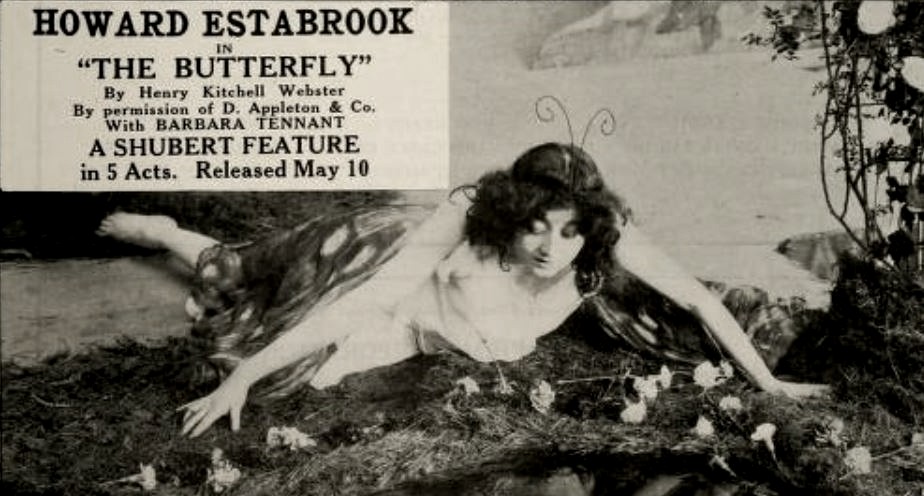
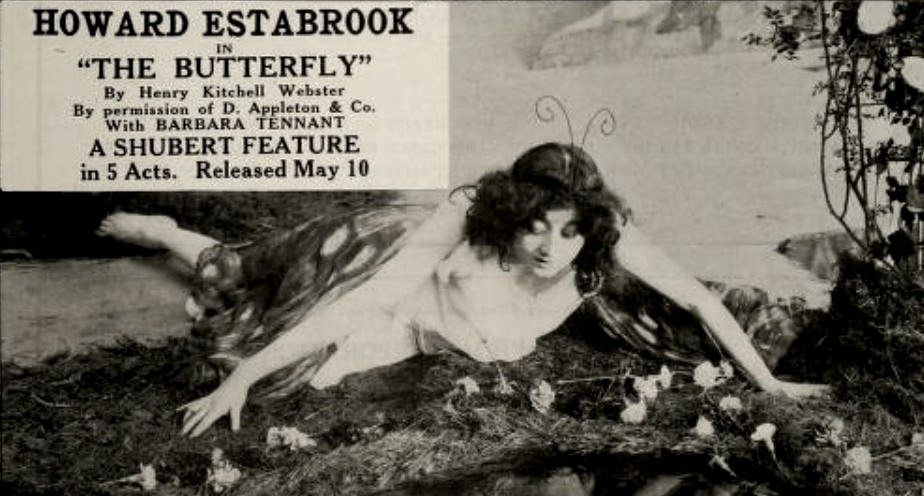
There are films you watch and films that watch you—The Butterfly belongs to the latter tribe, a brittle 1914 nitrate prayer that somehow survived the century’s bonfires to flutter once more before our streaming-weary eyes. Twelve minutes. That’s all. Yet inside its cramped 1.33:1 aperture thrums a lurid morality play that feels as if Hitchcock’s Vertigo were distilled in a penny arcade shot glass.
The plot, at first blush, sounds like Victorian cliffhanger leftovers: spurned hunchback, dazzling ingénue, jealous matron, two rival swains, murder most scenic. But watch how cinematographer O.A.C. Lund (pulling double duty as co-writer) refuses to let any emotional beat land cleanly. Every close-up is half-erased by mildew-like shadows; every intertitle arrives a beat too late, forcing you to assemble meaning in the dark. The result is a film that seems to breathe through broken teeth.
We open on backstage clutter: ropes sagging like nooses, a cracked mirror returning fractured vanities. The hunchback—never named, merely endured—shuffles into frame, spine curled like a question mark inked by Aubrey Beardsley on absinthe. Actor Fred Radcliffe plays him without a trace of the sentimentalized grotesque that would soften later Lon Chaney vehicles. His eyes glitter with the specific rage of someone who has memorized every synonym for repellent.
Enter Elaine, portrayed by Julia Stuart with the coltish uncertainty of a girl who has been told she is beautiful but hasn’t yet decided what currency that beauty spends. The hunchback sees in her the perfect weapon: polish the orphan’s raw talent, shove her into the spotlight, and let the stepmother’s envy do the rest. It’s Pygmalion retooled by Jacobean revenge dramatists—My Fair Lady with a shiv.
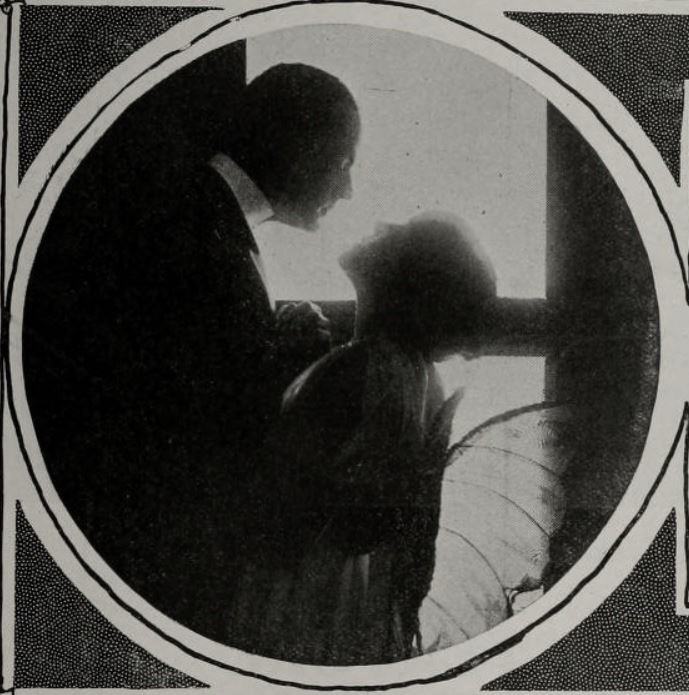
Note: Compare this dynamic to the sadistic mentor figures in Du Barry or the imperious impresario of Inspiration; what distinguishes The Butterfly is how the puppet master’s strings are already frayed by self-loathing.
Elaine’s transformation into headliner happens in a flurry of jump-cuts that prefigure Soviet montage by at least half a decade. One moment she’s flat-footed in rehearsal; the next she’s mid-pas de bourrée, tulle haloed by klieg lights that bleach the frame into near-ivory. The hunchback watches from the wings, clutching a curtain like a priest fingering vestments. His glee is indistinguishable from anguish.
The stepmother’s arrival at the theater is staged like a visitation of Nemesis in a penny dreadful: veil, feathered hat, a bustle that could anchor dreadnoughts. Barbara Tennant plays her with the brittle hauteur of someone who has never been refused a wish, until now. When she sees Elaine transfigured into the titular Butterfly—the production’s star aerial danseuse—her face collapses into a silent scream that the intertitle card only approximates: "You dare rise above the muck I allotted you?"
What follows is a murder sequence so compact it feels carved rather than filmed. The hunchback corners the stepmother on a catwalk above the stage. Lund frames them from a god-like vertical angle—two black commas against a sea of nothing. No music, only the whirr of the projector’s sprockets. A glint of steel, a soft thuck (achieved through a savvy cut to a velvet curtain shuddering), and the body plummets into the orchestra pit, landing on timpani that release a sound like a wounded whale.
The perils-of-vertigo trope would resurface famously in The Perils of Pauline, but here the drop is not cliffside spectacle—it’s the vertiginous moral plummet of a man annihilating the thing he covets.
Guilt detonates the hunchback’s sanity in a sequence that feels eerily predictive of German Expressionism’s arrival six years later. He flees to a coastal escarpment where the surf gnaws rocks like molars on bone. Lund double-exposes the image so that the hunchback seems pursued by his own shadow, a doppelgänger twisted into a grotesque S-curve. When he finally topples, the camera lingers on empty air—no body shown, only the abstract absence where a soul once snarled.
Enter John Butler—Howard Estabrook supplies matinee-idle grace undercut by a tremor of genuine panic when constables clap him in manacles. The film now pirouettes into courtroom melodrama, albeit one staged in a single cramped set whose walls sweat ochre. Elaine, previously ornamental, seizes narrative agency: she commandeers the witness box, reenacts the hunchback’s limping gait, and produces the blood-spattered dance slipper that serves as both evidence and poetic justice. It’s a moment of proto-feminist self-advocacy that lands harder than anything in The Governor or The Prince and the Pauper.
The couple’s final clinch dissolves into a tableau of nuptial optimism—iris shot closing like a Victorian locket. Yet Lund denies us catharsis: the last intertitle intrudes with a Biblical verse about moths and flames, hinting that the butterfly’s wings were always destined for scorching.
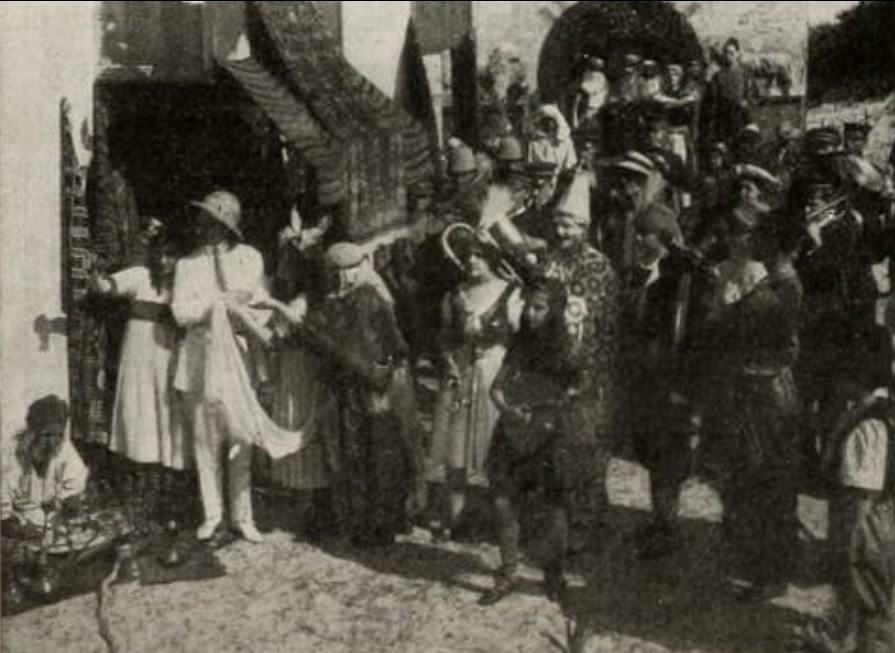
Shot on winter-withered locations in Fort Lee, New Jersey, the film’s exterior plates carry a sooty patina that makes the artificial studio sets glow almost preternaturally. Lund favors low-key tungsten that carves cheekbones into hatchet blades; the hunchback’s face often emerges from pure black, a disembodied mask floating like a Renaissance memento mori. Meanwhile, Elaine is lit with a diffuse halo—an early use of beauty diffusion achieved by stretching silk stockings over the lens, a trick later attributed to la Garbo cameramen.
Because the film is silent, performances must semaphore interior states through calibrated hyperbole. Radcliffe’s hunchback avoids the trap of mustache-twirling villainy; instead he gives us micro-gestures—a finger drumming against a thigh, a swallow that ripples like a stone through flesh. Julia Stuart, by contrast, deploys the wide-eyed rapture of Lillian Gish minus the porcelain fragility: when she learns of her stepmother’s death, her pupils bloom into twin eclipses, a silent howl more chilling than any scream.
Place The Butterfly beside La Dame aux Camélias and you’ll notice both pivot on women whose desirability becomes a death sentence. Stack it against Schuldig and you discern mirrored motifs of guilt transmuting into self-annihilation. Even the breezier The Whirl of Life shares this film’s fixation on the spectacle of female bodies commodified for applause.
In an era when TikTok “cancel” campaigns and Instagram facades perform strikingly similar mask dances, the hunchback’s voyeuristic revenge feels prophetic. He weaponizes another person’s luminosity to annihilate a rejector—an algorithmic maneuver avant la lettre. Likewise, Elaine’s courtroom self-defense prefigures the way women today leverage testimony as both sword and shield.
For decades the only print languished in the Russian state archive, misfiled under “Babochka.” A 2022 2K restoration by EYE Filmmuseum rescued 583 feet of previously missing footage, now streaming via Kino-Catastrophe and SilentShadows. The new score—percussion, toy piano, bowed saw—eschews nostalgic strings for atonal jitters that honor the film’s venomous heart.
The Butterfly is not a quaint relic; it’s a poisoned bonbon—dainty, exquisite, corrosive. It distills the entire melodramatic impulse of early cinema into a shot glass and slides it across the bar with a smirk. Drink, and you taste the metallic tang of vengeance, the saccharine drift of love, the acrid after-bite of madness. Twelve minutes, but they cling like tattoo ink. You leave the screening with wings beating against your ribcage, unsure whether they seek escape or simply wish to scorch.
Rating: 9/10 – A brittle, blazing artifact that proves even the silent era could howl in Technicolor nightmares.
IMDb 7.2
1926
Community
Log in to comment.