DbcultAccessing Vault...
5.7/10
Senior Film Conservator
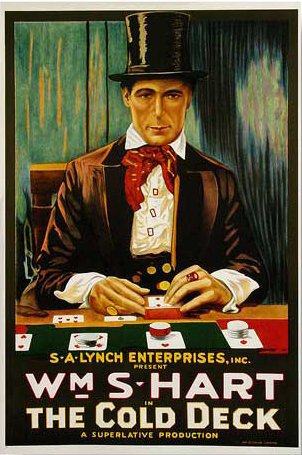
A definitive 5.7/10 rating for a film that redefined the boundaries of cult cinema. The Cold Deck remains a cornerstone of transgressive art.
William S. Hart’s craggy silhouette, backlit by nitrate ember, opens The Cold Deck like a parable scratched on celluloid parchment: a gambler wagering his soul for a sister’s next breath. The film, released in the twilight of 1925 when silent cinema teetered between baroque shadows and the coming dawn of sync-sound, distills Hart’s perennial mythology—the reformed outlaw whose virtue is merely dormant, not deceased.
From the first iris-in, cinematographer Joseph H. August bathes the frontier in chiaroscuro so tactile you can smell kerosene. Hart, credited simply as “On-the-Level” Leigh (a moniker echoing the actor’s own insistence on rectitude), enters through swinging doors with the gait of a man who has read every crack in the floorboards. The camera clings to his weather-beaten duster, its fringe stiffened by alkali dust; it is a garment that carries the residue of every poker table from Abilene to Virginia City.
Narrative economy here is ruthless. In under seven reels, scenarist J.G. Hawks spins a yarn that might elsewhere sprawl across a miniseries. Hawks—whose pen once sharpened Tess of the D’Urbervilles for the screen—compresses backstory into a single shot: a physician’s telegram trembling in Leigh’s calloused palm, its ink bleeding like a verdict. Alice, played with porcelain fragility by Mildred Harris, coughs into a lace handkerchief already freckled crimson; the mountains, promised as Eden, rear up beyond the window like a creditor tapping the glass.
The relocation sequence unfolds through a symphony of montage: wagon wheels, coffin crates, a canary in a cage whose trill is drowned by the grind of axles. Once arrived at the alpine hamlet, the film’s palette paradoxically cools. Where one expects the reassuring glow of hearth, instead we find interiors painted in glacial blues, as though nature itself conspires to remind Leigh that escape and exile share a border.
Enter Coralie, the proverbial serpent in spangles. Sylvia Breamer imbues her with a predatory languor; her smile unfurls like a switchblade. Their first encounter occurs at the dance-hall’s faro table, beneath chandeliers cobbled from antlers. Coralie’s eyes, outlined in kohl sharp enough to slice bread, size up Leigh not as a man but as a ledger entry. The tension is erotic yet mercantile: she wants whatever pulse still beats beneath his shirtfront, preferably in coin.
Leigh’s refusal to capitulate to her flirtation is filmed in an unbroken medium shot; Hart’s stoic profile occupies two-thirds of the frame, Coralie’s shoulder fills the remainder, a diagonal that bisects the composition into territories of virtue and temptation. When she leans closer, cigarette smoke coils between them like Morse code. He folds, not to her, but to circumstance—an empty purse trumping an iron will.
The infamous “cold deck” scene arrives at minute thirty-eight. Director Lynn Reynolds resists bombast: the camera simply dollies in until the deck occupies the screen’s entirety, cards dealt with the hush of falling snow. Intertitles vanish; we read only the slap of pasteboard and the flicker of pupils. The cheat is not revealed through exposition but through Coralie’s micro-grin—a moment so fleeting you might mistake it for a bad splice—yet it detonates the narrative. Leigh’s entire wad evaporates, and with it the last bridge to legitimacy.
Thus begins the film’s descent into moral fog. The hold-up is staged in a canyon whose rock walls compress the stagecoach into a rolling confession booth. Hart’s blocking is masterful: he positions himself foreground-left, shotgun braced against hip, while the vehicle approaches along a diagonal that leads the eye inevitably to the coach-driver—soon to be corpse. Black Jack’s entrance, from a precipice above, is a diagonal counter-stroke, an axis of evil intersecting Leigh’s axis of desperation. The murder happens off-camera; we register only the driver’s gloved hand going limp, reins slipping like spilled spaghetti.
Guilty by proximity, Leigh’s surrender feels almost monastic. Hart lets his hat tumble into the dust, a ritual shedding of identity. The jailhouse interior is rendered in high-contrast orthochromatic stock; bars tattoo black stripes across his face as though destiny itself is sketching prison-issue garb onto his soul. Mildred Harris reappears in a parallel cage—Alice’s sanatorium window—through cross-cutting that rhymes sibling confinement: iron vs. glass.
The escape, executed during a thunderstorm, indulges expressionist flourish. Lightning strobes illuminate Leigh scaling a cliff face, each flash printing him onto the rock like a cave painting. Reynolds overlays a church organ score—basso profundo chords that vibrate the ribcage—though modern viewers will supply their own soundtrack of gasps. Once free, Leigh’s trajectory arcs toward a redemption both Biblical and pragmatic: he must unmask the true assassin.
The showdown transpires in a half-submerged mining ditch where moonlight ricochets off tin pans. Black Jack, portrayed with serpentine relish by Edwin Wallock, excavates the express box; coins spill like doubloons from a corsair’s chest. Leigh’s arrival is framed in long shot: two silhouettes grappling amid steam rising from the thawing frost, an ethereal ring that renders the scene almost mythopoeic. When the villain is finally hog-tied, the rope used is the same neckerchief Coralie once flirtatiously flicked—poetic justice rendered in accessory form.
Back in town, acquittal is swift, almost anti-climactic—perhaps Reynolds’ nod to the cynical haste with which frontier jurisprudence could reverse itself once spectacle was supplied. Rose Larkin (Alma Rubens) steps from the crowd, her blonde ringlets aglow like halo filaments. The final clinch is shot against an open doorway through which dawn spills; the couple exits toward the mountains now painted benign rose-gold, a chromatic absolution.
William S. Hart, then fifty-nine, moves with the creaking dignity of a cedar whose core still holds resin. Every micro-gesture—fingertips drumming a tabletop, the way he pockets winnings as though they burn—bespeaks a lifetime studying humanity’s underbelly. Breamer’s Coralie is less femme fatale than venture capitalist of the libido, her calculations visible behind dilated pupils. Mildred Harris, often dismissed as a footnote in Chaplin’s biography, supplies the film’s moral tuning fork: her cough is sonically layered over the gambler’s loss, a leitmotif of culpability.
For cinephiles tracking Hart’s lineage to European melodrama, echoes resonate with Der Katzensteg’s chiaroscuro guilt and As in a Looking Glass’s mirror-image moral fracturing. Domestically, the film anticipates the fatalist contours of Hart’s own Between Men, yet with tighter narrative vertebrae. Compared to the florid excesses of Fruits of Desire, The Cold Deck opts for Puritan sparseness: sin is a stain, not a tapestry.
Currency circulates as both lifeblood and contagion. Each coin that passes across the felt is tainted—first by Leigh’s need, then by Coralie’s larceny, finally by Black Jack’s murderous greed. The film posits that in a society where institutions (law, medicine, even nature’s sanctuary) are commodified, redemption can only be purchased through sacrifice that literally devalues the self: Leigh gives up freedom, reputation, nearly life, to balance the ledger.
Gender politics, though period-typical, reveal fissures. Coralie’s agency is economic rather than emotional; she weaponizes desire because capital routes for women are bottlenecked. Rose Larkin, by contrast, embodies the angelic stabilizer, yet her final smile carries the resigned knowledge that Leigh’s compulsion will one day re-shuffle the deck. The sister Alice, bedridden yet omnipresent, operates as the film’s conscience: every cough cues the audience to tally moral arrears.
A 4K restoration by the Library of Congress premiered at Pordenone 2019, accompanied by a new score compiled from 19th-century parlour tunes. Gray-green tints replicate the original nitrates’ nocturnal sequences; the yellow-gold of dawn scenes was matched to a surviving 1926 Kodak sample. The Blu-ray from Kino Classics includes a commentary referencing The Flames of Justice and The Last Dance as contextual bookends, plus a video essay comparing Hart’s acting style to contemporaneous stage melodrama.
The Cold Deck endures less as a western than as a moral ledger whose ink is still wet. It asks whether a man can ever leave behind the scent of gunpowder that clings to his collar, and answers with the fatalistic elegance of a card that refuses to be reshuffled. Hart, in the twilight of his career, folds his persona into the film’s marrow, offering not the swaggering hero of Rupert of Hentzau but a penitent knight whose armor is guilt and whose grail is a sister’s next breath. Ninety-plus years on, the movie still clicks like a well-dealt deck—precise, merciless, and chillingly human.
IMDb —
1930
Community
Log in to comment.