DbcultAccessing Vault...
Cult Review
Senior Film Conservator
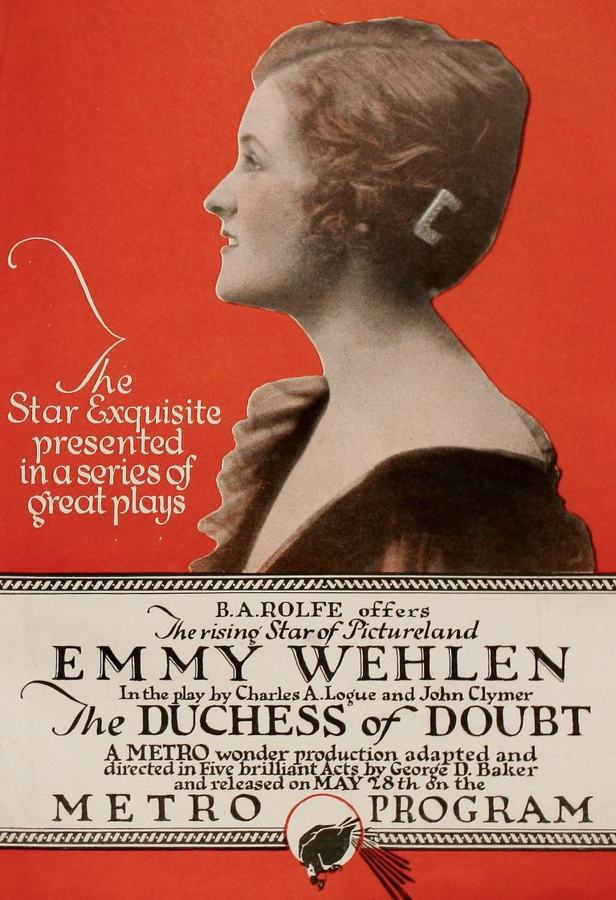
In the pantheon of early silent cinema, 1917 stands as a pivotal year where the medium began to shed its stage-bound origins for a more fluid, visual vocabulary. The Duchess of Doubt, directed by the prolific George D. Baker, serves as a quintessential artifact of this era, blending the melodrama of the Victorian age with the burgeoning consumerist fantasies of the pre-Jazz Age. At its core, the film is a meditation on the fluidity of identity and the precarious nature of social mobility, anchored by the luminous Emmy Wehlen.
Wehlen, a star who transitioned from the musical comedy stage to the silver screen, brings a rhythmic vitality to the role of Clover Ames. Initially introduced as a drudge in her Aunt Sarah’s boardinghouse, Wehlen’s performance captures the crushing weight of domestic servitude. The cinematography emphasizes the claustrophobia of the boardinghouse, a stark contrast to the later expansiveness of the winter resort. Unlike the gritty realism found in contemporaneous works like Alone in London, Baker’s lens here leans toward a stylized romanticism that permits the audience to believe in the impossible.
The narrative pivot—the inheritance of $7,000 from the mysterious Pierre Dubois—is handled with a brisk efficiency that echoes the pacing of a modern thriller. In an era where such a sum represented a lifetime of labor, Clover’s decision to spend it all on a fleeting performance of nobility is a radical act of self-assertion. This isn't merely a rags-to-riches tale; it is a critique of the performative nature of the upper class. By donning the mantle of a Duchess, Clover exposes the superficiality of the social elite who accept her based solely on her plumage and the confidence of her artifice.
This theme of deception for the sake of social survival is a recurring motif in the cinema of the 1910s. One might look at The World and the Woman to see a similar exploration of a woman reinventing herself against the backdrop of societal judgment. However, The Duchess of Doubt maintains a lighter, almost satirical tone that differentiates it from the heavy-handed moralizing often seen in Hazel Kirke.
The entry of Walter Gray (played by Walter Horton) adds a layer of ironic symmetry to the plot. Gray’s decision to travel incognito as a ribbon clerk creates a double-blind romance. The chemistry between Wehlen and Horton is palpable, even through the flickering grain of a century-old master. Their interactions at the fashionable winter resort are a masterclass in silent flirtation, where subtext is conveyed through a subtle tilt of the head or a lingering gaze. The irony that both are pretending to be something they are not—one ascending the social ladder, the other descending it—provides the film’s most poignant commentary on the American class structure.
This dynamic of dual identities was a popular trope, famously utilized in The Man from Home, where the clash of international cultures and internal identities creates the primary friction. In The Duchess of Doubt, the conflict is more localized but no less profound. It questions whether love can survive the stripping away of the masks we wear to impress the world.
George D. Baker’s direction is characterized by a sophisticated use of space. The resort scenes are framed with a grandiosity that feels aspirational, utilizing deep focus to show the bustling activity of the socialites in the background while Clover navigates her internal anxiety in the foreground. The use of intertitles, written by Charles Logue and John B. Clymer, is sparing but effective, allowing the visual storytelling to carry the emotional weight. This approach is reminiscent of the technical precision seen in Stuart Webbs: Das Panzergewölbe, where the visual narrative often supersedes the need for textual explanation.
Furthermore, the lighting in the boardinghouse scenes utilizes a chiaroscuro effect that highlights the grim reality of Clover’s initial life. This contrast between the dark, cramped quarters of her past and the bright, airy vistas of her temporary Duchess persona serves as a visual metaphor for her psychological liberation. It is a technique that echoes the atmospheric tension of Umirayushchiy lebed, though applied here to a more optimistic narrative arc.
When Clover’s funds inevitably dissipate, the film takes a turn toward the pragmatic. Her return to the workforce, this time in Gray’s department store, grounds the fantasy in the reality of the early 20th-century working woman. The department store itself is a character—a cathedral of commerce where class boundaries are both enforced and blurred. Clover’s transition from a pseudo-Duchess to a shopgirl is handled without the typical Victorian sentimentality found in The Little Girl That He Forgot. Instead, there is a sense of resilience and agency in her character.
The revelation of Walter Gray’s true identity as the owner’s son is the ultimate 'deus ex machina' of the plot, yet it feels earned within the logic of the film’s romantic universe. It satisfies the audience’s desire for a 'Cinderella' ending while subtly critiquing the idea that a woman’s only path to security is through a fortuitous marriage. This tension between independence and romantic destiny is also explored in A Daughter of Australia, though Baker’s film feels more urban and modern in its execution.
To fully appreciate The Duchess of Doubt, one must view it alongside other works of the period that grappled with similar themes of hidden truth and social perception. For instance, Who Killed Simon Baird? deals with the consequences of secrets, albeit in a much darker, more suspenseful register. In contrast, The Duchess of Doubt uses its secrets to facilitate a comedic and romantic resolution. The lightness of the film is a breath of fresh air compared to the heavy existentialism of The Last Dance or the religious overtones of The Little Church Around the Corner.
The film also shares a certain European sensibility in its depiction of the 'resort life,' perhaps influenced by the aesthetics seen in Höhenluft. The international flavor of the silent era allowed for a cross-pollination of styles that is evident in Baker’s direction. Whether it is the Italian influence seen in Il film rivelatore or the subtle dramatic shifts found in Qristine, The Duchess of Doubt stands as a robust example of a global cinematic language in its infancy.
Ultimately, The Duchess of Doubt is more than a mere curiosity of the silent era; it is a vibrant, witty, and visually engaging piece of storytelling. Emmy Wehlen’s performance remains a highlight, showcasing a range that encompasses both the tragic and the triumphant. The film’s exploration of class, identity, and the transformative power of wealth remains surprisingly relevant in our modern age of social media personas and digital masquerades.
In the final analysis, the film succeeds because it treats its protagonist’s ambitions with respect rather than mockery. Clover Ames is not a fraud; she is a woman who, for a brief moment, dared to inhabit the life she was told she could never have. The wedding bureau conclusion might seem conventional, but it represents the ultimate validation of Clover’s worth—not as a Duchess, but as a woman capable of commanding her own destiny. For fans of silent cinema, this is a mandatory viewing, a sparkling gem that captures the essence of an era where anything seemed possible on the flickering screen.

IMDb 6.8
1934
Community
Log in to comment.