DbcultAccessing Vault...
Cult Review
Senior Film Conservator
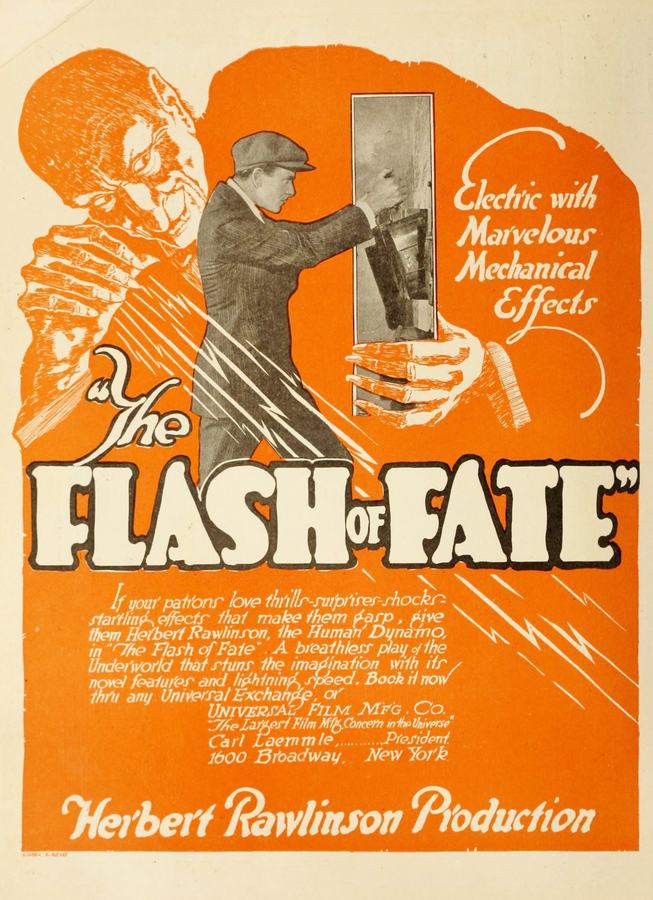
The flickering shadows of 1918 cinema often promised more than they delivered, yet every so often, a work like 'The Flash of Fate' emerges from the archives to remind us of the raw, unpolished power of early narrative experimentation. This is not merely a story of crime; it is a visual treatise on the crushing weight of urban modernity.
The film opens with a sequence of financial ruin that feels remarkably contemporary. Abner Hinman is not just a stockbroker; he is a specter of systemic corruption. When Randolph Shorb’s father takes his own life, the film pivots from a Victorian melodrama into something far more jagged and cynical. Unlike the more poetic tragedies found in The Dumb Girl of Portici, 'The Flash of Fate' leans into the grime of the city. Herbert Rawlinson’s portrayal of Randolph is a masterclass in silent-era transformation. His transition into 'The Ferret' is marked by a subtle hardening of the features, a shift in posture that suggests a man who has traded his soul for the cold comfort of the shadows.
The collaboration between Randolph and Philadelphia Johnson (played with a menacing charisma by Frank MacQuarrie) creates a fascinating dynamic of mentor and protégé in the arts of the illicit. Much like the obsessive descent seen in Greed, Randolph’s pursuit of wealth is a double-edged sword that slices through his personal relationships with surgical precision. The cinematography captures this descent through high-contrast lighting that prefigures the noir aesthetics of the 1940s.
One of the most intriguing aspects for any film historian is the presence of L. Frank Baum. While the creator of Oz is usually associated with whimsical fantasies, his involvement here underscores the experimental nature of the Universal Film Manufacturing Company during this period. The ensemble, including Willis Marks and Madge Kirby, operates with a synergy that elevates the somewhat formulaic 'rooming house' peril into a genuinely claustrophobic experience. The threat to Mary is handled with a visceral tension that echoes the social anxieties found in Her Great Chance.
The narrative structure, penned by the likes of Waldemar Young, manages to avoid the sluggish pacing that plagued many of its contemporaries. There is a kinetic energy to the way Joe Freeman is manipulated into a bank heist—a sequence that rivals the urban franticness of Manhattan Madness. The film understands the geography of the city, using it as a trap that slowly closes around its protagonists.
If there is one reason 'The Flash of Fate' deserves a seat in the pantheon of significant silent films, it is the 'power house' climax. In an era before the digital age, the idea of using the entire city's electrical grid as a communication device was nothing short of revolutionary. Randolph, frantic and desperate, uses Morse code to flash messages across the skyline. This sequence is a triumph of editing and visual metaphor. It transforms the city from a place of isolation into a unified beacon of hope.
The rhythm of the lights—on, off, on, off—creates a heartbeat for the film’s final act. It is a proto-technological 'deus ex machina' that feels earned because of the emotional stakes established in the first half. While A Study in Scarlet relied on deductive reasoning, 'The Flash of Fate' relies on the sheer, brute force of modern infrastructure to resolve its moral crisis.
The film’s resolution—Randolph’s vow to lead an honest life—might seem like a standard Hays Code-era concession, but in the context of 1918, it carries a different weight. It is a recognition of the 'social harvest' mentioned in films like Sowers and Reapers. The Ferret must die so that Randolph can live. This psychological shedding of the criminal persona is depicted with a sincerity that avoids the saccharine pitfalls of The Return of Mary.
The screenplay expertly balances the melodrama of Joe Freeman’s suicidal ideation with the gritty reality of the gang's arrest. It explores the concept of 'fate' not as a fixed destiny, but as a series of flashes—brief moments of choice where one can either sink into the abyss or reach for the light. This duality is what makes the film more than just a period piece. It is a study of the human condition under the pressures of early 20th-century industrialization.
When placed alongside international works like the Swedish När konstnärer älska or the German Tyrannenherrschaft, 'The Flash of Fate' stands out for its uniquely American obsession with the intersection of technology and morality. While European cinema of the time was often exploring the 'Tyranny of the Mad Czar' style of historical grandiosity (see The Tyranny of the Mad Czar), this film is firmly rooted in the asphalt and wires of the contemporary US metropolis.
The grit here is comparable to Juan José, yet the resolution is distinctly more optimistic, reflecting a post-war desire for reconstruction and personal reform. It lacks the pastoral serenity of When You and I Were Young or the nautical simplicity of Cap'n Eri, opting instead for a pulse-pounding urbanity.
'The Flash of Fate' is a testament to the ingenuity of the silent era's storytellers. It takes the trope of the 'gentleman thief' and strips away the glamour, replacing it with a visceral need for justice. The use of Morse code as a narrative pivot remains one of the most clever uses of 'modernity' in early cinema. While some of the secondary plot points involving Mary and Joe feel somewhat dated, the central arc of Randolph Shorb is a compelling look at the cost of vengeance.
For those interested in the evolution of the crime thriller, this is essential viewing. It bridges the gap between the moralistic fables of the early 1910s and the complex character studies that would define the next decade. It is a film that asks us to look at the lights of our own cities and wonder what messages are being flashed in the dark. Much like The Eyes of the World, it suggests that even in a world of betrayal, there is a way to find clarity if one knows where to look.
☆☆☆☆ — A luminous example of silent-era innovation.
IMDb 6.3
1935
Community
Log in to comment.