DbcultAccessing Vault...
Cult Review
Senior Film Conservator
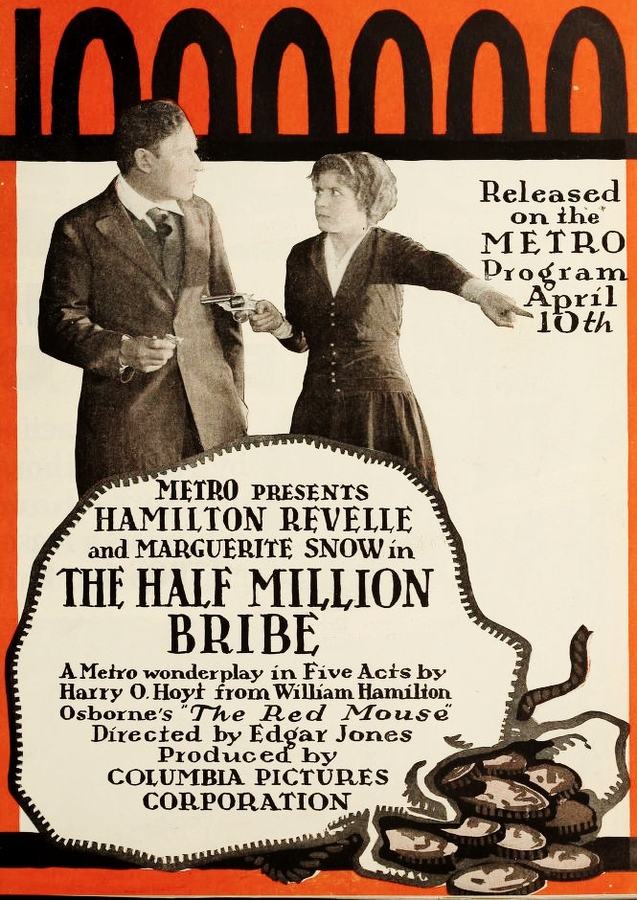
Stepping into the world of The Half Million Bribe is akin to entering a meticulously crafted, moralistic maze, where every turn reveals not just a new plot twist, but a deeper layer of human fallibility and the surprising pathways to redemption. This is no mere potboiler; it's a profound psychological examination, disguised as a gripping crime drama, that challenges our preconceived notions of justice, consequence, and the redemptive power of adversity. From its very inception, with the discovery of Colonel S.F. Hargraves' lifeless body in the illicit confines of Cradelbaughs, the film establishes a tone of grim intrigue, propelling us headlong into a narrative that refuses to offer easy answers or predictable resolutions.
At the heart of this intricate web lies District Attorney Murgatroyd, portrayed with an unnerving blend of stoicism and calculated intent. His character, embodied by the formidable Ferdinand Tidmarsh, is not merely a prosecutor; he is a social engineer, a moral alchemist intent on transforming a dissolute clubman, J. Lawrence Challoner, played by the compelling John Smiley, through an ordeal of his own design. The initial accusation by 'Big Jim' Pemmican (Walter Hitchcock), the gambling house manager, against the inebriated Challoner serves as Murgatroyd's unwitting opening gambit. What follows is a masterclass in manipulation, a series of strategic deceptions that would make Machiavelli proud. Murgatroyd's acceptance of Mrs. Challoner’s (Diane D'Aubrey) half-million-dollar bribe is not a lapse into corruption, but rather a calculated appropriation, a means to an end that only he fully comprehends. This is where the film truly shines, presenting a protagonist whose actions, while seemingly unethical, are ultimately revealed to be profoundly moral, albeit through a lens of extreme pragmatism. One might draw parallels to the complex moral ambiguity found in films like Der Fund im Neubau - 2. Teil: Bekenntnisse eines Mörders, where the nature of confession and guilt is similarly twisted and examined, though Murgatroyd’s intentions elevate his actions beyond mere self-interest.
J. Lawrence Challoner begins his journey as an archetype of inherited privilege and self-indulgence. His drunken stupor at the scene of the crime is not just circumstantial evidence; it's a metaphor for his life – blurred, irresponsible, and disconnected from genuine consequence. Murgatroyd's relentless prosecution, the staged 'third degree,' and the subsequent 'confession' are all part of a grander design to strip Challoner of his illusions and, more importantly, his wealth. The genius of the narrative lies in its portrayal of Challoner’s subsequent fall: his brief escape, his wife’s desperate efforts, and his eventual surrender. The trial itself, with Pemmican's testimony and that of a maid who heard Challoner and Hargraves quarreling over Letty Love (Pemmican’s wife), paints a convincing picture of guilt, ensuring Challoner experiences the full weight of societal condemnation. This period in Challoner’s life, marked by public disgrace and imprisonment, is the initial forging in Murgatroyd’s metaphorical fire. It's a harsh awakening, a forceful severance from the cushioned reality his wife's fortune had afforded him. The film dares to suggest that for some, true character can only be revealed when stripped bare of all comforts, a theme that resonates with the struggles against fate seen in literary adaptations such as Les Misérables, Part 2: Fantine, where individuals are similarly tested by extreme hardship.
The narrative takes a sharp, yet perfectly logical, turn with Pemmican's deathbed confession. Shot in a rival gambling house, the dying man sends for Murgatroyd, revealing the true motive and perpetrator of Hargraves' murder. Pemmican admits to killing the Colonel, driven by jealousy over Hargraves' and Challoner's affections for Letty Love, his own wife. This pivotal moment not only exonerates Challoner of the murder charge but also confirms Murgatroyd's preternatural ability to anticipate, or perhaps even subtly orchestrate, the eventual revelation of truth. It's a testament to the film's writing, credited to Harry O. Hoyt and William Hamilton Osborne, that this twist feels earned rather than contrived. Murgatroyd's subsequent visit to Challoner in prison, where he reveals the false confession and arranges his release, is a crucial step in the district attorney's grand plan. He advises Challoner to disappear, to start anew without the shadow of his past, or more accurately, without the crutch of his former wealth. This sequence highlights the audaciousness of Murgatroyd’s methods, daring to manipulate legal process for what he perceives as a greater, moral good.
Diane D'Aubrey's portrayal of Mrs. Challoner is nothing short of exceptional. She embodies the long-suffering yet resilient spouse, her love for her husband unwavering even in the face of his self-destructive tendencies. Her initial willingness to sacrifice her entire fortune to save him speaks volumes of her devotion. However, it is her confrontation with Challoner after his relapse into drinking that truly defines her strength. Drawing a revolver and threatening to shoot him if he advances, she shatters his drunken complacency. This moment, a raw and visceral display of her breaking point, is the true turning point for Challoner. It’s a powerful subversion of the damsel-in-distress trope, revealing a woman of profound inner steel. The subsequent revelation of their impending parenthood further anchors Challoner's transformation. The thought of bringing a child into the world as 'the child of a murderer' fuels his desire for genuine reform, pushing him beyond mere sobriety into a quest for personal integrity. This emotional depth adds a layer of profound human drama, reminiscent of the enduring relationships and moral fortitude often explored in epics like War and Peace, albeit on a more intimate scale.
The character of Shirley Bloodgood, played by Carol Seymour, serves as a vital moral compass and an unexpected catalyst for the final unraveling of Murgatroyd's scheme. As Mrs. Challoner's steadfast friend and Murgatroyd's fiancée, Shirley occupies a unique position, capable of influencing both sides of the unfolding drama. Her persistent curiosity about Mrs. Challoner's lost fortune, and her astute observation – "any man who would take the last penny a woman has is capable of doing anything. How do you know that the confession Mr. Murgatroyd obtained was not real? I would never stop until I found out" – plants a crucial seed of doubt in Challoner's mind. This moment is not merely expository; it is a profound commentary on the nature of trust, suspicion, and the relentless pursuit of truth. Shirley's unwavering commitment to uncovering the full story forces Challoner to re-examine everything he thought he knew, driving him to conduct his own investigation. Her character embodies the innocent yet insightful observer, often found in narratives that hinge on uncovering hidden truths, much like the investigative zeal in The Child of Paris, where secrets slowly come to light.
The climax of The Half Million Bribe is not a violent confrontation, but a revelation – a profound intellectual and emotional climax. When Challoner, his wife, and Shirley confront Murgatroyd, expecting to expose his corruption, they are met with a calm smile and the untouched securities, exactly as Mrs. Challoner had given them. Murgatroyd's explanation is a tour de force, a stunning articulation of his radical philosophy: "It was Mrs. Challoner's money that made a fool and idler of her husband. He needed to be set right, and drastic treatment was necessary... I realized that the only way to save Challoner was to reduce him to poverty." This moment recontextualizes every event, transforming a tale of crime and deception into an audacious experiment in character rehabilitation. Murgatroyd, far from being a villain, emerges as a complex, almost paternalistic figure, willing to risk his reputation and moral standing to forge a man of substance out of one of privilege. His methods are extreme, even ethically questionable, but their efficacy is undeniable. The film challenges us to consider whether the ends can, in certain extraordinary circumstances, justify the means, particularly when the 'means' involve such profound psychological manipulation. It's a daring narrative choice that elevates the film beyond typical genre fare, inviting deeper reflection on societal responsibility and individual transformation.
At its core, The Half Million Bribe is a searing critique of inherited wealth and the idleness it can foster. Challoner's journey from a debauched clubman to a responsible, loving husband and father is a testament to the idea that true character is often forged in hardship. The film posits that sometimes, the greatest act of love or justice is not protection, but the removal of comfort. Murgatroyd's actions, though harsh, are ultimately therapeutic, akin to a surgeon performing a painful but necessary operation. The performances are uniformly strong, with Ferdinand Tidmarsh's Murgatroyd anchoring the narrative with his inscrutable wisdom, and John Smiley’s Challoner undergoing a believable transformation from weakness to strength. Diane D'Aubrey’s Mrs. Challoner provides the emotional core, her unwavering love serving as both a motivation and a mirror for her husband’s flaws. The screenplay by Harry O. Hoyt and William Hamilton Osborne is remarkably sophisticated for its era, weaving a complex tapestry of moral ambiguity and psychological depth. It avoids simplistic good-versus-evil dichotomies, instead presenting a nuanced view of human nature and the societal forces that shape it. The film's resolution, with covers laid for four at Sherry's, signifies not just a happy ending, but a new beginning, a testament to the power of shared understanding and hard-won personal growth. The joy is palpable, earned through a gauntlet of trials that few would willingly endure, yet which, for Challoner, proved utterly essential. It's a narrative that lingers, prompting introspection long after the final frame.
The lasting impression of The Half Million Bribe is its audacious exploration of justice beyond the letter of the law. Murgatroyd’s actions, while ethically fraught, ultimately serve a higher purpose: the moral rectification of an individual. This challenges audiences to consider the true meaning of rehabilitation and responsibility. The film’s intricate plot, rich character development, and profound thematic underpinnings ensure its place as a compelling drama worthy of rediscovery. It’s a narrative that eschews the easy path, opting instead for a winding, often uncomfortable, journey towards genuine transformation. The performances, particularly by Tidmarsh and D'Aubrey, elevate the material, lending gravitas and emotional resonance to the complex ethical landscape. The careful construction of the plot, where every detail, from the initial murder to the final revelation, serves Murgatroyd’s overarching design, is a masterclass in screenwriting. The film reminds us that sometimes, the greatest acts of love are the hardest, and true redemption often requires a descent into the very depths one seeks to avoid. It’s a narrative that, in its subtle yet powerful way, continues to resonate with contemporary discussions about privilege, accountability, and the often-unseen forces that shape human destiny. The film's unique approach to character development, where Challoner's weaknesses are systematically dismantled and rebuilt, stands as a testament to the power of narrative to explore complex human conditions. It’s a film that demands attention, rewards contemplation, and ultimately leaves an indelible mark on the viewer's understanding of justice, love, and the arduous path to self-improvement. The Half Million Bribe is not just a story about a crime; it is a story about the making of a man, through means both questionable and ultimately, profoundly effective. The film's subtle commentary on societal expectations and the true measure of a man's worth makes it a timeless piece of cinematic art. This journey of Challoner, meticulously crafted by the writers and brought to life by the dedicated cast including Frederick Heck, Hamilton Revelle, Fred Williams, Marguerite Snow, and Carlton Brickert, remains a testament to early cinema's capacity for profound storytelling.
IMDb —
1927
Community
Log in to comment.