DbcultAccessing Vault...
Cult Review
Senior Film Conservator
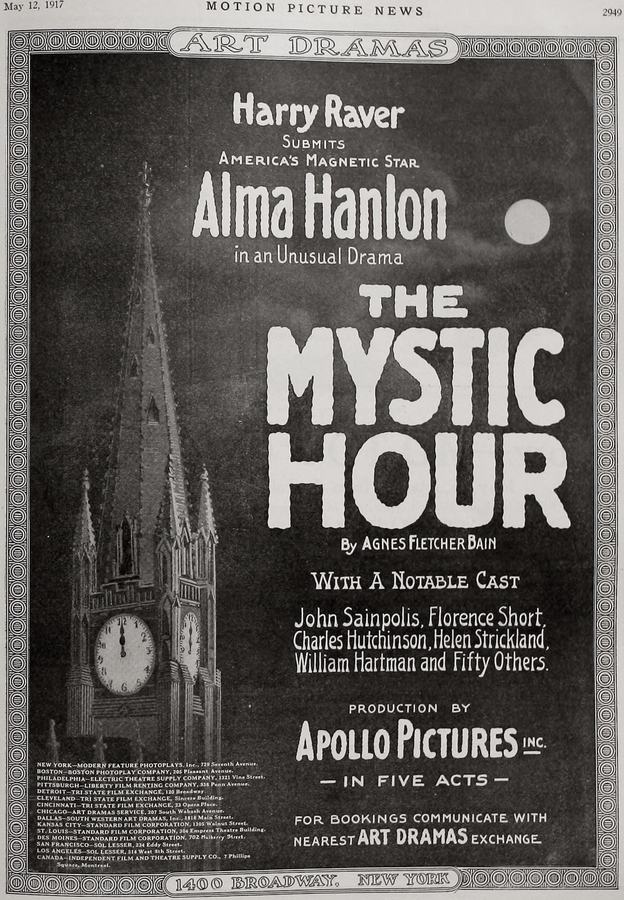
There is a peculiar, almost primordial allure to early cinema, a raw, untamed energy that often delves into the human psyche with an intensity that belies its nascent technical limitations. The Mystic Hour, a 1917 silent film directed by Fred Rath and penned by Agnes Fletcher Bain and Rath himself, stands as a testament to this era's audacious exploration of guilt, obsession, and the thin veil between thought and deed. It’s a compelling psychological drama that, even over a century later, manages to resonate with a haunting power, echoing the foundational anxieties of the human condition.
At its core, the narrative of The Mystic Hour is a study in psychological unraveling. We are introduced to Guido, an artist, portrayed with a compelling intensity by John St. Polis. Guido is not merely vexed; he is consumed by an all-encompassing, venomous desire for the death of Clavering, a wealthy man played by Charles Hutchison. Clavering has committed the cardinal sin, in Guido's eyes, of entering into a forced marriage with Margaret, the woman Guido loves, brought to life with poignant grace by Alma Hanlon. This isn't a fleeting resentment; it's a profound, corrosive obsession that infiltrates every fiber of Guido's being. It dictates the strokes of his brush, shadows his dreams, and colors his every waking moment with a dark, almost hypnotic intensity. The film masterfully portrays this internal struggle, relying on the expressive power of silent film acting and visual cues to convey Guido's escalating mental anguish.
The genius of the screenplay by Agnes Fletcher Bain and Fred Rath lies in its audacious premise: what if a wish, however malevolent, could manifest into reality? This question hangs heavy in the air, a palpable shroud over Guido's consciousness. His desire for Clavering's demise isn't a mere passing thought; it's a meticulously cultivated fantasy of vengeance, a dark muse for his artistic soul. The film invites us to ponder the very nature of intent and consequence, blurring the lines between psychological projection and tangible outcome. This thematic depth is reminiscent of D.W. Griffith's The Avenging Conscience: or 'Thou Shalt Not Kill', another early cinematic foray into the torment of a guilt-ridden mind, though The Mystic Hour approaches the concept with a unique twist on the source of that guilt.
The narrative escalates dramatically when Guido awakens from a vivid, terrifying dream in which he has brutally murdered Clavering. The dream is so visceral, so convincing, that it leaves him shaken to his core, a premonition of dread clinging to him like a shroud. The very next morning, the unthinkable happens: Clavering is found murdered. This pivotal moment plunges Guido into a profound psychological abyss, an uncanny valley where the boundaries of dream and reality dissolve. He is consumed by the horrifying, almost inescapable feeling that he is the murderer, that his fervent, obsessive thoughts somehow willed the crime into existence. John St. Polis's portrayal of this internal torment is particularly striking, conveying a man trapped in a self-made prison of guilt and paranoia, his eyes haunted by the specter of a crime he believes he committed, if not by hand, then by heart.
Margaret, witnessing Guido's agonizing descent, becomes his anchor, though her methods are unconventional. In a desperate attempt to alleviate his crushing fears, she proposes a radical form of therapy: Guido must paint the picture of his dream. This act of artistic exorcism is a brilliant narrative device, transforming the artist's canvas into a confessional, a battleground for his tormented soul. It’s a testament to the film's bold psychological ambition, suggesting that art can be both the source of one's torment and the path to liberation. This exploration of art's power to confront and heal (or reveal) is a fascinating element, setting The Mystic Hour apart from more straightforward crime dramas of the era like The Rail Rider or The Lone Star Rush, which focused more on external action and adventure.
The climax of The Mystic Hour is a masterclass in narrative irony and psychological suspense. The completed painting, a chillingly accurate depiction of Clavering's demise as envisioned in Guido's nightmare, becomes an unwitting instrument of justice. Clavering's butler, a character whose presence has been largely understated, stumbles upon the artwork. The visual fidelity of the painting, capturing the grim details of his dead master, is so potent, so horrifyingly real, that it shatters his composure. Overcome by the sheer terror of the image and the weight of his own conscience, the butler confesses to murdering Clavering for his money. This revelation is a stunning twist, not only absolving Guido of his imagined guilt but also exposing the true, mundane motive behind the violent act – greed, rather than the intricate psychological machinations Guido had envisioned.
This resolution is incredibly sophisticated for its time. It subverts expectations, offering a conclusion that is both surprising and deeply satisfying. It affirms that while the human mind can conjure the darkest fantasies, true culpability often lies in tangible actions and motivations. The power of art, in this instance, transcends mere representation; it becomes a catalyst for truth, a silent witness that compels confession. This narrative ingenuity places The Mystic Hour in a lineage of films that explore hidden secrets and their eventual, often dramatic, unveiling, much like the thematic undercurrents found in stories such as The Dead Secret, though with a distinct psychological bent.
The ensemble cast, led by John St. Polis as Guido, delivers performances that are deeply evocative, relying on the grand, expressive gestures and nuanced facial expressions characteristic of the silent film era. St. Polis's portrayal of Guido’s mental anguish is particularly memorable, conveying a character teetering on the brink of madness, his internal conflict rendered with palpable intensity. Alma Hanlon's Margaret is equally compelling, providing a much-needed emotional anchor and displaying a quiet strength that drives the plot towards its resolution. Charles Hutchison, as the ill-fated Clavering, effectively establishes the character's presence, making his demise impactful. Even Florence Short and Helen Strickland, in their supporting roles, contribute to the film's atmospheric tension and emotional landscape.
Fred Rath's direction, coupled with the intricate screenplay, ensures a steady, compelling pace. The film builds its suspense gradually, allowing Guido's obsession to fester and grow before unleashing the shocking events. The use of close-ups and dramatic lighting, though perhaps rudimentary by today's standards, would have been highly effective in conveying the characters' internal states to audiences of the time. The narrative doesn't rush its psychological exploration, instead allowing the audience to truly inhabit Guido's tormented mind. This deliberate pacing ensures that the final reveal carries maximum impact, a testament to the filmmakers' understanding of dramatic tension. While many films of the era, such as Pirate Haunts or The Destroyers, focused on external adventure, The Mystic Hour bravely delved inward.
Beyond the immediate plot, The Mystic Hour grapples with profound philosophical questions. Does intense thought or desire hold a power beyond the rational? Is there a cosmic justice that aligns events, or merely a series of coincidences that test the limits of human perception? The film flirts with the idea of a psychological projection so powerful it could manifest reality, only to pull back and ground the resolution in tangible human motivations. This sophisticated interplay between the mystical and the mundane gives the film a depth that transcends its genre. It's a subtle commentary on how easily the human mind can fall prey to its own fears and convictions, even in the face of contradictory evidence.
The film also subtly critiques the societal pressures that lead to 'forced marriages,' hinting at the underlying unhappiness that can fuel such dark desires. Margaret's predicament, caught between the man she loves and a wealthy husband, is a classic dramatic trope, but here it serves as the catalyst for a much deeper psychological exploration. The film's willingness to delve into these darker facets of human experience, rather than shying away, marks it as a significant piece of early cinema. One can draw parallels to the dramatic intensity and societal commentary found in films like Tess of the Storm Country, though The Mystic Hour chooses a more internal, psychological battlefield.
While perhaps not as widely remembered as some of its contemporaries, The Mystic Hour is a remarkable example of early psychological thriller filmmaking. It demonstrates that even in the nascent stages of cinema, filmmakers were keen to explore the complexities of the human mind, pushing boundaries beyond simple action or melodrama. Its narrative sophistication, compelling performances, and thought-provoking themes ensure its place as a significant, albeit often overlooked, work. The film's ability to create genuine suspense and deliver a satisfying, ironic twist without relying on spoken dialogue is a testament to the artistry of silent film storytelling.
For enthusiasts of film history and psychological dramas, The Mystic Hour offers a fascinating glimpse into the origins of a genre that continues to captivate audiences today. It reminds us that the fundamental anxieties about guilt, obsession, and the hidden corners of the human psyche are timeless. One might even compare its nuanced psychological landscape to the more overt dramatic explorations seen in European silent films like Blodets röst or Havsgamar, showcasing a universal appeal for stories that probe the depths of human emotion. The film stands as a testament to the creative ambition of Agnes Fletcher Bain and Fred Rath, who crafted a narrative that is both thrilling and intellectually stimulating.
In an era where cinema was still finding its voice, The Mystic Hour dared to whisper the dark secrets of the mind, proving that the most profound dramas often unfold not on grand stages, but within the confines of a single, tormented soul. Its legacy lies in its bold attempt to visualize the intangible, to give form to fear, and to ultimately reveal the truth through the most unexpected of mediums: a painting born of a nightmare. It’s a film that demands rediscovery, a potent reminder of the enduring power of early cinema to explore the eternal mysteries of human nature with both elegance and depth. Its influence, though perhaps subtle, can be traced through the subsequent decades of psychological thrillers, cementing its place as an important, foundational text in the genre. Much like The Green Cloak or The Children in the House, it uses its narrative to delve into the intricate dance between human emotion and fate, but with a unique, artistic twist.
IMDb 6.2
1937
Community
Log in to comment.