DbcultAccessing Vault...
Cult Review
Senior Film Conservator
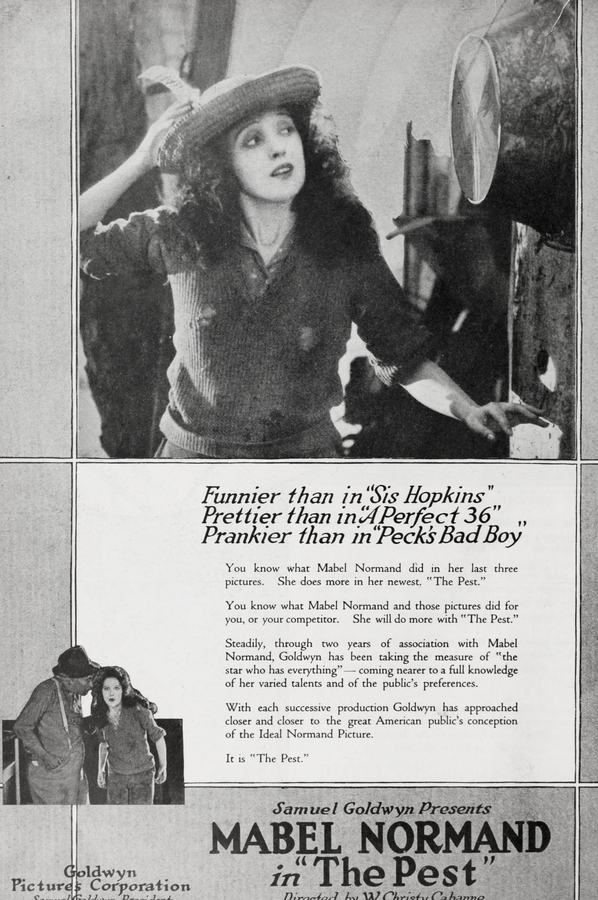
Stepping back into the cinematic landscape of 1916, one encounters Melville W. Brown's 'The Pest', a film that, despite its somewhat unassuming title, delivers a surprisingly sharp, often uproarious, and ultimately heartwarming commentary on class distinctions and the often-deceptive veneer of high society. This silent-era gem, propelled by the unparalleled comedic genius of Mabel Normand, navigates the treacherous waters of social climbing and the inherent purity of an uncorrupted spirit against a backdrop of urban artifice. It's a delightful exploration of how genuine character can effortlessly disarm and expose the hollow pretenses of the so-called 'sophisticated' set, proving that true wit and integrity often reside where least expected.
The narrative unfurls with the introduction of Jigs Blodgett, a character brought to vivid life by the inimitable Mabel Normand. Jigs is not merely a 'country girl'; she embodies an almost elemental innocence, a refreshing lack of guile that stands in stark contrast to the calculated maneuvers of the city dwellers she soon encounters. Her journey begins, as many cinematic tales of the era did, with a migration, albeit a subtle one, into the orbit of a prominent family. Her nascent friendship with Gene Giles, portrayed with earnest charm by John Bowers, the nephew of a distinguished judge, serves as the initial bridge between her rustic simplicity and the complex world of urban affluence. This relationship, blossoming from genuine camaraderie, sets the stage for the dramatic and comedic confrontations to follow. Bowers imbues Gene with a sincerity that makes him an immediate foil to the more cynical elements, effectively grounding Jigs' experience in a relatable human connection.
The opposing force in this social drama manifests in the form of John Harland, a character rendered with a palpable air of calculated opportunism by Charles K. Gerrard. Harland's affections are not for Blanche, the judge's daughter, but for the considerable financial and social capital her family represents. His courtship is a transparent performance, a cynical bid for position and wealth, highlighting a pervasive theme of the era: the commodification of marriage and social standing. Blanche herself, brought to life by
The party scene, central to the film's comedic and dramatic thrust, is where the meticulously laid plans of Blanche begin to unravel. What Blanche anticipates as a spectacle of Jigs' embarrassment transforms into a showcase of Jigs' unexpected resilience and innate charm. Mabel Normand, in a performance that underscores her mastery of both physical comedy and subtle emotional expression, allows Jigs to navigate these treacherous social waters not with clumsy ineptitude, but with an endearing blend of naiveté and accidental brilliance. Her blunders are not pathetic but endearing, her responses to snobbery often unintentionally witty, turning the tables on her would-be tormentors. This reversal of expectations is a testament to Brown's direction and Normand's performance, allowing the audience to revel in the sweet vindication of the underdog. The humor here is not derived from Jigs' awkwardness, but from the discomfort and eventual discomfiture of her 'sophisticated' hosts, whose carefully constructed façades crumble under the weight of genuine human interaction.
The script, penned by Melville W. Brown himself, demonstrates a keen understanding of social satire, crafting situations that are both humorous and revealing. Brown, wearing both the writer's and director's hats, manages to keep the pacing brisk, a crucial element for silent comedies, ensuring that the audience remains engaged without the benefit of spoken dialogue. His direction allows the visual storytelling to flourish, utilizing expressive close-ups and dynamic staging to convey character motivations and emotional shifts. The supporting cast, including Alec B. Francis, Pearl Elmore, Vera Lewis, and James Bradbury Jr., each contribute to the rich tapestry of the film, providing believable reactions and adding layers to the social microcosm depicted. Their collective performances underscore the film's central theme: the superficiality of appearances versus the enduring power of authentic character. For anyone interested in the period's exploration of social dynamics, examining films like Marrying Money or even The Absentee might offer interesting parallels in how wealth and status influenced narratives.
Mabel Normand's performance as Jigs is undoubtedly the beating heart of 'The Pest'. Normand, a celebrated figure of early cinema, possessed a unique ability to blend slapstick comedy with genuine pathos, making her characters both hilarious and deeply relatable. Here, she doesn't just play a naive girl; she embodies the spirit of unvarnished truth, a force of nature that cannot be contained or defined by the rigid social codes of her oppressors. Her facial expressions, her comedic timing, her subtle gestures – all combine to create a character who is utterly captivating. She reminds us why she was such a dominant force, a true pioneer whose influence can still be felt in comedic acting today. One might draw comparisons to the spirited independence found in characters from other films of the era, such as those in Pride, where personal integrity often clashes with societal expectations. Her ability to command the screen without uttering a single word is a testament to the power of pure performance, an art form that reached its zenith in the silent era.
The film also subtly critiques the very notion of 'sophistication'. Blanche and her friends, despite their polished exteriors and refined manners, are revealed to be petty, cruel, and ultimately rather dull. Their lives lack the vibrant authenticity that Jigs, with all her rustic charm, effortlessly possesses. This is a common trope in early cinema, where the urban elite are often depicted as morally compromised, while the rural or working-class characters possess a more robust sense of ethics and genuine human connection. Films like The Old Folks at Home often explored similar themes of contrasting values between different societal strata. 'The Pest' leverages this contrast for both comedic effect and social commentary, inviting the audience to question who the true 'pest' really is in this scenario.
The ingenuity of the plot lies not just in the reversal of fortunes, but in how it subtly champions genuine character over superficial status. Jigs' victory is not achieved through cunning or manipulation, but through the sheer force of her unaffected personality. This makes her triumph all the more satisfying. The film's conclusion, without giving too much away, delivers a gratifying resolution that reinforces its core message: true value lies not in inherited wealth or social standing, but in kindness, integrity, and an open heart. It’s a narrative arc that resonates, much like the moral lessons often found in films such as Love or Justice, where character choices dictate ultimate outcomes.
Visually, 'The Pest' is a fine example of early cinematic craftsmanship. The sets, while perhaps not as opulent as later productions, effectively convey the differing environments of Jigs and her new acquaintances. The costumes, particularly those worn by Blanche and her friends, highlight the fashion trends of the era, contributing to the sense of period authenticity. The cinematography, though adhering to the conventions of 1916, is clear and allows the actors' performances to shine through. Melville W. Brown's direction is competent and assured, allowing the story to unfold naturally while maximizing the comedic potential of each scene. His ability to draw nuanced performances from his cast, particularly from Mabel Normand, is commendable. This film, like many from the nascent days of cinema, served as a foundational text for developing narrative structures and character archetypes that would become staples of Hollywood. Think of the evolving character dynamics seen in Flirts and Fakirs or the more dramatic confrontations in The Battle of Love, and you see a spectrum of storytelling techniques being honed.
In retrospect, 'The Pest' stands as more than just a historical curiosity; it's a testament to the enduring power of well-crafted storytelling and compelling performances. Mabel Normand's Jigs Blodgett remains a memorable character, a beacon of authenticity in a world obsessed with appearances. The film's exploration of class, social pretense, and the triumph of genuine character over manufactured sophistication continues to resonate, offering both laughter and a gentle reminder about where true value lies. It's a film that, despite its age, feels remarkably fresh in its comedic timing and its underlying message. For enthusiasts of early cinema, particularly those drawn to the comedic stylings of the era, 'The Pest' is an essential viewing experience. It provides valuable insight into the societal concerns and entertainment values of the time, much like how The Man Who Disappeared or Nászdal offer glimpses into other facets of dramatic storytelling from the same period. It’s a delightful journey back to a time when cinema was still finding its voice, and in films like 'The Pest', that voice was already remarkably clear and engaging. The nuanced portrayals by the ensemble, including Leota Lorraine and Jack Curtis, further solidify its place as a well-rounded cinematic effort. Even compared to more dramatic fare like Fedora (1916) or the intriguing mystery of The Man Who Woke Up, 'The Pest' carves out its own distinct and valuable niche, proving that silent comedy could tackle profound social observations with grace and uproarious humor. It's a charming piece of history that continues to entertain and provoke thought, reminding us that sometimes, the most 'pest'-like individuals are those who seek to diminish others, rather than the innocent souls who simply refuse to conform to their narrow expectations. The enduring legacy of The Pest is a testament to the timeless appeal of a good story, well told, and brilliantly performed.
IMDb —
1923
Community
Log in to comment.